On a clear February afternoon, snowboarders carved down packed powder at Beech Mountain in western North Carolina, riding atop one of the deepest bases the resort has seen in years. The snow was bright and grippy, the kind that squeaks under boots in the parking lot and throws a fine mist into the air when a board slices through it.
At nearly the same moment, thousands of miles away in the Italian Alps, Winter Olympic organizers were positioning more than 56 million cubic feet of machine-made snow across Alpine venues in Milan-Cortina — a deliberate preproduction strategy to guard against a winter that has been warmer and less predictable than hoped.
Other WRAL Top Stories
The contrast is striking, North Carolina flush with snow while parts of the West endure record-low snowpack after an unusually warm and dry start to winter. In Colorado and Utah, snow cover has shrunk dramatically compared with historical averages, raising concerns not only for ski towns but for spring water supplies and wildfire season. For many Southeastern skiers who typically book flights to Denver or Salt Lake City, the lack of snow has been impossible to ignore.
“I usually go out West,” said Kim Smith, a skier from Florida who now splits time between Sugar Mountain and Snowshoe. “But we didn’t get the Ikon this year. We’ve been staying closer.”
Closer, this winter, has meant deeper.
But a good season in one place does not erase a warming trend everywhere. If anything, scientists say, it highlights how uneven and volatile modern winters have become.
“Across the Northern Hemisphere, over the last 100 years, we’ve seen a decline in snow cover,” said Kristina Dahl, vice president for science at Climate Central. “Winters are warming faster than summers, which means precipitation is more likely to fall as rain than snow.”
Snow, it turns out, lives on a knife’s edge. A few degrees can determine whether a storm drapes a mountain in powder or washes it clean. When temperatures hover near freezing, accumulation becomes fragile. A warm afternoon can undo a week’s worth of snowfall. Rain can melt what cold air worked to build.
That sensitivity is playing out on the Olympic stage.
>> Ask the Meteorologist: Why is the IOC considering changing date of Winter Olympics?
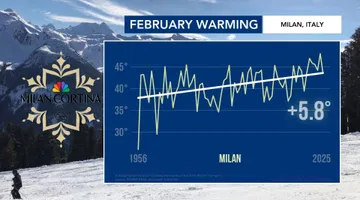
Cortina d’Ampezzo, which first hosted the Winter Games in 1956, has warmed about 6.4 degrees Fahrenheit in February since then. The town now sees roughly 41 fewer freezing days each year than it did seven decades ago. The 2022 Beijing Games relied almost entirely on artificial snow. And researchers analyzing 93 past and potential Olympic host sites found that by the 2050s, only 52 — about 56% — are projected to remain climate-reliable under current emissions policies. For the Paralympics, typically held later in the season, the number shrinks further.
Even many of those “reliable” sites would still depend on artificial snow.
>> How ski resorts are adapting to climate change
But snowmaking is adaptation, not immunity.
Machines require sustained cold air and significant energy and water inputs. If powered by fossil fuels, they can contribute to the warming that makes them necessary. And as temperatures continue to climb, the window for producing and preserving artificial snow narrows.
“Artificial snow is not the silver bullet,” Dahl said. “There will come a point where it’s simply too warm to maintain it consistently.”
At Beech Mountain Resort, snowmaking is not framed as a stopgap. It is infrastructure.
“It’s absolutely a core part,” said Talia Freeman, director of marketing and sales for the resort. “That’s how we get open. That’s how we stay open.”
Freeman, now in her 17th ski season, said this winter has been one of the strongest in recent memory, bolstered by steady cold stretches that allowed crews to build a substantial base early. Advances in snowmaking technology mean that when temperatures dip to freezing, even briefly, crews can capitalize quickly.
“Twenty years ago, we were really reliant on natural snowfall,” she said. “Now we’re confident we can start making snow early and build a strong base.”
In some ways, she added, the technology has made operations more predictable.
And yet predictability, scientists say, is precisely what is eroding at the planetary scale.
Dahl describes a pattern of “weather whiplash” — rapid swings between warm and cold, wet and dry — that is becoming more common as the climate warms. One week may bring heavy snow. The next, rain and midwinter thaw. North Carolina has experienced both in recent years: snowstorms followed by temperatures in the 50s, rain events that chip away at carefully groomed slopes.
The unevenness can make climate change feel abstract, even contradictory. How can winters be warming if snow is piling up?
Because warming does not eliminate cold. It destabilizes it.
As the International Olympic Committee considers moving future Games earlier in the calendar and requiring stronger climate commitments from host cities, ski resorts from Avery County to the Alps are recalibrating what winter means.
For now, riders at Beech Mountain glide beneath chairlifts as snow guns stand silent but ready, angled toward the slopes like sentries awaiting the next cold front.
Freeman said the ski industry has always lived with uncertainty.
“You’re almost like a farmer,” she said. “You’re relying on the weather.”
But the weather is changing.
From North Carolina’s Blue Ridge Mountains to the Olympic podium, winter sports are increasingly built not just on snow, but on adaptation.
“The future for snow looks pretty slushy,” Dahl said. “It’s uncertain. And it’s in humanity’s hands.”