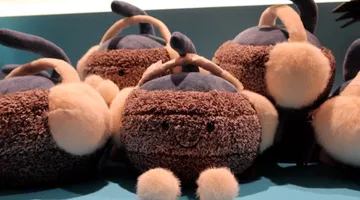
The mascots for the 2026 Milan Cortina Winter Olympics are undeniably adorable, but what are they?
Tina and Milo, named for the Olympic Winter Games host cities Cortina d’Ampezzo and Milano, are stoats, a species of weasel native to Europe Asia, and the northern regions of North America.
Other WRAL Top Stories
You can also find preserved stoats displayed throughout exhibits within the North Carolina Museum of Natural Sciences' mammal collection. Mike Cove, a mammologist with the museum, talked with WRAL News and shared some interesting facts about what he calls "voracious little carnivores."
Can you find stoats in North Carolina?
No, we don't have stoats here, but two weasels are native to North Carolina, including the long-tailed weasel and the least weasel, or "little weasel," which is considered the smallest carnivore in the world.
The least weasel is less common in North Carolina and may only be spotted in the Appalachian Mountains, while the long-tailed weasel has more of a statewide distribution and can be found in North Carolina's Piedmont and Coastal Plain regions, Cove explained.
Stoats are ‘voracious predators’
Stoats are not just carnivores; they are obligate carnivores, which means they mainly eat meat, Cove explained. This is especially interesting due to their size (stoats are smaller than omnivores like foxes and raccoons, which also consume fruit in addition to prey).
The stoats' sharp teeth help them capture their food.
"One of their key characteristics is their desire to consume and act as predators," Cove said. "They're strong and tenacious, and they will take down their prey and consume it."
The majority of a stoat’s diet comes from rodents, but they also eat rabbits, snakes and birds, Cove explained. Their need for prey is one of the reasons we don't see more stoats in heavily populated areas.
"That is another contributing factor of why weasels are more sensitive to human-disturbed areas ... because they have to find all of these prey to eat," Cove explained, comparing them to larger carnivores like lions, leopards and cheetahs.
Stoats turn white in the winter
Stoats have a camouflage coat. In the winter, they change to a vivid white color to help them hide from predators like coyotes, wolves and other large carnivores. In the winter, they molt and become all white, except for their characteristic black-tipped tail.
"This tail, since it's black, can actually serve as kind of a distraction," Cove explained. "When they're running across the snow, the predators might see the black tail and aim for targeting that and miss the whole body of the weasel."
Why did the Winter Olympics use stoats as mascots?
Tina, the lighter-colored stoat, represents the 2026 Olympic Winter Games, and Milo, the darker-colored stoat, represents the 2026 Paralympic Winter Games.
According to the Olympics website, the pair of siblings represents "the contemporary, vibrant and dynamic Italian spirit."
Cove described stoats as "super-energetic" and "fast." They're also natural athletes and very resilient.
"They're really adapted to live in these very cold environments where they're living in deep snow," Cove said. "They kind of coast along the top of the snow, but then will actually tunnel down under into this layer called the subnivean zone," which is found under the snow.
Less snow impacts the stoats and the Winter Games
The sites for the Winter Games have not been as cold as they were historically, which can contribute to softer or melting snow, causing problems for athletes.
WRAL meteorologist Elizabeth Gardner recently reported that low snowfall levels have raised concerns about the impact of climate change on winter sports as Salt Lake City, set to host the 2034 Winter Games, experiences a snow drought.
The weasels are also negatively influenced by a lack of snow, Cove explained.
"Now that we have less snow, they're actually standing out more, and that might make them more susceptible to predation," Cove explained. "There's an opportunity to learn from this and remember that we need to adapt ... and I think that humans should be involved and consider that."
Tina and Milo aren't just cute mascots; they may represent a bigger picture.
"We can look at what's happening and learn from it, adapt, and hopefully help solve it for the future of the stoats, the weasels and all of biodiversity," Cove said. "I love the message of coming together as a global community for something like the Olympics and remembering that we're all connected in that way."