RALEIGH — It will cost a bit more for incoming undergraduate students from North Carolina to attend most UNC System universities this fall.
The UNC System Board of Governors voted Thursday to approve near across-the-board tuition increases at the state’s 16 public universities, including the first tuition hike on incoming in-state undergraduate students in nearly a decade.
Other WRAL Top Stories
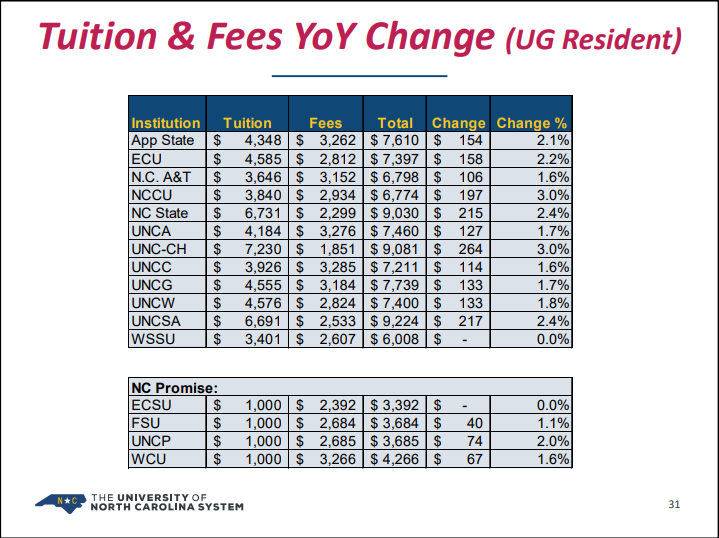
The public school system hasn’t raised tuition on in-state undergraduates since 2017. Most of the 16 universities in the UNC System asked for a 3% increase. The average increase is $125 across the system with UNC-Chapel Hill the highest at $211. Out-of-state undergraduate tuition would rise by nearly $1,000 per student across the system.
Combined with larger tuition increases on out-of-state undergraduates and graduate students, both in-state and out-of-state, and students in professional programs, the hikes would generate $49 million across the system. The in-state undergraduate tuition increases would provide $5.9 million of that in the first year.
“Inflation pressures and the rising cost of everyday operations have affected the institutions we lead, and we cannot expect our universities to continue holding the line on in-state tuition without suffering negative impacts on long-term sustainability,” wrote Wendy Murphy, the board’s chairwoman.
Murphy said the system has to focus on affordability and sustainability, and she called it "a managed tuition increase."
"What we've done here is measured," Murphy said after the vote. "And I think that people should feel good that this President [Peter Hans] and his system office are holding our campuses accountable to create efficiencies and best practices."
The tuition increases come as universities face budget pressures from the state and federal government, as well as a mandate to trim administrative costs from the Board of Governors and campus-level trustees.
Since the summer of 2025, universities across the system have cut about 1,000 administrative positions, saving nearly $78 million on an annualized basis, according to system leaders. UNC-Chapel Hill, the state’s flagship university, is seeking additional cuts.
“We are trying to approach it from a balanced perspective where we are trying to balance maintaining excellence, affordability and financial sustainability of our institutions,” said Jennifer Haygood, the senior vice president for finance and administration with the UNC System, during Wednesday’s committee meeting.
The in-state undergraduate increase would not impact current students and those who start in the fall would not face future tuition increases.
Art Pope, a member of the 24-person board, applauded campuses for tightening their belts but said there were other steps they could take before raising tuition on in-state students. He opposed the increases, especially on North Carolina students."We can still do so much better reducing the nickels and dimes that become millions, prioritizing the core academic mission of teaching and research and other areas and make it as free as practicable tuition for our in-state residents," Pope said Wednesday. "Other states are doing it."
He cited Purdue University in Indiana and the University of Florida as examples.
Pope spoke against the hikes again Thursday, arguing that there were more savings to be found. He was the lone board member to speak on the proposals before the final vote.
Board policy requires that all system universities remain in the bottom quartile when compared to their undergraduate resident peers. Half of the 16 UNC System schools charge the least for in-state undergrads among their peer groups, including North Carolina State University and North Carolina Central University, according to system data.
"This board ... should really be complimented on holding firm for these past nine years," said Harry Brown, a member of the board, on Wednesday. "That's just really well done. I think it's forced the campuses to really take a strong, hard look at what's most important for them as a campus."
The Board of Governors in September set parameters for tuition and fee proposals. It allowed individual campuses to increase tuition up to 3% for in-state undergraduates.
Each university's board of trustees previously approved the requests. UNC Chapel Hill trustees narrowly approved the 3% increase for in-state undergraduates in November after extensive debate.
The four "NC Promise" schools, at which tuition is capped at $1,000 by the state legislature, and Winston-Salem State University, didn't propose any increase on in-state undergraduate students. Appalachian State University proposed a 2.5% increase and UNC-Asheville proposed a 1.5% increase. The rest proposed 3%.
Mandatory fees, too, will be increased by an average at 1% across the schools.
“For so much of the UNC System’s history, the debate was not about if tuition would go up, but about how much it would go up,” Murphy wrote. “This Board, working with our president and our chancellors, changed that expectation. We created a new affordability baseline for North Carolinians, one that prioritizes families and their needs.”
Less than 50% of UNC System graduates have student debt upon graduation down from 62% in 2017, according to the system. The amount that students are borrowing has fallen 35% since 2018, the system said.
“There is still work to be done around college access,” Murphy wrote, “and my colleagues and I are committed to finding responsible and sustainable ways to provide quality education while holding tuition rates as low as possible.”