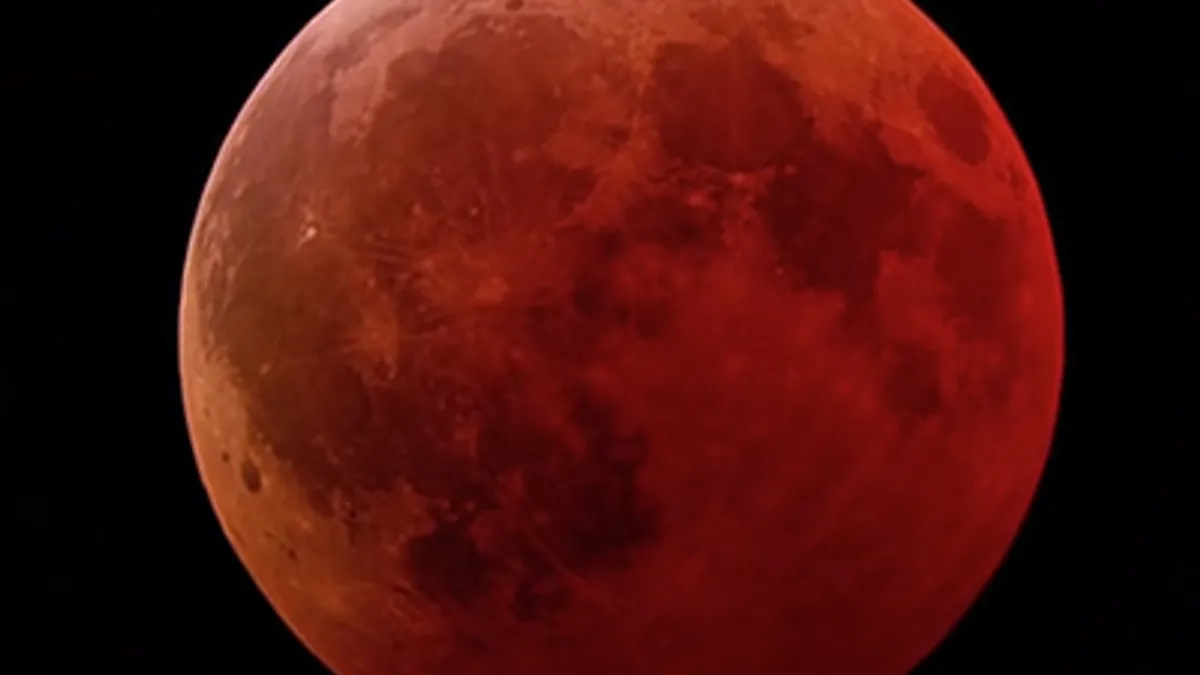
The show begins just before 5 a.m. as the Moon slides into the umbra, the darkest part of Earth’s shadow.
You might notice a slight darkening of the Moon’s surface beginning at 3:44 a.m. as the Moon moves through the Earth’s penumbra, the brighter portion of the shadow.
Other WRAL Top Stories
One of the most striking moments comes around 5:30 a.m., when the Moon is about halfway in and halfway out of the umbra.
At that stage, the curved edge of Earth’s shadow is well defined along the curvature of the Moon’s surface. Aristotle used this observation as evidence of the Earth's spherical shape.
Totality begins just after 6:00 a.m., when the Moon is fully immersed in the umbra and often takes on a coppery red color due to sunlight filtered through Earth’s atmosphere. Think of it as seeing all sunsets and sunrises on Earth simultaneously cast onto the lunar surface.
| time | altitude | |
| Partial Eclipse Begins | 4:40 a.m. ET | 22º |
| Halfway | 5:30 a.m. ET | 15º (treeline) |
| Total Eclipse Begins | 6:04 a.m. ET | 7.1º |
| Maximum eclipse / Selenelion | 6:33 a.m. ET | 1.5º |
| Moonset | 6:43 a.m. ET | 0º |
Viewing tips
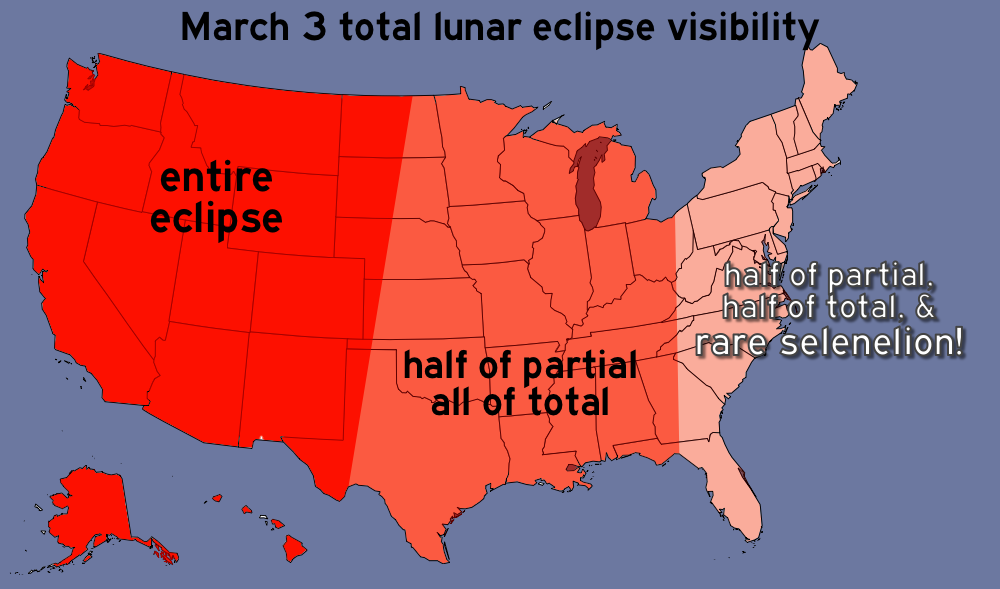
Lunar eclipses are visible anywhere on Earth where the moon is above the horizon.
You don’t need a telescope or binoculars, and because you’re looking at dim, reflected sunlight from the Moon, special eclipse glasses are not required.
For this eclipse, the Moon will be low in the sky during the early stages, so a clear horizon is key to seeing as much of the eclipse as possible. The partial eclipse begins as the Moon is just above the tree line for many. By the time the partial phase arrives, it will have sunk to just 7 degrees above the horizon.
Selenelion
Along the East Coast, observers have the added chance to witness a rare effect called a selenelion, where the reddish eclipsed Moon is visible along the western horizon at the same time the Sun is rising in the east for a few moments.
Sometimes called a “horizontal eclipse” or selehelion from the Greek moon goddess Selen and sun god Helios, occurs as Earth’s atmosphere bends (refracts) light upward, lifting each body above the horizon.
Selenelion requires a clear view of both horizons to see, right at moonset or sunrise. Coastal areas, open plains, or high elevations work best. In North Carolina, ridge-top overlooks in the mountains or tall buildings with clear sightlines east and west offer the best chances.
Upcoming eclipses
If getting up before dawn isn't for you, there are others in the coming months and years.
A nearly total (but not quite) lunar eclipse occurs the night of Thursday, Aug. 27, 2026. The faint penumbral eclipses in February and August 2027 will barely be perceptible, and the barely partial eclipse in January 2028 will likely disappoint.
The next total lunar eclipse visible from our region won’t occur until the evening of June 26, 2029, beginning at a much more convenient 9:30 p.m.