NC schools should focus on improving 7th- and 8th-grade performance, leaders say
North Carolina school leaders say principals need to focus more on seventh- and eighth-grade students, to keep them from falling behind in school.
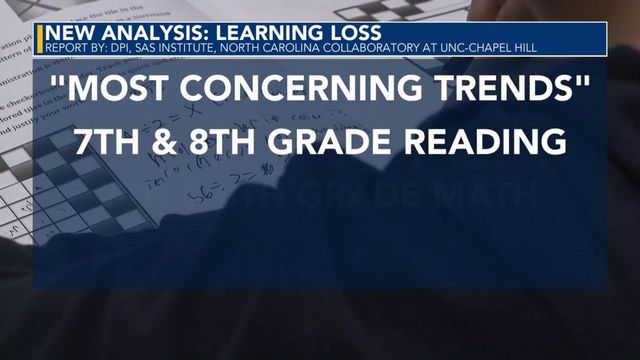
That's because a new analysis shows seventh and eighth-grade students are on a worse trajectory than other grade levels, though they have shown improvement since the pandemic.
Other WRAL Top Stories
Earlier this fall, the state Department of Public Instruction reported that more students were passing their standardized tests and rebounding from Covid-19 learning loss, especially elementary students.
But seventh- and eighth-grade students haven’t rebounded as much.
That's something state leaders say they and school districts will have to investigate further.
Schools have now used up all of the temporary federal funding that helped them with learning recovery. That temporary funding topped $6 billion over four years, with an estimated $1 billion or more spent on learning recovery programs, such as summer school and tutoring.
So more analysis that drills down into the district or school-level or to different demographic or disability groups can help schools zero in on which students to spend their more-limited resources on now. The state also plans to analyze data for school districts on test performance for students with more school absences; a higher share of students is now missing at least 10% of school days than before the pandemic, though it’s getting better.
“I think North Carolina has got some work to do to figure out how to better support middle school students,” said Jeni Corn, director of impact evaluation and strategy at the North Carolina Collaboratory, which coordinates research on the impact of federal pandemic stimulus dollars. “There might be some policy structures that we might want to reconsider for middle schools.”
Last year’s seventh and eighth graders were fourth and fifth graders when schools learned remotely for some or all of the 2020-21 school year.
A higher percentage of them passed their end-of-grade exams than the group from two years ago, when schools were coming back into daily in-person learning, with the exception of seventh-grade reading. In 2022, 48.8% of seventh graders passed their reading exam. In 2024, 48.3% did.
In terms of the percentage of students passing, the results look like this:
- 48.3% of seventh graders passed their reading exam, down from 50.1% in 2023 and down from 58.8% in 2019
- 50.4% of seventh graders passed their math exam, up from 50.2% in 2023 but down from 58.4% in 2019
- 51.3% of eighth graders passed their reading exam, up from 50.9% in 2023 but down from 55.6% in 2019
- 46.7% of eighth graders passed their math exam, up from 44.7% in 2023 and down from 52.6% in 2019
Board Member Wendell Hall asked if the slow progress was because of the particular stresses of that age group, socially and emotionally, “that children are not taking the learning process to heart as much as the earlier grades?”
But researchers weren’t so sure that could be why.
Not every state is doing the same type of analysis as North Carolina, but SAS Institute, a partner with DPI and the Collaboratory on the research, has been working with other states and school systems in crunching the numbers on student performance.
John White, vice president of the SAS team working with the groups, said that if the unique struggles of middle school were driving the results, researchers could expect to see the same slowed progress in other states at those same grade levels.
“We’re not seeing that exact same pattern in every state,” he said.
Corn said age and maturity level and factor in, as well as the growing complexity of curriculum once students reach seventh grade.
Other board members and board advisers suggested North Carolina schools may not be connecting with middle school students enough, to show them how to apply what they are learning to the real world and their future.
“I’m not sure that purpose … is as clear for our students,” said Kimberly Jones, a teacher and adviser to the board.
Superintendent Catherine Truitt agreed.
“The data is very clear nationally that it’s an even bigger problem for boys than for girls,” Truitt said.
Researchers are also further examining how effective each type of intervention deployed to help speed up learning has been. That will include looking at tutoring, intervention teachers and varying hiring practices.





Copyright 2026 by Capitol Broadcasting Company. All rights reserved. This material may not be published, broadcast, rewritten or redistributed.