Truitt reflects on academic, financial challenges facing NC schools as she prepares exit
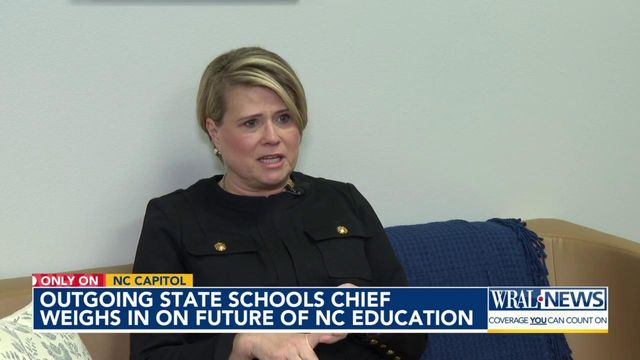
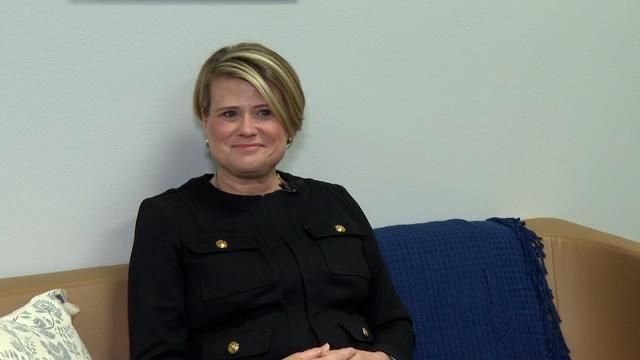
North Carolina schools’ biggest challenges are continuing to improve — from pandemic learning recovery to connecting students with meaningful opportunities after graduation, outgoing state Superintendent of Public Instruction Catherine Truitt said Monday in an interview with WRAL News. But more could be done to help students catch up and prepare them for a modern economy, she said. Truitt also discussed book bans and the role parents, lawmakers and school administrators can play in reducing code-red lockdowns.
Truitt is preparing to leave her post after four years, following a Republican primary loss to homeschooler Michele Morrow. Morrow lost in the general election to Democrat Maurice “Mo” Green, who will assume the role on Jan. 1. She's been assisting him in his transition.
Other WRAL Top Stories
Truitt, who has been helping Green in the transition, discussed expanded private school vouchers, changing the way teachers are paid, improving school funding and the culture wars that in part inspired people to vote for Morrow in the primary.
Truitt said she was proud of her work with the North Carolina General Assembly to enact the “Science of Reading,” a form of reading instruction that rejects using sight words or context clues in teaching children to read and places a greater emphasis on phonics.
Since 2021, North Carolina schools have been training teachers in the new reading approach, and Truitt believes they’re already seeing results by way of improved reading test scores for younger grades.
Here what else Truitt reflected on:
On teacher pay. Truitt doesn’t support continuing to pay teachers based on their years of experience.
“We cannot continue to pay teachers solely based on the number of years of experience that they have,” Truitt said. “It's an outmoded way to compensate people.”
It’s also an underwhelming prospect for people who might be considering teaching as a career, that their pay won’t substantially change if they do well, Truitt said.
She suggested getting rid of class-size caps in elementary grades and using the money saved on paraprofessionals, teaching assistants and higher teacher pay.
“That's a very unpopular decision, but I do think that one of the things that we need to do in order to improve teacher retention is better supports in the first year, which is expensive, and that we need to change the way we compensate teachers so that we create a career path that leads to rewarding teachers who are leaders in their building,” she said.
Truitt still supports her proposal for teacher licensure reform, which was never taken up by state lawmakers and which was opposed by the North Carolina Association of Educators.
She proposed creating a hierarchy of teachers, rather than treating them all the same.
If Truitt’s proposal had become law, it would have drastically raised pay and provided more money for teachers who perform the best. It would have cost hundreds of millions of additional dollars. The NCAE opposed the plan because it distrusted the method the state would use to prove a teacher was more effective than other teachers.
On school safety. Truitt acknowledged an uptick in unsubstantiated threats made to schools that are causing code red lockdowns while authorities investigate. She hopes the state’s new law requiring all schools to have a threat assessment team will at least help head off bad behavior.
But punishments for making threats are really up to local leaders, she said.
“There is no state law that says, ‘Here's the consequence for when this happens,’” she said. And because students often make these threats while they’re at home on their phones, parents need to be extra vigilant, she said.
“I believe schools are, by and large, very safe places, and that all principals care about school safety, but I think that parents get frustrated when they don't feel that they're being communicated with, whether that's coming from the principal or the teacher,” Truitt said.
On academic challenges. Combating pandemic learning loss has been successful so far — though not completely overcome — because of data analysis and targeted interventions based on those analyses, Truitt said.
Green’s office will need to drill down into why middle school students have struggled more on their tests than other grade levels and then come up with solutions to the problem with state lawmakers, she said.
But schools also need to work on preparing students for life after graduation, she said.
Truitt worked with lawmakers to start a pilot program for career planning in middle schools and high schools. That will expand to all schools next year. Each student would work with a school counselor to develop a career plan and ensure they’re taking the right classes in school or doing other relevant things to help them get there.
Throughout Truitt’s tenure, she emphasized access to college courses and working with the private sector to bring more career and technical education to high school students. She and the department have also developed a set of skills they’re still working with schools to ensure high school students have, an effort she’s calling “Portrait of a Graduate.”

“We still have not adjusted K-12 public education to keep up with the economy and the pace of change due to technology and those things mean at the end of the day that we're not preparing students for the postsecondary plans of their choice,” Truitt said.
On school funding. Another area the state needs to rework how it funds is students with disabilities, Truitt said.
The General Assembly recently requested studies on other ways to fund special education — something the body has done off and on for decades — and Truitt believes lawmakers are nearing making changes to provide more money for children with more severe disabilities.
Special education, often referred to as exceptional children’s services, is funded by providing the exact same dollar amount for each special education student, regardless of differences in their disabilities and needs. It’s a method the state has long been criticized for and studies have long recommended changing.
“We do need to fix [exceptional children] funding,” Truitt said.
School systems and charter schools are also funded for only up to 13% of their student bodies. So if 14% or more of their students are identified as having a disability requiring special education services, they’ll only receive funding for the 13%, meaning services would be watered down.

Truitt argued the General Assembly has made progress on school funding in another way: In leveling the playing field for urban and rural districts by providing extra funding for non-urban districts to pay teachers and administrators. That can help non-urban counties recruit educators, she said.
On private school vouchers. Truitt doesn’t believe expanded private school vouchers will negatively affect public schools’ bottom lines.
Public schools, because they are largely funded based on headcount, lose money for every child who leaves them to attend a private school. Many voucher-expansion opponents have argued that loss of funding will be consequential because schools have fixed costs that require steady funding, even if enrollment fluctuates. The Office of State Budget and Management estimated public schools could lose a combined $76.2 million next year under the recently approved expansion, but the estimate ranges have varied quite a bit because of the lack of data on how many new voucher recipients already attend a private school. Public schools received more than $10 billion from the state last year. There are roughly 2,700 public schools in the state.
Truitt supports expanding access to private school vouchers but believes the state’s voucher program needs to include more public oversight.
“If a school is going to take a voucher, they must be accountable to the state the same way our public schools are,” Truitt said.
She pushed for the state to be able to choose a test that private schools that accept vouchers must then administer. The results still won’t be published publicly, in the same way results are published for traditional public and public charter schools. But some schools meeting certain criteria will be required to report some results to the state, which would make them public records.
On culture wars. Truitt said she believes interest groups on the left and right are distracting people from more serious issues in schools. “Education has become incredibly politicized on both sides of the aisle over the last four years,” she said.
Truitt used the example of banning books from school libraries — something she says has gone too far in some places.
“The truth usually lies somewhere in the middle,” she said. “Are there books that are inappropriate? Yes. Is the library full of them? And is this some master plan to take down our teenagers? No.”
Truitt also said parents prefer having a choice of where to send their children to school and suggested school choice wasn’t a controversial issue, either, despite some opposition from certain interest groups.
On what’s next for her. Truitt said she plans to work in education. She said she’s staying in North Carolina, where her youngest child is still in high school in Wake County.
She’s working with Green on the transition of power to oversee the 1,300-employee department, which manages more than $13 billion in state and federal funds. She called it “very high-functioning” and responsible for “amazing things” during her time.
“I'm absolutely feeling sad that I'm exiting,” Truitt said. The department has been supporting local leaders through number-crunching, events and regional support, which “the department wasn't really doing before.”
Green has rehired a former, longtime DPI administrator, Maria Pitre-Martin, who left the department for a leadership role at the University of North Carolina at Grensboro in October 2023. In a statement to WRAL News, Green said he was still looking at forming the rest of his leaderhsip team.
"I am very appreciative of Superintendent Truitt's support during this period of transition, as she has provided a wealth of insightful information and connected me with many talented leaders within the NC Department of Public Instruction," Green said in the statement.



Copyright 2026 by Capitol Broadcasting Company. All rights reserved. This material may not be published, broadcast, rewritten or redistributed.