As NC's teacher pipeline dwindles, education colleges are getting creative
The number of people enrolling in educator preparation programs in North Carolina has been falling for years. Now the number of people completing the programs is plummeting — a troubling sign for a state that has been struggling to hire and retain public school teachers.
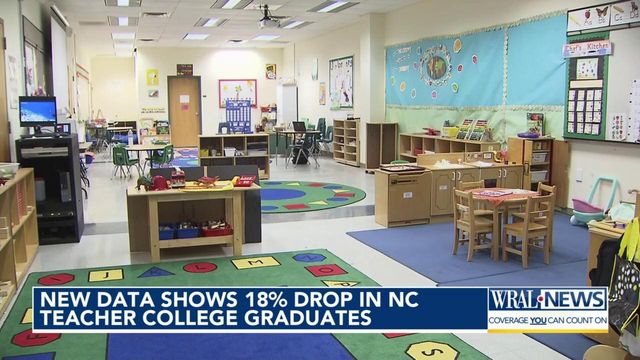
About 800 fewer people completed educator preparation programs in 2024 than in the prior year, an 18% decline, new data from the North Carolina Department of Public Instruction shows.
Other WRAL Top Stories
And now roughly half of the people who enroll in one of the state's educator preparation programs end up graduating and teaching in a North Carolina public school.
Educator preparation programs — essentially degree programs designed to funnel people into education jobs — are largely housed in public and private four-year colleges.
The drop in people completing the programs underscores ongoing challenges to the teaching profession in a fast-growing state that is increasingly having to fill its ranks by recruiting educators from other states, other countries, and even other professions.
The state is also losing teachers at a faster rate than its gaining them, Andy Baxter, a department data analyst, told the State Board of Education last week. For every four teachers completing an educator preparation program, two end up teaching in North Carolina, while seven end up quitting, said Baxter, who briefed the board on the new data.
There were some bright spots in the new numbers.During the 2023-24 school year, about 5,400 people were enrolled in their first year of an educator preparation program, a number that’s been sliding for several years but still remains about 20% higher than 10 years ago.
As the pathway to teaching has changed, so have some school systems’ and universities’ approaches to getting more students into teachers colleges, with expanded partnerships to make it easier and cheaper to become a teacher.
State lawmakers in 2023 passed a bill that would make it easier for some people to renew their teaching licenses, by allowing a principal and superintendent recommendation to stand in for a licensure exam. A new bill would remove licensure exam requirements altogether.
At the same time, the federal government has cut into some of the efforts colleges and schools systems were making to better recruit, train and retain educators. The U.S. Department of Education last month cut millions of dollars in teacher training program grants in North Carolina out of concern over possible curriculum disagreements related to diversity.
Getting people into the profession is just the first battle, said Erin Horne, assistant dean for professional education and accreditation at North Carolina State University. Keeping them is another challenge altogether. Horne is worried that the teaching profession has become a “revolving door” of inexperienced teachers replacing too many experienced teachers leaving, disrupting schools’ cultures and climates.
“We're seeing a lot more folks that are leaving the classroom mid-year, end of the year, just a lot of kind of comings and goings, if you will, which can lead to negative impacts on student achievement,” Horne said.
Leaders react
Some people who attend a North Carolina university to study teaching end up teaching in other states, too, Superintendent Mo Green said. That's particularly true at universities close to state borders, such as South Carolina and Virginia, where school districts pay more, he said.
State Board of Education members suggested further study of what contributes to people exiting the teacher pipeline at multiple points, such as before they graduate or after they graduate. About 74% of people who start a program complete one. Ultimately, just 56% of people who start programs end up teaching in a North Carolina public school.
The state surveys teachers on why they quit the profession, but the survey has long been criticized by teachers and other education leaders for not including questions about whether pay contributed to a teacher's decision to leave. Board members noted that the survey doesn't capture reasons why people may not be completing an educator preparation program, either.

Board members also suggested more mentoring to keep teachers in the profession once they start teaching; teacher turnover is much higher in the first few years than later on in the career.
Benefits are also critical, even as the state health plan faces rising costs and deficits forcing rate increases, some said.
"We all know beginning teachers need to be paid more, but we also need to make sure their benefits ... stay in tact," Kimberly Jones, an adviser to the board, said. Better benefits have historically been considered a hallmark of working in government, said Jones, who is also a teacher.
North Carolina ranked 42nd among states in starting teacher pay in the National Education Association’s 2024 ranking of state teacher pay, with average starting pay of $40,136. The state ranked 38th for average annual pay, at $56,559. Since that study came out, starting pay has gone up to $41,000 per year.
Expanding teacher college recruitment
North Carolina has expanded its Teaching Fellows program in recent years, after reestablishing it in 2018. The program awarded 462 spots for the current school year — more than three times the number of spots awarded for the 2023-24 school year.
Public school systems, community colleges and four-year institutions are also increasingly recruiting current high school students to the profession and establishing programs designed to make it easier — and even cheaper — to earn a teaching degree.
That's happening in two main ways: One is via "grow your own" programs in school systems that provide incentives and training to existing high school students or employees to earn a bachelor's degree in education with the agreement that they will eventually teach in the school system for a certain number of years afterward.
Another approach is by creating partnerships among institutions themselves. East Carolina University, for example, has agreements with community colleges and school systems to provide training, field experiences and support during teachers' early years.
“These pipeline programs with these partnerships are one of the really innovative ways that different communities across the state are thinking about getting people into the profession and then trying to recruit them back to teach in the communities that they're from, which is a really valuable thing,” said Lauren Fox, senior director of policy and research at the Public School Forum of North Carolina, which is working with districts and colleges on boosting teacher colleges. That’s especially critical in lower-wealth communities that can struggle to hire people. The students benefit, too, she said, because they better connect with teachers who are from their communities.

ECU's Project Leap partnership with Lenoir Community College, Jones County Schools, Lenoir County Schools and Greene County Schools allows students to get apprenticeships after transferring to ECU.
All of North Carolina's 58 community colleges offer associate's degrees in teacher preparation, and a uniform articulation agreement allows them to transfer all credits into 39 different universities in the state toward a bachelor's degree in teaching, according to the Public School Forum of North Carolina.
"We're constantly partnering with districts," said André Green, dean of the ECU College of Education. Districts are increasingly looking for their own ways to recruit their former students back to campus as teachers.
"Everybody recognizes the importance of the profession,” he said. “And now... people are investing money into making sure that they can get quality teachers."
The university has seen slight growth in its undergraduate education majors. Enrollment was up 4% to 901 in fall 2024.
Green also spends a lot of time talking up the teaching profession. He thinks that selling up the positives can help lure talent to the classroom.
"We as society, we have to do a better job, I think, telling the positive stories about education and not just the negative stuff that you see you see going on," Green said. "There's so many positive things that go on within the K-12 system, within a school. Every day, lives are being changed. Trajectories are being changed."
People often get talked out of the teaching profession, Fox said. Often, parents discourage their children from majoring in education because other college degrees lead to higher career earnings.
Some teacher education and recruitment programs have found success by talking with parents, in addition to the students, about what the teaching profession is like, Fox said.
Impact of testing requirements
North Carolina's educator preparation programs saw a spike in enrollment in 2020, when the state granted a waiver that year to the basic testing requirements for undergraduates. The waiver was an accommodation for disruptions during Covid-19 pandemic shutdowns. First-year enrollment peaked to about 7,800 people during the 2020-21 school year, but dropped to about 5,700 the next year, after the waiver was removed.
Last year, the State Board of Education voted to recommend that lawmakers get rid of that exam — the Praxis Core exam — because data indicates that passing it doesn't correlate with how effective a teacher is later on. That exam is a general knowledge exam, versus the two other exams teacher candidates take, which are related more to the teaching profession and the type of teaching they are pursuing.
Only undergraduates are required to take the Praxis Core test. People who make a career change into the education field don't have to take it.
Senate Bill 204, introduced by three Republican senators during the current state legislative session, would go even further than that. It would eliminate the Praxis Core exam, along with the two other tests that all teaching candidates need to take.
Horne, the N.C. State assistant dean, is skeptical about eliminating all tests and noted that some research supports the edTPA exam, which teaching candidates and temporarily licensed teachers must take shortly before obtaining their full, renewable license.

Fox said some data supports teachers being more effective who pass the more advanced skills tests related to their teaching subject area.
Horne and Fox each emphasized more support for teachers as critical to keeping them from dropping out of teachers colleges or the profession altogether.
Fox said mentorship is key and something not enough school systems are invested in. The state only funds pilot programs for Advanced Teaching Roles, one of the most popular forms of teacher leadership and mentoring.
At the college level, Horne said, N.C. State is having more success keeping students enrolled by adding more support programs for students.
From where she stands, Horne sees a lot of positives for the future of the profession.
N.C. State is hosting a symposium for future teachers in the eastern half of North Carolina in May, and it already has 250 applicants, she said.
“I think there's a there's a draw out there,” Horne said. “There's an interest in our young folks and wanting to become educators, and we have… an interest in making sure they are highly prepared and highly qualified to go out and become educators.”


Copyright 2026 by Capitol Broadcasting Company. All rights reserved. This material may not be published, broadcast, rewritten or redistributed.