They're NC's fastest-growing source of new teachers. But thousands of them are leaving every year
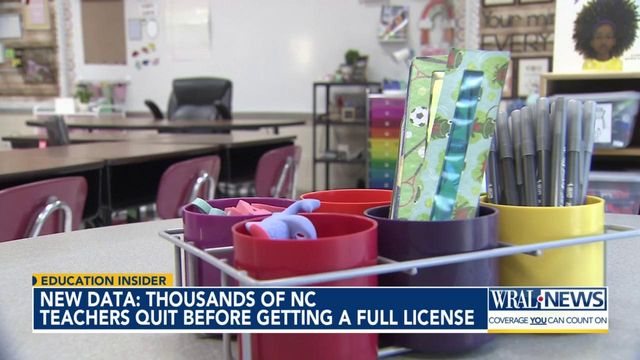
Thousands of people who switched careers to become North Carolina public school teachers are leaving their roles within three years, new data shows, the latest indicator of the hiring challenges plaguing school districts across the state.
Temporarily licensed teachers — largely people who enter the profession from another field are the fastest-growing teacher population in the state — make up 10% of North Carolina’s teacher workforce, up from 2.6% a decade ago. But many of them are leaving because they find it difficult to meet the professional or academic requirements to earn a full teaching license, which is required to keep teaching for longer than three years. A lot of it has to do with time and cost.
Other WRAL Top Stories
"The worst thing for these kids is the turnover," said Jeremy Mittag, who taught special education at Sanderson High School in Raleigh for three years before leaving the profession this summer. "By your second and third year you develop a rapport, you know what you're doing, you're able to communicate with the kids with special needs. And next year they'll have a brand new teacher with no experience."
Mittag said he wanted to keep teaching. He'd gotten the hang of it and cared about the students, but he became too frustrated with the time and cost to obtain a full teaching license.
Temporarily licensed teachers, who make up about 10% of the state's public teaching profession, are paid on the same scale as fully licensed teachers. But they have three years to earn a full teaching license in order to continue receiving full teacher pay. If they don’t earn the license, they become classified as a substitute teacher — a position that earns significantly less than full-time teachers.
Earning a full professional teaching license requires thousands of dollars in tuition, hundreds more for mandatory tests and often little to no financial aid toward any of the costs. Teachers must complete 18 college credit hours or an equivalent self-paced online program. And they need to have an undergraduate grade point average of at least 2.7 before entering one of those programs, even though students can graduate from college with lower GPAs.
To stay in his role, Mittag, a 20-year law enforcement veteran, would have had to take three college classes to raise the GPA he earned when he received his undergraduate degree in the 1990s. Only after raising his GPA to the required 2.7 would he be able to enroll in the educator preparation program.
Instead, he'll take state retirement and find other work.
State law doesn't allow for exceptions to GPA requirements, even if the degree was earned decades before — and even though one can earn a degree with a lower GPA. Allison Winzeler, director of Pathways to Practice, an educator preparation program that's a partnership between North Carolina State University and the University of North Carolina at Chapel Hill, says she’s torn on the requirement because she empathizes with people who want to continue teaching.
"I get those folks that have a lower GPA and they give me a very long email with why that happened, like, 'These were all the reasons I had a 2.3 in college,'” she said. "And you can tell this was 30 years ago. This person is a fully formed adult now. They probably have lots of life experience that will make them a perfectly capable teacher."
Teachers say they are often limited in their ability to pursue the full license because of the cost and the brief time frame to obtain it. Many say they don't complete much of the college coursework until well into their three years, in part because of how demanding their first year of teaching is and their desire to wait to make the financial investment until they know they want to continue teaching.
Some school systems have helped with the costs of tuition, but not many, Winzeler said.
"The cost is what is killing everybody," said Laura Harmon, Mittag's fellow special education teacher at Sanderson High School in Raleigh and who is also a temporarily licensed teacher. "It's just ridiculous.” Harmon estimated it would cost her about $8,000 to complete a qualified teaching program. Financial aid and grants are rare, she said.
Harmon is still completing her online program, Teachers of Tomorrow, but has had to take breaks from the program during months when the tuition was too much for her family, such as when they were hit with medical bills after her daughter suffered a knee injury this year.
Harmon works part-time in behavioral healthcare to supplement her income. Before teaching, she worked for years in the state prison system as a correctional case manager.
"I don't mind putting in the work in the way of the school," Harmon said. "Like, I'll put in the hours, it's fine. I'll figure it out. That's what I've always done."
Thousands quitting
More than 7,100 traditional public school classrooms were not filled by a qualified person at the beginning of the last school year — more than twice the total three years before, North Carolina Department of Public Instruction data shows. Of the classrooms not staffed with a qualified person last year, more than 1,500 of them were in special education, followed by about 1,500 in core K-5 classrooms. Nearly 600 middle and high school math and nearly 500 middle and high school science classrooms were not filled by a qualified person. Many of those classrooms were likely filled by temporarily licensed teachers.
Schools are hiring more of them as they struggle to find qualified candidates, a problem many didn’t have just a decade ago.
North Carolina has three temporary teacher licenses, and a teacher can only have any combination of temporary licenses for up to three years.
A “permit to teach” is a nonrenewable one-year license for someone with a college degree but no coursework in the subject they're teaching. They're not enrolled in an educator preparation program.
An “emergency license” is a nonrenewable one-year license for a teacher with a college degree and at least 18 hours of college coursework in the subject they're teaching.
Both permits can turn into a “residency license” — another kind of temporary license — after they’ve expired, provided the teacher has enrolled in an educator preparation program. About one-third are choosing not to.
The state estimates that more than 1,700 emergency and permit-to-teach teachers left during the 2024-25 school year. On top of that, hundreds more residency-licensed teachers quit or are dismissed every year, including 706 from March 2023 through March 2024, the most recent year of available data.
Teachers on the first two licenses leave the profession at a rate 163% higher than experienced teachers, and residency licensed teachers leave at a rate 55% higher, according to DPI.
Several legislative efforts aimed at easing the licensure process — including ones focused on standardized test performance or getting rid of licensure requirements for some teachers — stalled in the North Carolina General Assembly this year.
While some teachers told WRAL News they believed licensure requirements such as standardized exams were unnecessary, costly and stressful, some education experts were skeptical of eliminating them altogether.
"I worry that that could de-professionalize the profession of teaching," said Erin Horne, assistant dean for professional education and accreditation at North Carolina State University's College of Education. "We do want to ensure that our teachers are going into our classrooms with some minimal level expectation of qualifications, both in content and in pedagogy, before they enter the classroom."
‘Out on a limb’
Hayden Stephens, 23, just wrapped up her first year as a biology teacher at Broughton Magnet High School in Raleigh.
Stephens graduated last year from the University of North Carolina at Wilmington with a degree in marine biology but changed her career plans and decided not to go to graduate school.
She pursued a gut feeling to become a K-12 teacher, hoping to inspire young people the way she'd been inspired by her teachers when she was in school.
"Becoming a teacher was kind of like going out on a limb for me," Stephens said. "I was very unsure of it at the time because of all of the opinions that I'd gotten from other people, but as soon as I got into it, I was like, 'Yeah, this is for me. This is this is where I'm supposed to be.'"
She plans to continue teaching, but it hasn't been simple.
During her first year, Stephens frequently worked 10-hour days. She enrolled in Teachers of Tomorrow, the self-paced online program popular among teachers who don't have flexible schedules or who don’t live near a university that offers teaching courses. The program requires hundreds of hours of instructional videos, sometimes in subject areas that don't apply to everyone. Students aren't eligible for financial aid. Stephens didn't have much time during the school year to work on it. She's hoping to finish the work this summer after starting a year ago.
"I only had about a month to work on it before I started teaching, and it very quickly became a lot to manage," Stephens said. "I didn't make a lot of progress on it during the school year just because of how exhausted I was from the teaching job, to then have to come home and basically start this second job that wasn't paid."
Her program is about 300 hours of online modules, plus reading, tests and projects. Then she has to serve as a student-teacher for multiple days. The requirement doesn't make much sense to Stephens, given that she's already been teaching.
Education leaders say the preparation is important, in part because only so much can be learned on the job. Student-teaching is a critical experience that career-switching teachers miss out on, rendering them without a role model for things that are tougher to learn from a textbook, such as classroom and behavior management.
Teacher turnover is largely due to teachers feeling unprepared, said Winzeler, of Pathways to Practice. The online educator preparation program hopes to prepare educators in real-time, during the school year, allowing teachers to see a difference in their teaching right away.
Teacher licensure rules are intended to establish a baseline for professional standards, something many education experts say is critical to maintain to ensure teachers are well-trained for the work.
"It's the most important profession," Winzeler said. "I say this as a parent. I say this as a former teacher, and I say this as someone currently supporting educators in the field."
Stephens said she's well supported at Broughton, where her co-workers are largely experienced and accomplished teachers. They want to help her, too. But Stephens thinks she's not the norm, based on what she hears from others in North Carolina teaching forums and what she's heard outside of her school.
Some people, after finding out she doesn't have an education degree, assume she's just trying out teaching and lacks passion and expertise.
As a young professional who just finished college, Stephens finds the Teachers of Tomorrow program to be a good deal. But she knows teacher pay is not high enough for many people, driving them away from the profession.
"For me, the good outweighs the bad," she said. "But I think it does keep qualified individuals from entering the field that would make great teachers, because it's just not a livable wage anymore."
Teachers told WRAL that continuing to teach would be easier if the burden of the educator preparation program were smaller — if the cost were lower or aid available, if they got credit for some experience and if course content stayed more relevant to their subject area or grade level. More time to complete the programs would also help. They said some of the content wasn't necessarily helpful, because it taught them how to do things they'd already had to learn on the job, although a lot of the content is still helpful. "I understand the need for it," Stephens said.
Pathways to Practice doesn't offer federal financial aid, but Winzeler said the program is going through an accreditation process that could make it easier for the program to qualify for federal financial aid — critical for teachers on tight budgets.
Starting teachers earn $41,000 per year in state base pay, while the most experienced teachers cap out at $55,950. After combining with local dollars, North Carolina's teacher pay ranks relatively low nationally. Both chambers of the North Carolina General Assembly are proposing teacher pay increases over widely differing amounts. Legislative leaders are far apart on spending plans for the two fiscal years ending June 30, 2027.


Copyright 2026 by Capitol Broadcasting Company. All rights reserved. This material may not be published, broadcast, rewritten or redistributed.