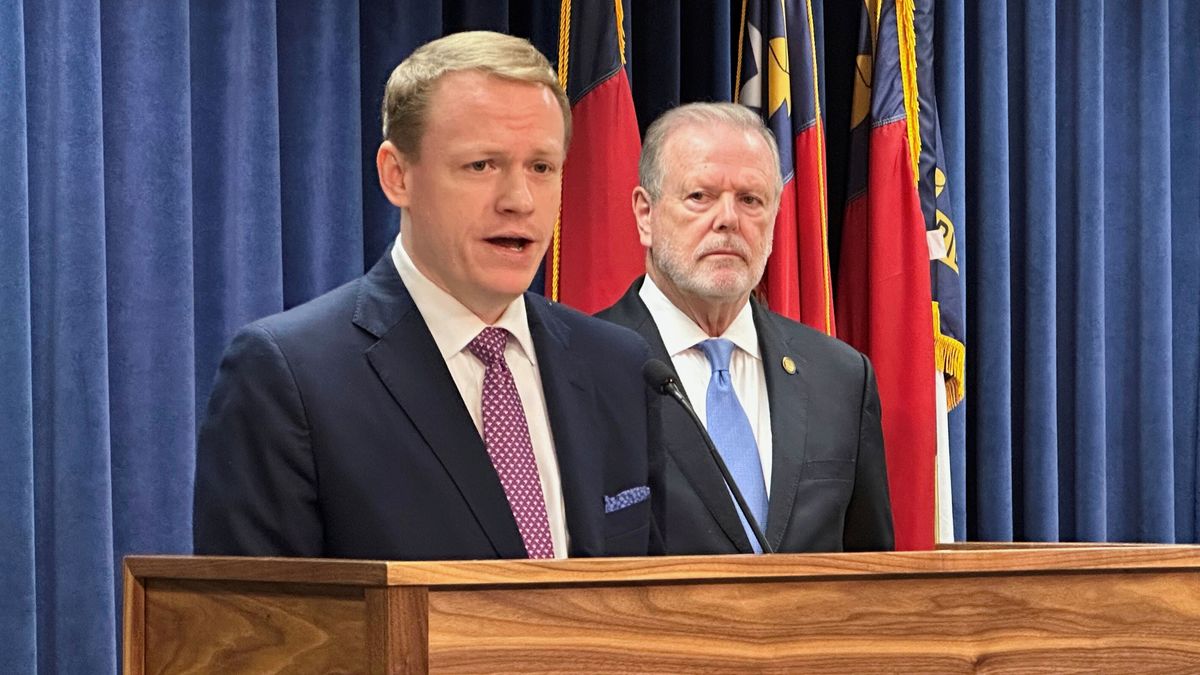
The governor’s order calling the legislature back to Raleigh for a special session next week to address Medicaid funding shortfalls is unconstitutional, Republican state lawmakers said Thursday, announcing their intent to ignore that order.
Democratic Gov. Josh Stein has the power to call the legislature back into session. And that’s what he did last week, urging lawmakers to use a Nov. 17 special session to address Medicaid funding.
Other WRAL Top Stories
State Senate leader Phil Berger and House Speaker Destin Hall wrote a letter to Stein Thursday saying that while the state Constitution does allow the governor to call special sessions in “extraordinary occasions," they don’t think the lack of Medicaid funding rises to that level — and therefore will not obey his order to convene the new session.
“Gov. Stein’s trumped-up ‘crisis’ is not ‘extraordinary,’ and thus the General Assembly will not convene upon his call,” Berger wrote in a statement Thursday, accompanying a formal letter he and Hall sent to Stein laying out their objections.
In a statement Thursday, Stein said Hall and Berger "would rather come up with excuses than fund Medicaid for the people of North Carolina. This is the latest example of their dysfunction that has become the norm of this North Carolina’s General Assembly.
"The Republican majority has made the time to damage our democracy with their gerrymander. But when it comes time to protect people’s health care? When it comes time to enact a comprehensive budget? They’re on vacation, and they’ll see us next year. All while North Carolina families pay the price."
Medicaid, which provides health insurance for nearly one-in-three North Carolinians, is hundreds of millions of dollars short as Republican lawmakers have failed to pass a new state budget, or any of several standalone Medicaid funding bills that have also been proposed. North Carolina is the only state in the country without a budget.
As a result, the state has begun cutting back on what it pays doctors, hospitals and health clinics for their work treating patients on Medicaid.
Most are facing 3% cuts, while some more specialty providers are facing cuts up to 12%. If the cuts continue, they could eventually lead to health providers declining to take on new Medicaid patients, going out of business, or both.
The state House and Senate are each controlled by Republican majorities, and GOP leaders in each chamber acknowledge that they haven’t approved enough spending to fully fund the state’s Medicaid system.
Both chambers have also tried to fix that problem, voting to approve bills to fund Medicaid. But they’ve also each refused to take a vote on the other’s proposals, as unrelated fights about broader state budget negotiations have seeped into the debates.
Republican leaders in both chambers have blamed the other chamber for their inability to agree on the details of a Medicaid funding bill. But Berger and Hall are in agreement on one topic: They believe the funding cuts to providers are premature, and that those cuts were ordered by the Department of Health and Human Services — part of Stein’s administration — as a political tool, aiming to ramp up pressure on state lawmakers from doctors and hospitals, which have well-funded lobbying arms and political operations of their own.
DHHS Secretary Dev Sangvai disputed claims that the cuts were unnecessary in an interview with WRAL News on Thursday. The cuts had to start at some point, he said. And while GOP leaders have said they plan to try again to pass a budget — or at least a Medicaid funding bill — sometime in the spring of 2026, he said he can’t bank on those negotiations going any better than the failed negotiations of 2025.
“Part of the reason why we put the rate cuts in place — and the magnitude of the rate cuts — is really to consider what happens if no additional dollars are funded,” Sangvai said.
But he also acknowledged that it’s probably true that state lawmakers are feeling pressure from doctors and hospitals to fix this quickly. Sangvai was the president of Duke Regional Hospital before Stein tapped him to take over DHHS, and he said if he were still in that role, he’d absolutely be asking state lawmakers to fix this and end the cuts.
“I would have done what I think a lot of providers are doing right now: Communicating with their lawmakers, communicating with their constituents, on the importance of this,” he said. “It's exactly what I would have done. And I think we have a ground-swell of support from the provider community, who understand why the department had to make these very difficult decisions. And they also understand how we can avoid making them — by getting the General Assembly back together.”
Hall, however, echoed Berger’s criticism that the cuts were premature and politically motivated, and that the special session to address the funding shortfall isn't needed. Despite the legislature's failure to act in 2025, Hall said Stein and DHHS should have more faith that Republicans will be able to make a deal in 2026.
“Stein is trying to shift blame from his self-created crisis,” Hall wrote in a statement. “He can and should simply stop all Medicaid cuts since the legislature will be back this spring with more than enough time to add additional funds if needed.”
Another gripe of GOP leaders is that while Medicaid remains underfunded, the legislature did approve $600 million to help partially bridge the gap earlier this summer. And while most of that money has gone toward paying bills, DHHS did use $100 million to address some internal administrative budget needs.
Sangvai defended that decision, telling WRAL News that the agency has overall cut its internal spending and that it was just attempting to fund basic needs. The GOP argument that cuts wouldn't have been needed without that administrative spending doesn't fly, he said, because even if he had spent $0 on administrative needs, Medicaid would still be short many millions of dollars.
"We have made significant administrative cuts," Sangvai said. "It's evident in our workforce and the type of services we provide ... But even if you look at the reduction in administrative work, and any sort of financial upside that demonstrates, there's still a shortfall. Altogether, we're short $319 million."