NC lawmakers try again to pass HOA reforms, making it harder for people to lose their homes
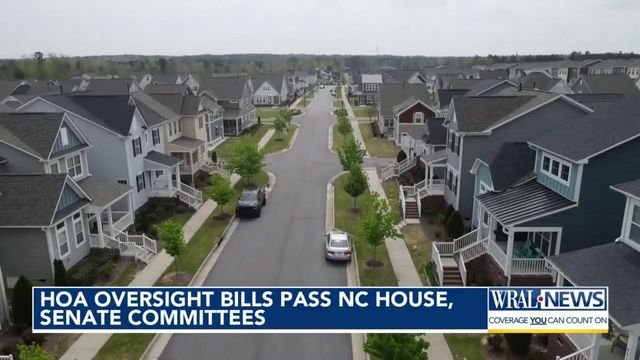
Two bills that would make it harder for homeowners' associations to take people's homes in foreclosure — and which would also extend other rights to homeowners living in a community under an HOA — are moving forward in state legislative committees Tuesday.
Fewer than half of North Carolinians live in HOAs, but the number who do is rapidly growing. Especially in the state's fastest-growing suburban areas, nearly all new homes being built are being built a part of a homeowners association. The growth in HOAs has also led in a growth in complaints about them to state lawmakers, who now say something must be done to decrease the power of the associations.
Other WRAL Top Stories
Rep. John Blust, R-Guilford, said the power imbalance between HOAs and individual neighbors is particularly troubling to him.
"If you don't do what they demand, they'll slap a lien on you faster than you can blink," Blust said. "But when they don't do something, you have no recourse against them."
Senate Bill 378 would ban HOAs from being allowed to foreclose on people over unpaid fines. Supporters say no one should lose their house simply because they waited a few days too long to mow the grass or take in their trash cans. The bill would also stretch out the foreclosure process, giving homeowners more time to resolve any issues. It would also ban HOAs from fining people for running businesses such as tutoring services or music lessons out of their homes, and it would instruct the state attorney general to track reports of complaints against HOAs around the state.
House Bill 444, meanwhile, would ban HOAs from being allowed to foreclose on people unless they're at least six months behind. It also contains many of the other rules in the Senate version of the bill regarding home businesses, and to require the attorney general's office to track complaints against HOAs, in addition to more technical rules surrounding contracts, home closings and other legal issues.
The major difference between the two bills is their disagreement over when an HOA would or wouldn't be allowed to foreclose on people — unpaid dues versus unpaid fines. It could indicate the House and Senate have still not resolved their differences that killed a similar attempt at reform two years ago.
Sen. Benton Sawrey, R-Johnson, sponsored the Senate version of the bill and said he's "cautiously optimistic" the House and Senate can resolve their issues this year and get something passed into law. Democratic Gov. Josh Stein previously said, when he was the attorney general, that he also favors HOA reforms.

The issue picked up traction at the legislature in 2023 but ultimately failed to move forward due to disagreements over the foreclosure rules between House and Senate leaders, which appear to still be unsettled.
Then in 2024 lawmakers and members of the general public met throughout the year to talk about what was needed, in efforts to try working out differences between the House and Senate. Whether or not that effort worked will likely be known within the coming months. Each version of the HOA reform bill is expected to pass its respective chamber this week and then head to the other, followed by negotiations over how — or whether — to find a middle-ground compromise.
Disagreement over what should or shouldn't be included in the bill isn't divided along typical partisan lines. Republicans and Democrats alike have some members who come down more on the side of homeowners and others who come down more on the side of HOAs. On top of that, a number of influential special interests are involved. The HOA industry has its own lobbyists, and the reform effort has also attracted attention from deep-pocketed groups including real estate attorneys, agents and homebuilders.
Rep. Frank Iler, R-Brunswick, is one of the House bill's lead sponsors along with Rep. Ya Liu, D-Wake. Iler said Monday that HOA lobbyists are telling lawmakers that 95% of HOAs do everything by the book and face few to no complaints.
But with thousands of HOAs in the state Iler said, that still means there are hundreds of abusive HOAs among that remaining 5%.
"I hope we can take action against the bad actors — bad actors brought back to being good actors," Iler said.
Other housing bills
Lawmakers are also expected this week to take up several other bills related to housing and development, typically with an eye toward helping developers. House Bill 765 would ban county commissioners or city council members from voting on rezoning pieces of land — a key step often needed to turn farmland into new subdivisions, for example — if that politician has ever "expressed or holds a fixed opinion" on the issue "that appears not susceptible to change."
For example, if a politician won election by promising local voters not to approve any new development in a certain area, that politician could then be banned from taking part in any votes on development in that area, if that bill becomes law. That bill, sponsored by several Republican House members who work as real estate developers or builders, is also scheduled for a committee hearing Tuesday.
Also coming up this week are Senate Bill 587, which would change rules for land use and billboards — a perennial source of political fights at the state legislature — as well as House Bill 369, which would ban cities and counties from requiring housing or apartment developers to provide any minimum amount of parking in new developments.



Copyright 2026 by Capitol Broadcasting Company. All rights reserved. This material may not be published, broadcast, rewritten or redistributed.