NC lawmakers approve voucher expansion, target sheriffs who won't work with ICE
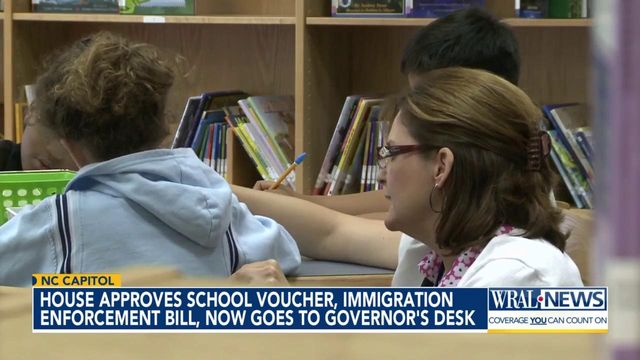
North Carolina lawmakers gave their final approval to a bill that would massively increase funding for private-school vouchers, as well as force sheriffs to work with federal immigration officials. The politically charged legislation, which cleared the Republican-controlled House Wednesday, combines the two unrelated issues, each long-awaited by conservatives.
The vote passed 67-to-43, mostly along party lines, with a small amount of Democratic support, following a previous party-line vote in the state Senate on Monday. It now goes to Democratic Gov. Roy Cooper's desk.
Other WRAL Top Stories
Cooper is expected to veto the bill, but Republicans have a veto-proof supermajority. So far this year, they've overridden all but one of his vetoes.
Both major-party candidates running to replace Cooper as governor — Republican Lt. Gov. Mark Robinson and Democratic Attorney General Josh Stein — quickly seized on the news.
"I applaud our conservative Republican lawmakers and legislative leadership for their actions today which maintain our trajectory of financial responsibility," Robinson wrote. "These budget revisions will help ensure that even more North Carolina families have access to Opportunity Scholarships, which allow parents to find educational opportunities that best meet the needs of their children."
Stein called the General Assembly’s decision "a betrayal of every child’s right to a sound, basic public education."
"The General Assembly won’t invest in our children and their futures," he said. "They are failing our kids, and it’s a disgrace."
Robinson also praised the bill's immigration changes as improving public safety. Stein made no comment on the immigration portion of the bill.
The proposal to force sheriffs to work with Immigration and Customs Enforcement has been in the works for more than five years — ever since a group of Democratic sheriffs swept the 2018 elections to take control over law enforcement in the state's seven largest counties. Many won by campaigning specifically on anti-ICE platforms and were reelected in 2022. They said fostering positive ties with local immigrant communities would help solve more crimes in the long run.
The bill's lead sponsor, Rep. Destin Hall, R-Caldwell, said sheriffs simply shouldn't be allowed to decide not to work with federal authorities.
"This puts an end to the insanity we've seen since 2018," Hall said.
The bill would require sheriffs who have inmates in their jails to keep them locked up behind bars even after they should be released from jail — perhaps because they made bail or had their charges dismissed — so that ICE can come pick them up, if they're suspected of being in the country illegally.
Critics say refusing to let people out of jail is potentially unconstitutional, but supporters say they don't think so. Court rulings across the country have reached mixed conclusions on the issue.
On vouchers, Republican state lawmakers first authorized taxpayer-funded grants for families to pay for private school tuition a decade ago.
The program has grown steadily since then, culminating this past school year when the legislature voted to lift all income caps and let any private school family get vouchers, no matter how wealthy. That led to an explosion in demand, and funding ran out before all the families could get vouchers.
The bill contained $1.1 billion in new spending, nearly half of that for expanding the voucher program.
On Tuesday, a WRAL News Poll found that North Carolinians are deeply divided on vouchers. Most are in favor of vouchers in general. But most also oppose putting more money into the program, like the legislature just did.
- The poll found that only 16% of North Carolina adults supported putting more money into vouchers.
- Another 40% were OK with the idea of vouchers at some lower level of funding — including some who said the current level of spending was fine and others who said they support vouchers but want the legislature to reduce funding to the program.
- Only 22% said they totally oppose any state funding for vouchers. Another 21% had no opinion.
Inside the legislature, Republicans say letting all families qualify for vouchers, no matter their income, is a good policy to bolster school choice options. Democrats say it's a transfer of wealth, at the expense of public schools, to rich families and those who run private schools — many of them affiliated with conservative Christian churches — who also tend to be prominent GOP political supporters and donors.
Immigration a key issue for GOP
When the legislature mostly adjourned this year's session in June, they wrote in rules allowing themselves to come back into session sporadically — like this week's brief return — but only for specific types of bills. That's why the spending had to be rolled into another bill, House Bill 10, on sheriffs and ICE.
Republicans see opposition to immigration as a key political talking point in this year's presidential election. HB10 is a way for lawmakers to show conservative voters they're taking action on that issue by telling sheriffs they shouldn't be allowed to choose whether or not to work with ICE.
Hall criticized Democratic presidential candidate Kamala Harris for not doing more on the border while vice president, in his speech about the bill Wednesday.

Many Democrats, on the other hand, spoke out to accuse GOP lawmakers of exploiting prejudice to score political points. "This bill is based on fear and racial animus," said Rep. Marcia Morey, D-Durham.
But supporters, like Wilson County Republican Rep. Ken Fontenot, said it's about protecting victims of crimes: "I can't forget the young lady in my neighborhood who had been kidnapped from her town in Mexico and sex trafficked in Wilson and Greenville," he said. "Thankfully, those traffickers were caught and brought to justice."
Rep. Maria Cervania, D-Wake, called the bill "a moral outrage" that will lead to increased racial profiling of minorities — invoking her own personal history of having been once wrongfully detained by a deputy who, she said, accused her of being in the country illegally during a traffic stop and spent hours threatening to have her deported.
"One of the most heartbreaking consequences is the cruel and arbitrary separation of families," Cervania said. "Every day, children are torn from the arms of their parents, spouse are torn apart, families are torn apart, by deportation and detention."
Hall dismissed such concerns. While the bill would make it easier to deport people who have been accused of crimes, he said, "it has nothing to do with going out and rounding people up."
Half a billion for more vouchers
Proponents of the private-school vouchers say they’re essentially a funding mechanism that allows the state per-pupil allocation to follow a student where they ultimately go to school. They argue that families who aren’t happy with their assigned public school should have a choice to send their children elsewhere.
North Carolina private schools enrolled 131,230 students last school year, according to the state Division of Nonpublic Education.
Vouchers are funding nearly 46,000 students’ private school educations this year, according to a new analysis from the North Carolina Office of State Budget Management. About 54,000 applied for vouchers and are on a wait list for funding.
Republican leaders said their top budget priority this year was to eliminate that wait list. They failed to reach a budget deal earlier this spring, but have said some of the voucher funding could apply retroactively.
The deal would spend $1.1 billion on various causes, including about $490 million on vouchers spread over two years. The rest will go toward economic development efforts and Medicaid expenses, plus funding to account for enrollment growth in public schools: $95 million to K-12 schools and $64 million to community colleges.
Rep. Pricey Harrison, D-Guilford, criticized GOP lawmakers for spending over a billion dollars but not putting any new money into elections administration — despite the fact that lawmakers previously declined to fund all of the State Board of Elections' funding requests for this year's elections.
Election Day is now less than two months away, and elections officials were recently hit with hundreds of thousands of dollars in unplanned-for costs as the elections board was given a court order to reprint ballots without the name of erstwhile presidential candidate Robert F. Kennedy Jr.
Debate over private vs public schools
A chief complaint from voucher opponents is that because North Carolina funds public schools based on their enrollment, every student that's enticed to leave for a private school with the new voucher funding will cause public school funding to drop.
The state Office of State Budget Management last year estimated that, under the current funding plan, public schools could lose about $200 million in funding during the 2026-27 school year because of a loss in enrollment connected to the voucher program. It was based on the money available for vouchers and not necessarily demand for them.
Rep. Lindesy Prather, D-Buncombe, said her local public schools are projected to lose more than $5 million because of vouchers.
She said that since the vast majority of children still go to public schools, the state government should be focused on raising teacher pay, bolstering mental health services for students and putting safety upgrades into schools — but "instead of funding any of those things, we are sending more money to discriminatory, religious private schools," Prather said.
Rep. Kelly Hastings, R-Gaston, said he doesn't think Republicans are harming public education by funding vouchers. He said there are hardly any private schools close to his home in Gaston County, and so he wouldn't be supporting voucher funding if he didn't also think public schools had enough money.
"A lot of the public seems to get into the rhetoric about how we've dismantled public education, which couldn't be farther from the truth," Hastings said.
Help for students with disabilities
The state's voucher program is broken into two programs; most of the money goes into a general fund anyone can apply for but there's also a separate, small fund dedicated for children with disabilities.
The bill adds $490 million to the state's spending on vouchers, including nearly $25 million to the disability program.
And while no lawmakers spoke about issues with school services for families whose children have learning or developmental disabilities, it was a concern of some of the people who came to the legislature to speak out ahead of the vote.
Unlike public schools, private schools aren’t required to accept students with disabilities or provide services for them. Some families may still opt for them for smaller class sizes, but many schools don’t offer special services. Schools that specialize in helping children with certain disabilities are often small and expensive and can be long distances away for some families.
So some protesters Wednesday said if lawmakers really want to help students with disabilities, they'd put more money into public schools for that purpose instead of setting it aside for private schools.
"If my kid doesn’t get the resources that we need, where else can I go?" said Susan Book, who said she's a parent in the Wake County Public Schools System. "… I’ve got no plan B. I’m here to fight for public schools."
WRAL reporters Eric Miller and Emily Walkenhorst contributed to this report.


Copyright 2026 by Capitol Broadcasting Company. All rights reserved. This material may not be published, broadcast, rewritten or redistributed.