NC lawmakers approve millions in Hurricane Helene disaster aid for western counties
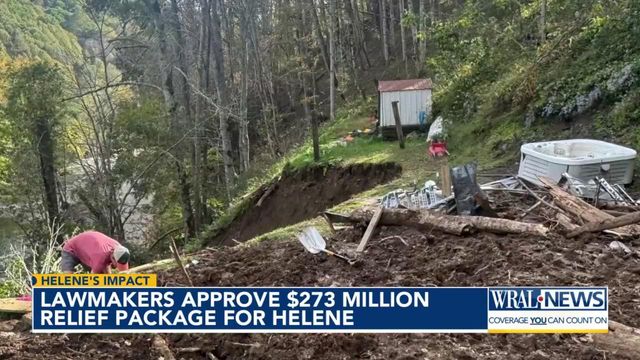
State lawmakers were back in session Wednesday, moving quickly to pass a $273 million disaster relief bill responding to storm damage from Helene that ravaged western North Carolina, in one of the worst natural disasters in state history.
The bill passed the state House and Senate unanimously Wednesday, sending the bill to Democratic Gov. Roy Cooper who's expected to sign it. In addition to the money, the bill also includes several temporary changes to state rules to increase the efficiency of the state's response, requested by Cooper's administration.
Other WRAL Top Stories
The state has $4.75 billion in general savings, often referred to as a "rainy day fund," as well as hundreds of millions more in other specifically targeted savings reserves that might be used for emergency response. More spending is expected to be authorized in the coming weeks.
"This is just the first step," state Senate leader Phil Berger, a Republican, said Wednesday.
The full extent of damage from Helene is still unknown due to limited communication and because parts of the state are cut off to traffic, but it’s likely to be in the billions of dollars. Hurricane Florence caused $17 billion in damage to eastern North Carolina in 2018, according to state estimates.
"We still don't know what we don't know up in the hills and the hollers," Sen. Tim Moffitt, R-Henderson, said Wednesday. "We're still working with folks that are very tough, that still do not want to leave their homes, and it has yet to set in on them that they're cut off from the civilized world. We're doing our best to get to them."

Multiple lawmakers from the western part of the state became emotional as they spoke, some breaking down in tears.
"I promised I wouldn't cry, but people are still needing help, even though we didn't ask for it," Rep. Jennifer Balkcom, R-Henderson, said. "This is just a start. This is a start to give people what they need."
Rep. Dudley Greene, R-McDowell, noted that his hometown isn't expected to have a grocery store open for weeks. And now the weather is cooling, leading officials to scramble to make sure people have shelter, heat and warm clothing as temperatures could soon drop to near freezing.
"This morning, the lows were in the 40s," he said. "Next week, they'll be in the 30s. ... So as people are asking what's needed up there — things like kerosene heaters, blankets, warm coats."
The state government won’t be asked to pay for all the damages and costs of emergency response. Some could be covered by insurance. And much will be covered by the Federal Emergency Management Agency, the Small Business Administration and other federal government sources.
FEMA has already doled out tens of millions of dollars to western North Carolina residents, and applications for aid are still open.
People can apply for FEMA aid for everything from property damage to food, water and baby formula. Democratic President Joe Biden recently added Mecklenburg and Swain counties to the list of counties eligible for FEMA housing aid, bringing the total to 27 of North Carolina’s 100 counties.

Elections, schools, power and water
Disaster recovery efforts aren’t just about money to rebuild homes, roads and businesses. In a letter to state lawmakers Monday laying out disaster relief requests, Gov. Roy Cooper's budget director Kristin Walker also included a lengthy list of temporary policy changes for state agencies that he said "will enable them to work more nimbly and with greater efficiency.”
Her requests touched on aspects of state government ranging from probation hearings to landfill access, child care center inspections, DMV fees and more. GOP leaders said they plan to approve much if not all of those requests. "We don't need these efforts tied up in bureaucracy and delay," House Speaker Tim Moore said Wednesday.
Clean water concerns: Many residents in the affected areas have been under boil water advisories since more than two dozen water treatment plants were affected by the storm. Likewise, wells could be contaminated by the floodwaters and mudslides that often contained sewage, pollutants, dead animals and other contaminants.
Sen. Ralph Hise, R-Mitchell, represents several mountain counties and also previously served as the mayor of Spruce Pine. He said Helene was the worst storm he's ever seen, and that rebuilding efforts — including at the local water treatment plant — are expected to take years.
"Mitchell County's water treatment system for the entire county, both towns, is gone," Hise said. "It does not exist. It's unsalvageable. That's a four-year process, and we don't have a temporary solution right now."
Education: Public schools will likely need changes to state law tweaking their calendar rules about the number of days schools must be open and when — as well as making sure teachers still get paid. In much of the state, especially in rural counties, the local school system is usually one of the biggest employers. Wednesday's bill included money to keep school workers paid, as well as policy changes requested by school officials.
North Carolina Superintendent of Public Instruction Catherine Truitt has been working on a series of recommendations to the legislature, including funding to keep paying teachers and other school personnel and flexibility for remote learning or extension to the school calendar. She is expected to request more than $100 million to help the Helene-impacted schools.
Elections: With voting already underway in North Carolina, state elections officials have begun making some changes to help elections continue with tweaked rules for some of those western counties — and it’s also possible that the state legislature will make further changes to election rules.
Berger said the state elections board has already made emergency rules for 13 counties most heavily impacted by the storm but lawmakers plan to expand that to all 25 counties under emergency declarations. The new rules for that region make changes to mail-in voting rules and will also loosen the rules for poll workers, to allow more people to serve and help ensure polling places are open and don't face long lines.
Power outages: With 84,000 Duke Energy customers in western North Carolina still without power as of Tuesday afternoon — a number that could represent tens of thousands of families as well as local businesses — it didn't appear that Duke Energy asked for help from the legislature on getting power restored. The company has already restored power to the vast majority of western North Carolina; remaining areas could simply need to wait for roads to be rebuilt before Duke Energy crews can go in and address the remaining outages.
"Suffice it to say that they are dealing with, like everyone else, a situation that is unlike anything they've seen before," Berger said when asked Wednesday about efforts to restore power.
Duke Energy wrote in an update Tuesday that the damage in western North Carolina is unprecedented, and that while many do now have power back, the remaining work could be a long and expensive process: “Extremely difficult and targeted work lies ahead before the company can restore additional customers in the hardest-hit communities.”




Copyright 2026 by Capitol Broadcasting Company. All rights reserved. This material may not be published, broadcast, rewritten or redistributed.