Cooper vetoes 'sham' legislation to strip power away from Democratic state officials
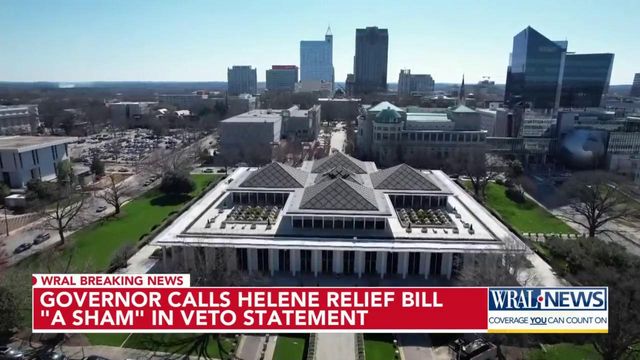
Gov. Roy Cooper vetoed a bill Tuesday that would enact sweeping changes stripping power away from the governor and other executive branch offices won by Democrats in the 2024 elections.
Starting in January, the state will have several new Democratic officials in incoming Gov. Josh Stein, Lt. Gov. Rachel Hunt, Attorney General Jeff Jackson and Superintendent of Public Instruction Mo Green. If the legislature is able to override Cooper’s veto of Senate Bill 382, those officials will all have less power and influence than the current leaders in those offices. GOP leaders called the bill a Helene relief aid bill, but critics said it contained very little actual funding for western North Carolina and mostly focused on unrelated, more politically motivated issues.
Other WRAL Top Stories
"This legislation is a sham," Cooper wrote in his veto message. "It does not send money to Western North Carolina but merely shuffles money from one fund to another in Raleigh. This legislation was titled disaster relief but instead violates the constitution by taking appointments away from the next Governor for the Board of Elections, Utilities Commission and Commander of the NC Highway Patrol, letting political parties choose appellate judges and interfering with the Attorney General’s ability to advocate for lower electric bills for consumers."

Perhaps the biggest change would take away the governor’s control over the elections board — a longtime goal of GOP leaders who have seen numerous other efforts ruled unconstitutional in court, or shot down at the ballot box by voters, ever since Cooper was first elected governor eight years ago.
The changes would also handcuff the attorney general, largely banning the office from the independent litigation that past attorneys general including Stein and Cooper have engaged in. It would also consolidate control over state energy policy in GOP hands, by stripping various powers in that realm from the governor, lieutenant governor and attorney general. And it would eliminate a school safety task force led by the superintendent of schools.
The bill was Republican legislative leaders’ reaction to their party’s losses in races for those four offices in this year’s elections. And while voters also broke the GOP’s veto-proof supermajority, the new lawmakers won’t be sworn in until January — giving Republicans just enough time between the November election and the start of the new year to try speeding through last-minute changes to the balance of power in state government.
Unlike with past bills that passed along party lines this year, however, this time a veto override isn’t guaranteed to be successful.
Republicans do appear to have enough votes to override Cooper’s veto in the state Senate, at least as long as all their members are able to get to Raleigh over the holidays in December to vote. But in the House of Representatives, three Republicans voted against their party and joined Democrats in opposing the bill.
None explained their reasoning, but all were from western North Carolina. And the power-grab bill was framed as a Helene relief bill, drawing criticism from some for its unrelated provisions as well as the fact that it spent relatively little money on Helene relief.
The bill contains $277 million for Helene aid, most of which wouldn’t be allowed to be immediately spent. Lawmakers simply proposed earmarking that amount of money, held in savings, for future use in western North Carolina. The same day they voted to do that, Republican lawmakers also voted to inject billions of dollars more into private school tuition vouchers over the next several years.
“The state legislature has failed to approve meaningful funding for western North Carolina while making plans to lock in billions of dollars for taxpayer-funded vouchers for unaccountable, unregulated private schools in the near future,” Cooper wrote in a news release last week.
In October, Cooper announced that Helene was the most destructive storm in state history, doing $53 billion worth of damage. He suggested the state pay $3.9 billion toward responding to the damage in western North Carolina. Republican lawmakers have so far approved less than $900 million, putting them $3 billion short of Cooper’s plan.
Republican legislators have said that they plan to discuss approving more aid in the future.
"This is not a quick recovery for western North Carolina," said Sen. Ralph Hise, R-Mitchell, a western North Carolina lawmaker and top member of GOP leadership, during the Senate debate. "This will be a years-long process."
But the relatively small amount of funding in this bill, even as GOP leaders authorized billions more in spending on vouchers the same day, struck some critics as a clear statement on the state’s priorities.
"Calling this bill a disaster relief bill is pretty rich," said Rep. Eric Ager, D-Buncombe, during the House debate. "It moves some money around here in Raleigh, but it doesn't get it into the hands of the people that need it. Instead, this bill is focused on a whole host of political priorities."


Copyright 2026 by Capitol Broadcasting Company. All rights reserved. This material may not be published, broadcast, rewritten or redistributed.