New NC laws raising costs for drivers, protecting people who buy tickets online, going into effect in 2025
The new year will mean higher bills for some North Carolina drivers, as new state laws raising toll road fees and boosting the minimum required amount of auto insurance coverage will take effect Wednesday.
Those are among the dozens of legal changes approved by the state legislature recently that will become official in 2025.
Other WRAL Top Stories
Often when the legislature passes a law, it goes into effect immediately. But some changes — particularly big ones that people, businesses or the government itself might need time to prepare for — don't become law until months after they're passed.
Among the new laws going into effect are:
- Stricter requirements for auto insurance coverage amounts, and higher toll road costs.
- Undoing some juvenile justice reforms passed in recent years.
- Looser rules for new home construction.
- Stricter rules around fees or changing prices on ticket sales for concerts and sporting events, when sold by companies in the secondary market.
- Lower income tax rates for people and businesses, plus new tax credits for corporations that donate property for environmental conservative, historic preservation or similar uses.
- Many of the new provisions in a wide-ranging bill stripping power from offices Democrats won in the 2024 elections.

Most of those changes take effect Jan. 1. The auto insurance changes were initially scheduled for a Jan. 1 start date as well, but state lawmakers gave drivers a six-month reprieve and recently voted to push it back to July 1.
Some of the changes, notably the new rules for secondary-market ticket businesses such as Ticketmaster or StubHub, passed the legislature with at least some bipartisan support.
Others, such as the laws undoing juvenile justice reforms and loosening regulations on new home construction, were more politically controversial and passed only after Republican state lawmakers overrode Democratic Gov. Roy Cooper's veto on those bills.
New laws for drivers
The toll road increases will only add up to a few cents per trip on the toll roads, the Department of Transportation said. While that might add up for frequent drivers, another bill could bring bigger sticker shock: Toll road late fees. Those could increase by as much as 50%, under another new law DOT sought and the legislature approved. The tolls and late fees are used to pay for upkeep on the toll roads.
The auto insurance changes grabbed attention when the legislature first passed them. WRAL reported in May that, once the changes become law, North Carolina will have the most expensive minimum coverage requirement anywhere in the country.
When a car crash happens, it's the responsibility of the driver who's at fault to pay for the damage. If that driver has insurance — which is mandatory in North Carolina — then insurance will pay for at least some of the costs, and potentially all, depending on the driver's coverage level and the extent of the damage.
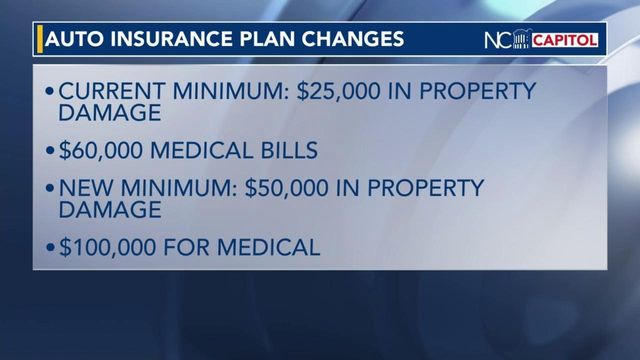
Under current law, the lowest possible coverage levels are $25,000 for property damage and $60,000 for medical bills. This new law will double the property damage minimum to $50,000 and will raise the minimum medical liability coverage to $100,000.

Many drivers already have insurance that covers those higher amounts of damage. But for people who have cheaper plans, they could soon see their premiums increase to account for the higher amounts of coverage.
When WRAL reported on the changes earlier this year, a spokesperson for the insurance industry said that would likely only require about a 5% increase in premiums for those affected. But an independent insurance agent said the increases could be more than twice that much.
Other new laws
Some parts of Senate Bill 382, the wide-ranging bill that combined Helene relief aid with unrelated provisions stripping power from Gov.-elect Josh Stein and other Democrats who won offices in November's elections, will also become law in January. But they could also be stopped in court, with judges ordering that pieces of the law may not go into effect while lawsuits are pending. Cooper and Stein have already sued over parts of the bill taking away the governor's influence over the state Highway Patrol and Board of Elections; more lawsuits are still expected over other parts of the law.

Other controversial laws that go into effect with the start of 2025 include major changes limiting the state's rules and regulations for home construction. Homebuilders stand to make more money, as the changes will require them to do less to meet requirements for energy efficiency and storm-proofing for natural disasters.
Legislators said they hoped homebuilders would pass on those savings to the general public in the form of cheaper homes. Cooper said it'll actually lead to higher costs for homeowners in their energy bills, and could also make North Carolina ineligible to receive federal disaster funding for future disasters if homes aren't being built well enough to withstand storms.
State lawmakers also changed the makeup of the state board that helps write building codes, taking away seats on the board that were reserved for architects, a firefighter and local government officials — a change Cooper said "limits the knowledge and practical experience of the body tasked with ensuring all buildings are safely designed."
Those home construction legal changes are in two bills, SB166 and HB488. Some parts of those changes are already law; some are set to become law in January and some are indefinitely blocked pending court battles. Cooper previously filed a lawsuit over HB488, arguing that parts of it are unconstitutional. He won a partial victory at trial and the case is currently before the N.C. Court of Appeals.


Copyright 2026 by Capitol Broadcasting Company. All rights reserved. This material may not be published, broadcast, rewritten or redistributed.