What to know about NC Republicans' effort to flip a U.S. House seat through redistricting
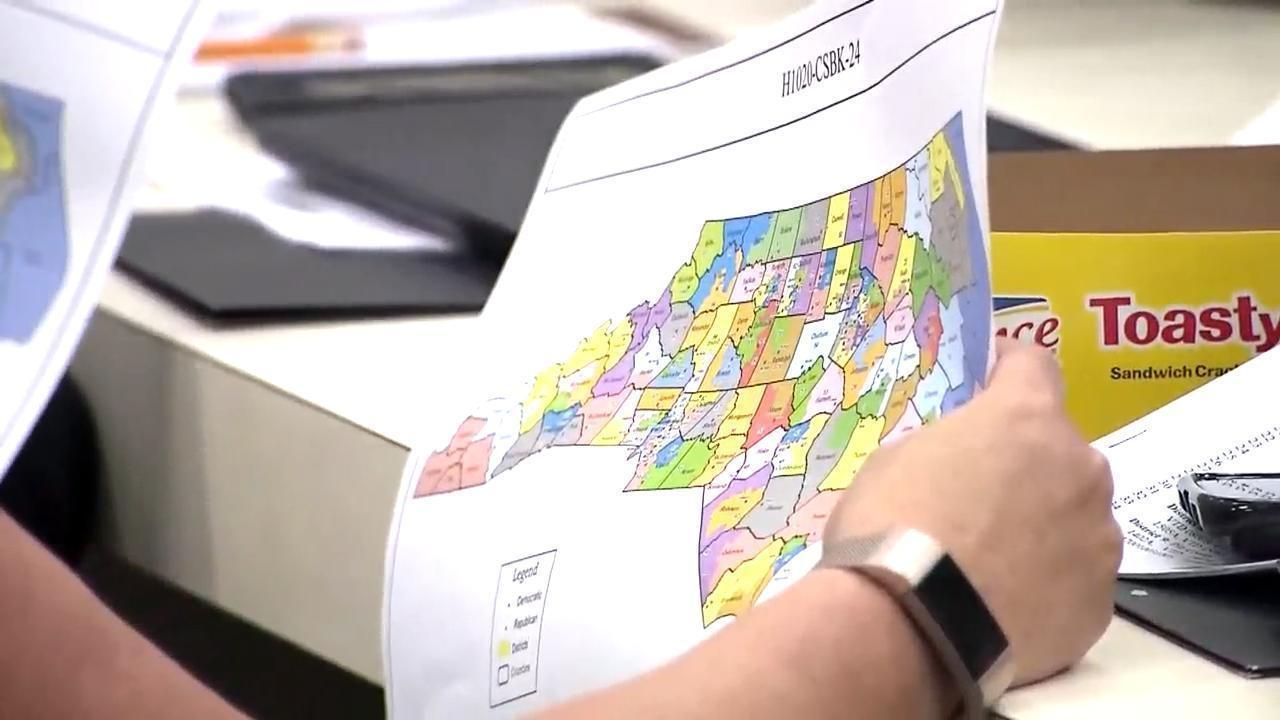
North Carolina Republicans are forging ahead with plans to redraw the state’s congressional districts further in their favor as President Donald Trump urges a nationwide gerrymandering effort to help the GOP maintain control of Congress in 2026.
The North Carolina redistricting process kicks off Monday with state House and Senate committees meeting to discuss a newly proposed map of the districts. Lawmakers could vote to approve the map as early as Tuesday, the same day Democrats are planning a large protest in downtown Raleigh around the legislative building.
Other WRAL Top Stories
The proposed map would give the GOP an edge in a northeastern North Carolina district that has been represented by Democrats for decades. If approved, the districts would likely be challenged in court.
Here’s a breakdown of what’s happening and why.
What are congressional districts, and how are they determined?
Each of the 50 states is represented in the U.S. House of Representatives, in different amounts. The seats are allocated based on population: The more people in a state, the more representatives that state gets in the 435-seat House.
North Carolina has the 10th-biggest population in the country and has 14 seats in the House.
The seats are divvied up every ten years. Each state is responsible for creating a map that features the appropriate number of districts, each with roughly the same number of people.
The redistricting process varies by state. Some states appoint political commissions to tackle redistricting. Some also design those commissions to be politically neutral. But in most states, including North Carolina, state legislators draw the maps themselves — and often to give their own party a built-in advantage, using past election results and other data, a process known as gerrymandering.
Why are lawmakers redrawing congressional districts now?
The president’s party typically loses seats in Congress in midterm elections, and that trend appeared likely to continue next year since Trump’s polling numbers have been falling in recent months.
Trump, a Republican, wants the GOP to maintain control of the U.S. House to ensure that his legislative priorities are accomplished. Republicans control the chamber by only a slim margin currently — 218 seats are needed for a majority, and the GOP has 219.
Republican state leaders across the country have jumped into action to redraw their congressional maps ahead of 2026, hoping that a new round of gerrymandering will be enough to maintain that majority and stomp out growing popular support for Democrats.

“We are doing everything we can to protect President Trump’s agenda,” North Carolina Senate leader Phil Berger said when he announced the legislature would redraw the map.
Republicans in Texas, Utah and Missouri have already redrawn their maps to try getting rid of Democratic lawmakers. Other GOP-led states including North Carolina, Florida, Indiana and Kansas could follow.
Are Democrats doing it too?
Some Democratic Party leaders have indicated they want Democratic-led states to redraw districts to defend their seats or pick up new ones. But so far no blue states have passed new maps to do so.
California appears likely to do so, however, and Maryland and Illinois could jump into the fray as well.
North Carolina Republicans are treating California Gov. Gavin Newsom’s threat to fight back as real; N.C. House Speaker Destin Hall said last week that “our state won't stand by while Democrats like Gavin Newsom redraw districts.”
What’s the current North Carolina map?
North Carolina has 14 seats in the U.S. House. Under the current map, 10 of those seats are safe Republican districts, three are safe Democratic districts — one in Charlotte and two in the Triangle — and one is competitive.
Because a Democrat won the state’s only competitive seat in 2024, Republicans currently hold a 10-4 advantage in the House delegation.
How many seats can North Carolina Republicans flip with a new map?
Republicans are targeting the seat held by U.S. Rep. Don Davis, a moderate Democrat who represents the northeastern corner of the state.
If the proposed map becomes law, it would give the GOP an edge in 11 of the state’s 14 districts, likely leaving the state with three congressional Democrats.
Republicans unsuccessfully targeted Davis in their previous round of redistricting, in 2023. They turned his district that year from a relatively safe Democratic seat to a tossup. But Davis won reelection to that tossup seat in 2024. So now Republicans will try, again, to turn his district even more red.
“I have undergone and survived multiple rounds of redistricting at both the state and federal levels,” Davis, a former state senator, told WRAL last week when lawmakers announced their intent to redraw the map. “Serving the hardworking families of the East is my unwavering commitment, regardless of party affiliation or the way the map is drawn.”
After the new map targeting Davis became public, he said he’s “considering every option” for his political future.
What happens if Davis loses?
Democrats have held North Carolina’s 1st Congressional District for more than a century — and its voters have elected Black representatives for 30 years straight.
That’s because of U.S. Supreme Court rulings on racial gerrymandering that say states like North Carolina, with a history of state-sponsored racial discrimination, must create districts that will elect Black representatives. Davis’s current district has the highest percentage of Black voters in the state.
The area was once represented by Eva Clayton, the first Black woman elected to Congress in North Carolina. When Clayton won for the first time in 1992, she became the first Black representative elected in North Carolina since the 1800s.
Republicans’ plan to flip the district in 2026 involves taking several more diverse cities out of the district — including Goldsboro, Wilson and Kinston — and sticking them into a neighboring Republican-leaning district, and replacing those areas with more conservative, less diverse areas in and around the Outer Banks.
That could open the map up to lawsuits alleging it’s the product of racially motivated gerrymandering.
Do the maps truly represent North Carolina?
North Carolina is a classic purple state — in each of 2016, 2020 and 2024 voters statewide supported Trump for president while also electing Democratic governors Roy Cooper and Josh Stein.
But in a state where both major parties can usually expect to more or less split the overall vote, an 11-3 map would have Republicans winning nearly 80% of the U.S. House seats.
The state’s political geography gives Republicans a slight edge in races determined by districts, like the U.S. House or state legislature. That’s because Republican voters are more spread out, while Democratic voters are more concentrated in urban areas.
But that doesn’t mean a map strongly skewed in the GOP’s favor is the only possible option.
As recently as 2022, North Carolina had a congressional map — put in place by court order — that was more reflective of the statewide vote: Seven safe Republican seats, six safe Democratic seats and one competitive seat.
That competitive seat was won by former Rep. Wiley Nickel, a Democrat from Cary, who served only one term in office before he was drawn out of that seat in the latest round of gerrymandering, ahead of the 2024 elections.
What does Nickel think of this latest round of redistricting?
The former congressman has been an outspoken critic of redistricting. He says the shrinking number of competitive seats in North Carolina and nationwide is harming political discourse — as well as the ability of Congress to accomplish much of anything.
“The biggest divide that I found in Congress wasn't Democrat-Republican,” Nickel told WRAL in an interview. “It was safe seats versus competitive seats.”
He predicted that in 2026, only about 5% of all U.S. House members will represent competitive districts, who will have to prove to voters back home that they can actually get things done.
“The people that I worked with when I was in the House were in districts like mine,” he said. “They were incentivized to work together to solve problems. We're seeing much less of that now, and it's one of the reasons why we have this government shutdown. Because each party is incentivized to just fight back and speak to the far left or the far right.”
Is it even legal to do redistricting before the next Census?
New maps are typically only drawn after a Census, which happens every 10 years, or when ordered by a court due to a lawsuit. But it is possible for the legislature to do what they’re doing now, and redraw the maps mid-decade.
The state constitution bans mid-decade redistricting for the legislative maps, but it says nothing about banning mid-decade congressional redistricting.
It's happened off an on, mostly since the 1960s, when the Civil Right Movement led to new laws and court rulings surrounding the rules for redistricting — to protect racial minorites, to enshrine the idea of "one person, one vote" and more.
That's led to mid-decades redistricting often since then, including as far back at the mid-60s. In 1967 Democrats in charge of the legislature gerrymandered the map to target Republican U.S. Rep. Jim Gardner. That map forced him to run against Rep. Nick Galifianakis — a Durham Democrat and the uncle of comedian Zach Galifianakis — and ended Gardner’s congressional career. Since Republicans took over the legislature in 2011, they've frequently had to redraw districts mid-decade as well, due to court rulings.
But while mid-decade redistricting is legal for congressional maps, state lawmakers can’t do anything about their own maps when they return to Raleigh Monday. North Carolina’s constitution bans any tweaking of state legislative districts, except after a Census or by court order.
Can Democratic Gov. Josh Stein veto the maps?
No. The state constitution bans the governor from vetoing any redistricting legislation.
That was a choice made by Democrats who ran the state legislature in the 1990s. It’s one they’ve since come to regret, after Republicans seized control of the legislature — and therefore the redistricting process — in 2010.
However, just because there’s no real obstacle to the maps becoming law doesn’t mean they’ll necessarily go into effect. Lawsuits are almost certain.
Those lawsuits could block the maps. But even if they fail to do that, they could still succeed in pausing them from being used in 2026.
What have courts said in similar lawsuits?
The state legislature now has near-unlimited power to skew districts for one party’s advantage, after a new Republican majority on the state Supreme Court reversed precedent in 2023 and greenlit the practice of partisan-motived gerrymandering.
But federal lawsuits are still possible over racial gerrymandering. The U.S. Supreme Court recently heard a Louisiana case that some predict could end in the court’s conservative majority giving Republicans more leeway to gerrymander maps to target Black members of Congress in ways that previously would’ve been considered a violation of the Voting Rights Act of 1965.
When will the redistricting process start?
The process kicks off at 10 a.m. Monday with legislative redistricting committees.
How long will this take?
Likely not long. The maps are expected to be voted into law within days.
Will the public be allowed to weigh in?
The legislature is allowing for people to submit written comments through an online portal. Republican leaders haven’t said yet if they’ll allow members of the public to speak in person at the legislature, as is common — but not guaranteed — for committee meetings, or if they’ll set up a separate public hearing.
Past redistricting sessions have run the gamut in terms of transparency. Some have featured days-long public hearings. Other have been deals made with little opportunity for affected voters to weigh in. Regardless, there’s little known evidence of lawmakers of either party taking public comments into serious consideration when drawing new maps.
Democrats are planning a protest around the legislature in Raleigh Tuesday.
If the maps pass, what happens next?
Both sides expect legal battles over the new maps. And with the midterm elections fast-approaching, a key question will be whether the lawsuits end up dragging out the legal battle for so long that a judge decides to just stick with the current maps, at least for 2026.
Candidates must file for office in December and the party primaries are in March. However, there is recent precedent in North Carolina for pushing back those deadlines — with primaries held during the summer instead — because of litigation over the maps.






Copyright 2026 by Capitol Broadcasting Company. All rights reserved. This material may not be published, broadcast, rewritten or redistributed.