Legal challenges against new NC congressional map in the works as Davis considers next move
Before North Carolina lawmakers even began debating what have become the state’s new congressional districts, numerous advocacy groups had already begun meeting with lawyers to determine whether to sue and, if so, how to frame any legal challenges to the map.
And Republican legislative leaders were already bracing for lawsuits over allegations of voters’ rights violations from opponents who say the new map illegally gives the GOP advantage in 11 of this battleground state’s 14 congressional districts, up from 10 previously.
Other WRAL Top Stories
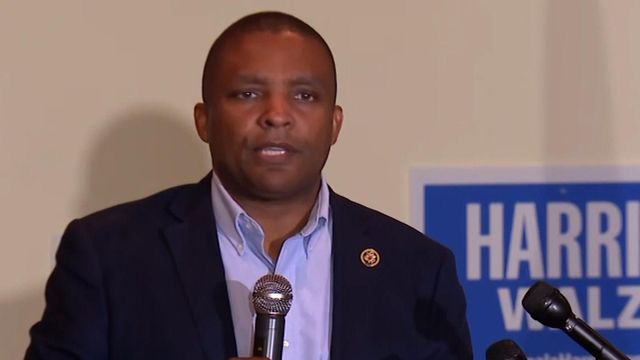
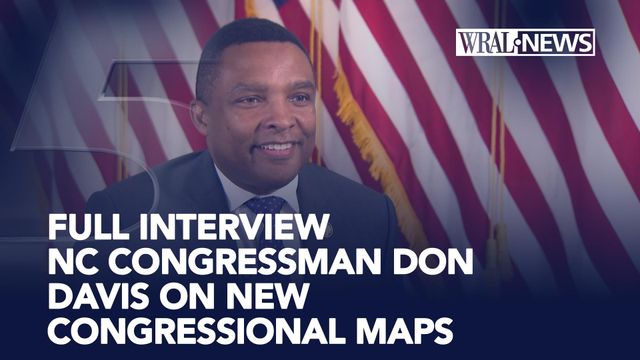
The target is Democratic U.S. Rep. Don Davis, a moderate Democrat who won a competitive seat in 2024 where voters also supported Republican President Donald Trump for president by a slim margin. The new map turns it into a district that would have supported Trump by double digits. But in an interview with WRAL Thursday, Davis indicated he’s still considering running for reelection, though he didn’t indicate which district.
“I will now run on my third new map,” he said. “And what is taking place right now — today I have people that are still coming to me from my old district saying, ‘Can you help?’ It's creating so much confusion, and it's time for us to settle this down. So people can know which congressional district they're in, and they can actually understand who their representative is, and they can allow their representative an opportunity to actually serve them.”
North Carolina has been here before. Since the 1980s, Republicans and Democrats have fought over congressional districts — legal pursuits that have reached the U.S. Supreme Court and have left the state with shifting voting lines and a revolving door of congressmen. Many of the nation’s most important legal rulings on what politicians can or can’t get away with, when redrawing districts, stem from that steady stream of North Carolina cases over the past 40 years. Up until 2011, it was Democrats facing lawsuits from Republicans over unconstitutional gerrymandering. Since then, the tables have turned.
“Every map we've passed results in a lawsuit,” Senate leader Phil Berger, R-Rockingham, told reporters on Monday when asked about the prospect of legal challenges. “So that's not a surprise.”
All of the speeches Republican leaders gave at the legislature this past week — as the plan zoomed through committees to final passage Wednesday — were carefully scripted, perhaps in anticipation that their words will again be quoted in court.
And outside groups have assured them challenges are coming, pointing to possible allegations of racial gerrymandering in a northeastern North Carolina district that has been represented by Black Democrats for decades.
Social justice group Repairers of the Breach plans to announce a lawsuit Nov. 2 at a rally in Wilson, one of the eastern North Carolina cities at the heart of the redraw.
“This redistricting plan will reduce the racial diversity of our legislative body and undermine the substantive — and symbolic — importance of representation,” Bishop William Barber II, the group’s president, said at a rally Thursday outside the state legislature.
Other possible opponents to the map include Democratic voters, liberal policy groups, racial justice advocates and nonpartisan groups that oppose gerrymandering in general.
Spokespeople for Berger and House Speaker Destin Hall didn’t immediately respond to requests for comment on Thursday.
Former U.S. Attorney General Eric Holder, a Democrat who served under President Barack Obama, said Wednesday that North Carolina’s new map “is morally reprehensible and legally indefensible — and it will be challenged in court.” Holder’s group, the National Democratic Redistricting Committee, has helped bankroll previous gerrymandering lawsuits in North Carolina and other Republican-led states.
Where the courts stand
There’s more than one way to challenge a map as being unconstitutionally gerrymandered, and in recent years Republican judges at the state and federal levels have shut the door on some of the avenues, restricting the options available in lawsuits.
A landmark 2019 ruling by the U.S. Supreme Court — one of several nationally important gerrymandering cases to have come out of North Carolina — saw the court’s conservative justices write that partisan gerrymandering was “incompatible with democratic principles” and yet also wasn’t something they believed federal courts should have the ability to rule on at all. Only state courts should have that power, the justices ruled, siding with North Carolina Republican lawmakers who drew the maps.
The North Carolina Supreme Court acted on that ruling, writing in 2022 that a clause in the state constitution declaring that “all elections shall be free” means that extreme partisan gerrymandering is unconstitutional.
But that 2022 anti-gerrymandering ruling came from a Democratic majority on the state’s highest court. Republicans flipped control of the court later that year and in 2023 used a rare procedural move to reverse the precedent from the earlier ruling without needing to hear a new case first.
That quick reversal greenlit politically motivated gerrymandering in North Carolina in time for Republicans to redistrict the state to their advantage ahead of the 2024 elections. They changed what had been an even 7-7 split in the state’s congressional delegation to a 10-4 advantage for their party. The map approved this week will go a step further, creating a likely 11-3 advantage for Republicans.
Allegations of racial gerrymandering
Republicans expect to be sued over allegations that the new map is racially discriminatory. It carves up a historically Black area of the state and seeks to end the area’s decades-long history of being represented in Congress by Black Democrats, in a seat — currently the 1st Congressional District — held by Davis since he first won election in 2022.
Lawsuits are expected to allege that the new map will actively harm residents of eastern North Carolina by not only taking away a competitive seat but also by increasing Republican representation of the area. Davis told WRAL as much Thursday, pointing to the harms he said GOP-backed policies are doing to his heavily rural, agriculturally focused district.
“I speak to so many farmers, and what I'm hearing is they're concerned about tariffs,” Davis said. “They're being pounded right now by tariffs. And what do we see? A $20 billion-plus bailout for Argentina? We have farmers right here in eastern North Carolina who are trying to figure out how they're going to keep their operations on and pass it on to their kids. These are the issues that I'm hearing about.”
Republicans have freely acknowledged that they targeted Davis to try forcing him out of office by adding thousands of new Republican voters to his district. That the map targets a Black member of Congress by removing thousands of Black voters from his district, they say, is coincidence. Berger and House Majority Leader Brenden Jones, R-Columbus, and Sen. Ralph Hise, R-Mitchell, said multiple times this week that racial data wasn’t used in the creation of the map.
Their assertion that the map is purely political, not racial, is geared toward the current posture of state and federal courts in which partisan gerrymandering is allowed but racial gerrymandering is not.
“The redrawing of District 1 was done based on political calculation and a determination that that district could be redrawn for a Republican to have a better chance of winning,” Berger told reporters Monday. “That's the only reason it was done.”
Barber said his group’s coming lawsuit would seek to defeat that argument and prove that the legislature is practicing racial discrimination, regardless of what GOP leaders say. And there’s history here: Barber led the state NAACP when it successfully blocked a series of new voting laws that Berger and other Republicans passed in 2013, which a federal appeals court said intentionally discriminated against Black voters despite Republicans’ claims then — like their claims now — that partisan politics alone motivated them.
Barber says the new map violates state and federal law, alleging that it goes against the spirit of the Voting Rights Act, which Congress passed in 1965 during the Civil Rights movement and has been used since then to protect Black representation in Congress. “These redistricting strategies aim to reinforce the political marginalization of minority communities, further reducing their influence in governance and policy making,” he said.
In this new round of redistricting, Republicans have said they targeted Davis to help Republicans retain control of the U.S. House in the 2026 elections, and they said they owed it to North Carolina voters who elected Trump. Trump won the state with 50.9% of the vote in 2024. If the map is allowed to be used in 2026, it would be expected to grant Republicans nearly 80% of the state’s U.S. House seats.
'Political data, and not racial data'
Democratic opponents say Republicans didn’t need data to know the racial ramifications of their new districts. It’s common knowledge in North Carolina politics which counties are home to more, or fewer, Black voters, Democrats argued.
The northeastern corner of the state state, which Davis represents, is part of a multi-state region known as the Black Belt for those counties’ large concentration of Black voters, dating back to the days of slavery when those counties, still mostly rural areas, were home to large plantations. The region stretches in a crescent from Maryland to Alabama, cutting through eastern North Carolina along the way.
“This map clearly carves out the Black Belt,” said Rep. Pricey Harrison, D-Guilford. “And whether the sponsor used racial data or not, he knows the districts well enough to know that he was splitting up the Black Belt.”
Hise, the bill’s sponsor, told lawmakers that not only did Republicans not use racial data when drawing the map, they didn’t need to.
“To be clear, [Republican leaders] do not believe that the use of racial data would have been helpful in reaching any political or other legislative redistricting goals,” said Hise, who said he drew the map himself. “Any political considerations in line drawing have been informed [by] political data, and not racial data.”
One key argument in the expected lawsuits is whether courts agree, or disagree, that voters in North Carolina are polarized along racial lines.
In 2024 in North Carolina, according to an analysis of voter data by demographers at UNC-Chapel Hill, 73% of all Black voters were registered Democrats, and most of the rest were unaffiliated. Registered Republicans in the state, meanwhile, were 88% white and 2% Black.
North Carolina’s redistricting is part of a broader national strategy, urged by Trump, to help Republicans maintain a narrow majority in the U.S. House and to defend against possible redistricting by Democratic-led states.
On Thursday, Virginia Democrats said they would seek to redraw the state’s congressional districts. Gavin Newsom, California's Democratic governor, has said he wants to redraw his state’s map to gerrymander some Republicans out of power to counter maps drawn in Texas, Utah and Missouri to push Democrats out of power.
"We commend our legislative leaders on their effort to jump into the fray to stop Gavin Newsom and California Democrats from stealing control of Congress from President Trump and Republicans," said Matt Mercer, a spokesman for the North Carolina Republican Party.
Davis, meanwhile, said the redistricting effort illustrates a need for redistricting reform — something Democrats in the state legislature currently support after years of writing the very redistricting laws that now benefit Republicans. Democrats controlled the state legislature for more than a century before Republicans took control in 2011.
“We need a national ban on mid-decade redistricting,” Davis said. “It doesn't matter Texas, California, Missouri, Kansas. We just need to pull together and support an end to this. This is not good for anybody.”
WRAL News reporters Shaun Gallagher and Heidi Kirk contributed to this report.




Copyright 2026 by Capitol Broadcasting Company. All rights reserved. This material may not be published, broadcast, rewritten or redistributed.