Slow rollout of NC House budget reveals cuts, partisan priorities
State lawmakers in the North Carolina House plan to spend the next several days unveiling and debating pieces of their new budget proposal, which will ultimately show how they plan to spend more than $30 billion on running state government.
The state Senate has already approved its budget plan, but the two chambers disagree on many issues. So once the House plan is also approved, GOP leaders from both chambers can come together to negotiate a final deal.
Other WRAL Top Stories
Republicans have large enough majorities in the legislature that Democratic lawmakers, as well as Gov. Josh Stein, will be largely shut out of the process — and likely unable to bring home much funding for the counties they represent.
The budget work in the House began Thursday with Republican leaders rolling out pieces of the budget, largely related to funding for specific programs and agencies. Details on tax cuts, as well as raises for teachers and other state employees, weren't made public yet.
The sections budget writers unveiled Thursday point to sweeping cuts in many areas of state government.
The partial budget plans rolled out in subcommittees Thursday showed that the House plans to recommend cutting hundreds of jobs in state government, which the Senate's budget plan also recommended. The focus will largely be on jobs that are vacant at the moment, so there would be few to no layoffs, but it also means those roles won't be able to be filled in the future.
The budget also calls for cutting tens of millons of dollars from the UNC System, as well as requiring new college tuition hikes. It suggests eliminating programs unpopular with conservatives, and it slashes K-12 spending in some areas while boosting it in other areas — including for programs aimed at boosting students' reading abilities.
Like the Senate budget, the House proposal would cut the Office of Historically Underutilized Businesses and a mentoring program for minority male students at community colleges. It would also eliminate the state's environmental justice program under the Department of Environmental Quality, as well as the state Commerce Department's office of Community and Culture Engagement.
All those programs slated for elimination are aimed at helping Black and other minority communities — efforts that have been targeted by Republican politicians nationwide.

Senate Leader Phil Berger has previously said the programs are being cut to align the state with Republican President Donald Trump’s new executive order banning diversity, equity and inclusion programs.
On Thursday Rep. Rodney Pierce, D-Halifax, tried unsuccessfully in the House General Government subcommittee Thursday to reinstate funding for the business office.
DMV boost
Delays, lines and technical glitches at the state's Department of Motor Vehicles have been a growing problem, with politicians on both sides of the aisle working to find fixes.
The budget proposes opening new DMV offices in three fast-growing suburbs of Raleigh, Charlotte and Wilmington. Those new locations are planned for Fuquay-Varina, Cabarrus County and Brunwick County at a cost of more than $10 million spread over the next two years.
The budget also proposes spending more than $3 million more per year to hire dozens of new driving examiners, and to ramp up production of license plates.
K-12 budget
Wake County Public Schools would be given $500,000 to come up with a plan for strategically tackling the district's widespread HVAC problems, which WCPSS leaders say have a pricetag exceeding $200 million.
The district could find some savings from another part of the budget that would allow 10 fast-growing school districts, including WCPSS, to be exempt from normal class-size requirements. Doing so would save those districts money by reducing pressure to hire more teachers and build more new schools. "It's a great provision," said Rep. Erin Pare, R-Wake, a top House budget writer.
In kindergarten through third grade, public schools are required to have no more than 16 to 18 students in a class. The proposed new rules would allow fast-growing school districts to put as many as 24 to 26 students in those early elementary school classes.
As for statewide efforts, the budget spends millions of dollars bolstering efforts to get students up to grade level on their reading skills, including new training for teachers, dyslexia screenings for young children and more. It would also spend an additional $10 million on students with disabilities and $5 million on programs aimed at getting fathers more involved in their children's lives and education.
Some of the new spending would be paid for by cuts, incluing elimination of administrative jobs, the elimination of the state's Textbook Commission, eliminating some specialty high schools and cutting in half a fund aimed at giving small, rural school districts extra money to raise teacher pay beyond what they could normally afford.
Social media, phones in schools
The House budget also contains several education policies unrelated to money, including a ban on cell phones being used during instructional time unless approved for educational or medical reasons.
The budget would also require schools to offer formal instruction throughout elementary, middle and high school on "social media and mental health" with topics including social media addiction, bullying, misinformation, avoiding sexual predators and more.

Schools would also be required to put new information on student ID cards, including contact information for the Suicide and Crisis Lifeline, which can be reached by calling 988 or texting HOME to 741741.
The budget would also make it easier for schools to hire psychologists. And the state's largest school district, WCPSS, would receive $4 million spread over two years to bolster its mental health offerings for students.
Elections board
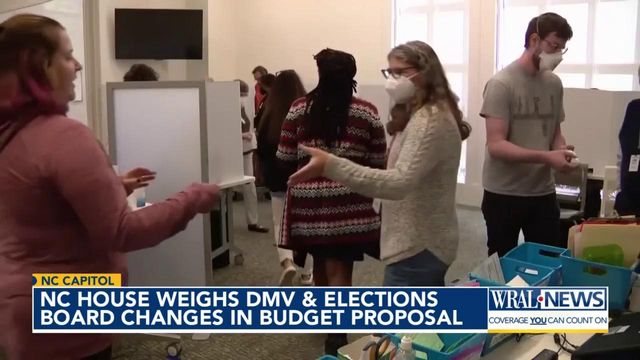
Just two weeks after oversight of state elections administration moved from Democratic Gov. Josh Stein to Republican Auditor Dave Boliek, House budget-writers are proposing to add seven new positions for political appointees. They'd be picked by new state elections director Sam Hayes, who was most recently the top lawyer for House Speaker Destin Hall.
Rep. Phil Rubin, D-Wake, raised concerns about politicizing the work of carrying out elections, saying the agency has never been given partisan appointees in the past.

The state elections agency has 65 positions, mostly career employees with expertise in elections and who are mostly protected by the State Human Resources Act, shielding them from politically motivated hiring or firing decisions. The new political appointees would be working alongside those career workers.
The budget would also move the state elections office to the Albemarle Building, where the auditor's office is located, and set aside more $1 million for legal fees for attorneys outside the office of Democratic state attorney general Jeff Jackson.
State elections board spokesman Pat Gannon said the new director, Sam Hayes, had requested the location change in the name of “efficiency and synergy.” He said Hayes had also requested the political appointees, noting that other agency heads are given similar “flexibility.”
Higher ed budget
The UNC System would lose the ability to hire dozens of employees in the future, with requirements to cut at least $7 million worth of currently vacant jobs. They'd also lose another $3.5 million for grad student tuition waivers. Those savings wouldn't go back into the university system, however, instead reverting to the general state budget to either be spent elsewhere or to help pay for tax cuts.
On top of that, the UNC System would be required to find an additional $60 million in annual savings — potentially through additional layoffs — plus $8 million more in savings from cutting one-time expenses like construction or equipment spending.
Universities would also be required to come up with an additional $30 million in revenue by raising tuition, if the budget plan is approved as rolled out Thursday. Tuition has remained flat for in-state students for nearly a decade, although some universities have raised prices substantially for out-of-state students.
The budget doesn't give the UNC System many rules for how to accomplish the nearly $100 million worth of combined tuition increases and budget cuts. The lawmakers leading Thursday's discussion said was at the request of system leaders, to be allowed to make those decisions themselves.
"Told us they knew cuts were coming, but they wanted flexibility," Rep. Brian Biggs, R-Randolph, said. "So we're giving as much flexibility as possible."





Copyright 2026 by Capitol Broadcasting Company. All rights reserved. This material may not be published, broadcast, rewritten or redistributed.