K-3 classes could get larger in Wake County under House budget proposal
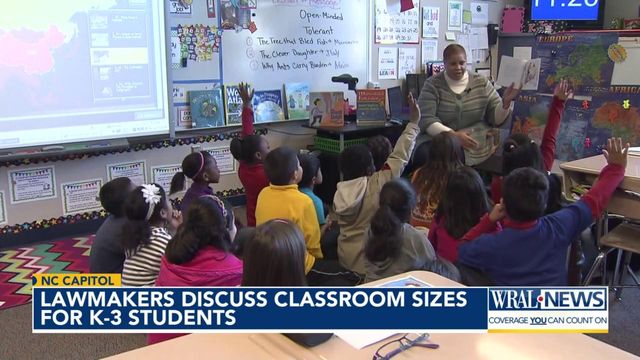
A provision in the North Carolina House education budget released Thursday would relax class size caps for kindergarten through third grade in rapidly growing districts, giving additional flexibility to high-performing schools in those districts.
The change would apply to the Wake County Public School System, which lobbied for the provision as part of the school board's legislative agenda.
Other WRAL Top Stories
Under current law, average class sizes for kindergarten are capped at 18 students. First-grade classrooms are capped at 16 students, and second- and third-grade classes are limited to 17 students.
However, under the proposal, school districts with student enrollment of 0.5% for two consecutive years would be considered a "growing" district for the next two years, allowing them to exceed the caps by three students per classroom. The proposal would remove the "average" qualification, making the caps hard.
Schools in "growing" districts with a school performance grade of B or higher would be allowed to add another 5 students per K-3 classroom, for a total of 8 more students per class, bringing the potential maximum class sizes to 26 for kindergarten, 24 for first grade, and 25 for second and third grades in those schools.
Wake County Board of Education Chairman Chris Heagarty told WRAL News class size flexibility would be immensely helpful for elementary schools in fast-growing areas like Holly Springs and Apex, where the mid-year arrival of a K-3 student can sometimes require reshuffling classrooms.
"It seems counterintuitive, right? Because everyone should like smaller class sizes, but smaller class sizes come with a very high cost," Heagarty said.
Heagarty said the proposal could save the district millions of dollars by reducing school reassignments, transportation costs, and new school construction, freeing up more money to renovate crumbling schools and provide additional school support staff.
"The money that we're spending on building new schools comes out of the same pot as the money that we'd use to renovate our schools. And what's been one of the biggest educational news items the last two years? Failing HVAC systems, not enough money for transportation," Heagarty said.
Asked whether student performance would suffer as a result, Heagarty said some of the highest-performing schools in the district are also the most crowded. He said research on the benefits of smaller class sizes is mixed, especially for K-3 students who are not disadvantaged or underprepared.
"Say you've gone from a classroom of 18 students to 20 or 22 students, but you've cut your bus ride in half every day," Heagarty said. "You're going to a school that's closer, in your neighborhood, so it's easier for your family to come and participate in classes, to volunteer, for you to participate in after-school activities."
If K-3 class size caps were lifted altogether, Heagarty said, the district could save the equivalent of building nine new schools.
According to a WRAL analysis, the class-size flexibility proposal would also apply to several smaller school districts, including Brunswick, Cabarrus, Catawba, Columbus, Perquimans, Pitt and Yancey counties, and the city school district in Mount Airy.
A day after this story aired, Rep. Erin Paré contacted WRAL to say that she had authored the provision, and that her intention was allow a maximum of 5 additional students per classroom, rather than 8. Paré, R-Wake, said she would run an amendment to clarify the language in the coming days.





Copyright 2026 by Capitol Broadcasting Company. All rights reserved. This material may not be published, broadcast, rewritten or redistributed.