State employees, teachers would see pay bumps under NC House's proposed budget
North Carolina teachers and state employees would receive pay increases under the two-year budget plan released Monday by the state House of Representatives — raises that will be paid for in part by eliminating thousands of vacant jobs across state government.
The House proposal has similarities to the Senate's plan, which proposed slashing several hundred jobs, and giving small raises to state workers. The House plan is more aggressive on both fronts, proposing higher raises as well as a larger number of positions to eliminate.
Other WRAL Top Stories
The release is the latest step in a long process to approve government funding for the fast-growing state. After the House approves its proposed budget, perhaps as soon as this week, its leaders will begin negotiating a final spending plan with the Senate, a process that could take months.
One potential hiccup is how to handle any further relief aid for Hurricane Helene. The state has already spent $1.6 billion. This week, Democratic Gov. Josh Stein called for an extra $900 million. The state Senate has proposed $700 million in extra Helene aid as part of its budget.
The House budget has nothing for Helene, although House leaders are planning to file a separate bill to focus solely on Helene funding — an attempt to keep that money free from the political fights that can bog down budget negotiations.

Another possible fight is brewing over plans to build the state’s first children’s hospital, a multi-billion-dollar collaboration between UNC and Duke University. The plan was first announced in 2023, when lawmakers voted to give it $319.7 million. This year’s dueling budget plans show broad disagreement: The Senate wants to more than double its funding, bringing it to $855.2 million. The House would prefer taking back some of the already-approved money, lowering the hospital’s level of state funding to $216.2 million.
The two chambers agree on other construction projects. Both would give an extra $180 million to N.C. State University for work on Poe Hall. More than 200 people have contacted WRAL’s 5 On Your Side saying they or their relatives contracted cancer after working or studying in Poe Hall, the home of the university’s education and psychology departments that was shut down in 2023.
The House budget also proposes opening new DMV offices in several fast-growing suburbs, including Fuquay-Varina in Wake County, to help alleviate problems with long wait times and hard-to-find appointments. And it would spend more than $3 million more per year to hire dozens of new driving examiners, and to ramp up production of license plates.
The DMV is one of few state agencies slated to get more employees under the budget plan. Many would see their current workforce levels stay stagnant, and would also be required to slash dozens or even hundreds of currently vacant positions.
Tax cuts, job cuts
The House budget continues Republicans’ plans to lower taxes, although it’s not as aggressive as the state Senate’s plan. The House would lower the personal income tax another 0.25%, raise the standard deduction, bring back an annual back-to-school-shopping sales tax holiday in 2026, and exempt people from having to pay taxes on the first $5,000 they earn in tips.
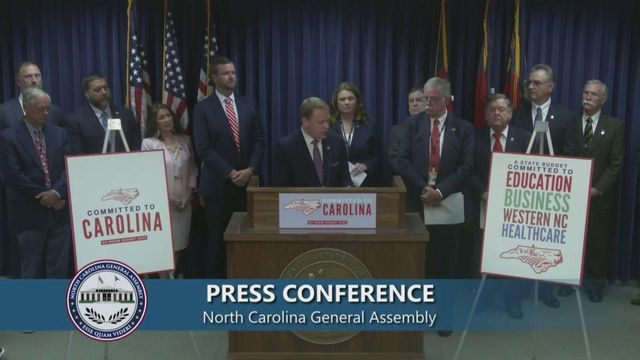
"What this budget is about on the House side is we continue to give that tax relief, while also making sure we're investing in this state's most important asset, which we believe are its people," House Speaker Destin Hall said during a news conference Tuesday.
The standard deduction would increase by $500 for single tax filers or $1,000 for married couples filing jointly. At the proposed new income tax rate of 3.99%, that would save single people just under $20 a year, or married couples just under $40 a year. It will cost the state $126.3 million annually, the budget estimates.
Similarly, the plan to end taxes on tips is expected to cost the state $41.8 million in lost revenue in 2026, when it would go into effect if approved, and the plan to reintroduce the sales tax holiday would cost $30.1 million.
The House plan would be more beneficial to low-income and middle-class families, while the Senate plan — with larger income tax cuts but none of the changes to sales taxes, tips or the standard deduction — would be more beneficial to wealthier families.

To help pay for those tax cuts, both the House and Senate are proposing cutting tens of millions of dollars from higher education funding in the state, as well as requiring universities to raise tuition to lower the amount of state funding they'll need in the future.
Both chambers' budgets also look to other sources of savings, such as eliminating programs aimed at helping minorities that Republicans say are examples of diversity, equity and inclusion and need to be cut to fall in line with a broader push against DEI programs, led by Republican President Donald Trump in the federal government.
Other savings would come from eliminating vacant jobs in state government, freeing up money that has been set aside for those roles to be spent on other purposes. The Senate budget proposes hundreds of job cuts; the House budget proposes at least 3,000.
State government has struggled for years to recruit or retain workers, due in part to competition with the private sector, where pay tends to be higher in many sectors. The state reported more than 14,000 vacant jobs last month.
By eliminating 3,000 of those vacant jobs, and preventing them from being filled in the future, the House budget plan would free up money for salary adjustments for the remaining jobs in each agency.

Under the House budget plan, most state workers would get at least a 2.5% raise over the next two years — and many if not all would be in line for even higher raises, depending on how much money their department freed up by eliminating open positions.
That baseline of a 2.5% minimum raise is double the Senate's proposed 1.25% raise for most state workers, although the Senate would give substantially higher raises to prison workers and state law enforcement officers like the Highway Patrol.
Ardis Watkins, who leads the State Employees Association of North Carolina, said neither the House plan nor the Senate plan do nearly enough for state workers. And for that matter, she added, neither did Stein’s budget proposal, which the governor announced earlier this spring.
“We now have three budget proposals on the table, and none of them take the vacancy crisis plaguing state government seriously,” she said. “State employees and taxpayers are in danger because no one is willing to make the investments necessary to provide essential public services.”
Teacher raises
The proposed House budget would make drastic changes to starting teacher pay and alter the structure of the teacher pay scale in a way that would allow more experienced teachers to receive bigger pay raises. Right now, teachers with more than 15 years of experience don't receive annual raises, unless a state budget increases the pay scale.
Teachers would get an average 8.7% raise over the next two years, with early-career teachers receiving large salary boosts and mid-to-late-career teachers receiving much smaller raises.
Beginning teacher pay would rise from $41,000 to $48,000 next year and $50,000 in the 2026-27 school year, under the House plan — more than a 20% increase by the end of the two-year budget plan. Hall’s office said that amount, combined with local supplements, would make North Carolina the top state in the Southeast for starting teacher pay.
It’s currently among the lowest in the country.
The House’s proposal, if adopted, would propel the state well above the national average in starting teacher pay, which was $46,526 during the 2023-24 school year, according to the latest rankings from the National Education Association, the nation's largest teachers' union. North Carolina ranked 39th, paying an average $42,542, once other state and local supplements factored in.
But the changes wouldn't do much to match the national average teacher pay of $72,030. North Carolina ranked 43rd in average teacher pay, at $58,292.
Teachers with 10 years of experience would receive a raise from roughly $49,000 currently to just under $53,000 by 2026-27. And teachers with 25 or more years of experience would see minor increases, from $55,950 currently to $57,110 next year and then $57,820 after that.
The House proposal would also restore bonus pay for teachers who have earned a master’s degree in their teaching field, something teachers have long advocated for.
Lawmakers phased out master’s pay in 2013 for new degree earners out of concern that master's degrees weren't improving student test scores. Some research has suggested that master's degrees can help when they are in the subject area the teacher teaches.
Retired state workers also wouldn’t be left out in the budget; they’d receive a 1% cost-of-living bonus to their pensions this year and a 2% bonus next year. The combined 3% bonus for retirees, spread over two years, is unlikely to keep up with inflation. But it’s more than the combined 2% bonus the state Senate proposed in its budget.
Negotiations ahead
The version of the House budget released Monday could change this week as it's debated in committee at the legislature, a process that will allow the public to weigh in and lawmakers to propose amendments. However, even once the budget passes the House the process won't be over.
The House and Senate must negotiate a final deal, a process that in years past has seen budget negotiations stretch months beyond the start of the new fiscal year on July 1.
Even though both chambers are run by Republicans, they disagree on many budget issues both big and small.
Democratic Gov. Josh Stein has proposed his own budget plans, which would contain substantially higher raises for teachers — as well as more spending on other items, such as Helene relief aid — than either the House or the Senate have proposed.
Unlike the federal government, North Carolina isn't allowed to engage in deficit spending. The state budget must be balanced. Stein, therefore, would pay for his higher spending by freezing tax rates at their current levels and slashing the amount of state funds given to private schools for tuition vouchers. That led GOP leaders to dismiss Stein's budget plan as soon as he proposed it.
Stein and fellow Democrats aren't completely powerless in state budget negotiations, however. Democrats flipped enough GOP-held seats in the 2024 elections to break that chamber's veto-proof supermajority, meaning that in order to override any potential vetoes from Stein, Republicans will need at least a small amount of bipartisan support.
WRAL Education Reporter Emily Walkenhorst contributed to this report.



Copyright 2026 by Capitol Broadcasting Company. All rights reserved. This material may not be published, broadcast, rewritten or redistributed.