NC Senate passes budget plan with tax cuts, employee raises, Helene aid and DOGE-style review
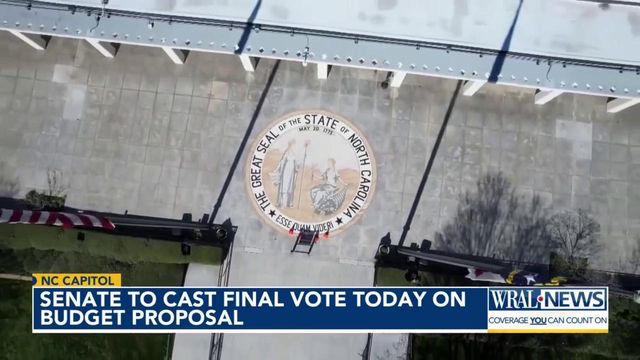
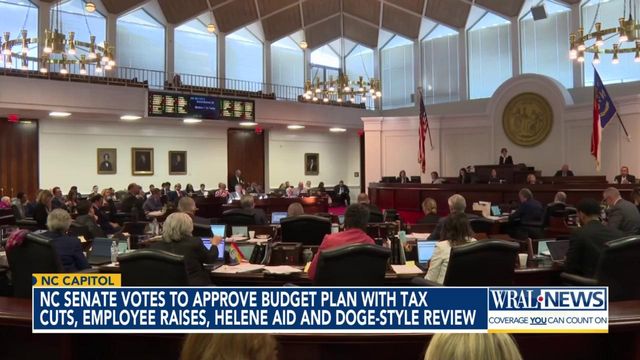
The North Carolina Senate passed the chamber's $32.6 billion budget proposal Thursday — the first step in what could turn into several months of negotiations over the final state spending plan.
Thursday's vote was largely a formality, following hours of debate Wednesday and an initial vote then. Now that the budget plan has passed the Senate, it heads to the state House of Representatives where it is likely to undergo major revisions, potentially leading to months of closed-door negotiations among legislative leaders over what the final budget should look like.
Other WRAL Top Stories
Although both chambers are controlled by Republicans, they don't always see eye-to-eye on big policy debates or spending proposals, both of which will be in the budget.
Hurricane Helene relief aid is one area both chambers agree on, but the exact details could be up for debate. The Senate has proposed spending an additional $700 million on Helene aid, on top of the $1.5 billion lawmakers approved already. And it would put another $1.1 billion into savings, for future natural disasters or other emergencies.
The relief funding comes as the federal government under Republican President Donald Trump has declined to extend a source of larger-than-normal Helene funding that had been approved by former Democratic President Joe Biden. State leaders have asked Trump to reconsider.
"We remain hopeful that the federal government will provide increased, and expected, reimbursements," Sen. Bill Rabon, R-Brunswick, said Wednesday. "But we must prepare."
Sen. Julie Mayfield, D-Buncombe, said the budget doesn't do nearly enough for her Asheville-area district or any of the rest of western North Carolina to help with Helene recovery, or with the forest fires that have since ravaged the area, fueled by the dead tees knocked down by Helene. She expressed hope that when the state House proposes its own budget plan, it will have millions more for western North Carolina.
Education is the largest chunk of state spending, and it makes up nearly 60% of the Senate's budget plan. Health care also receives subtantial attention in the plan, including policy changes — repealing the state's certificate-of-need laws — as well as spending plans, such as increased state support for mental health hospitals, child care subsidies and Medicaid, which provides health care to about 3 million North Carolinians.
Sen. Brent Jackson, R-Sampson, is a top Senate budget writer. He said that since Republicans took control of the legislature in 2011 they've worked to cut taxes while still supporting the functions of state government, and that this plan continues those trends.
"This budget continues the success North Carolina has seen in the last decade-and-a-half," Jackson said.
Democrats strongly disagreed, calling the tax cuts bad public policy that they said will reduce the state's ability to fund needed programs while doing little to benefit anyone but the most wealthy. "This is a cheapskate budget," Sen. Graig Meyer, D-Orange said. "... We could be doing so much more for North Carolina. Simply leaving the current tax structure in place would give us an extra $2.3 billion."
Meyer said the proposed tax cuts will save an average of $5 a year for the bottom 20% of North Carolinians, and it will save nearly $4,000 a year for the top 1% of earners. It's a budget plan, he said, that's premised on "giving away revenue to the wealthy without taking care of everyday North Carolinians and the needs that people have from their state government."
Democratic senators proposed dozens of amendments to the budget Wednesday. Republicans rejected all of them except one, which would fund more prosecutors in Wake and Guilford counties.
State workforce changes
Under the Senate proposal, most state employees would receive a 1.25% raise next year, as well as $3,000 in bonuses spread over the next two years.
Some people in certain jobs — particularly prison staff and state law enforcement — would receive larger raises. Over the next two years, the budget plan would fund the following average raises:
- 3.3% for teachers.
- 8.9% for correctional officers.
- 9.2% for the Highway Patrol.
- 14.4% for Alcohol Law Enforcement and State Bureau of Investigation officers.
The budget plan would also enact a review of state government modeled on the DOGE efforts led by billionaire Elon Musk under Republican President Donald Trump's administration. But state leaders have said their idea would be more careful and limited, with any cuts to be voted on by the legislature instead of unilaterally implemented by one person. The state-level review would be led by Republican State Auditor Dave Boliek.
In addition to other factors, that DOGE-style review in the budget would cut hundreds of jobs in state government. Some would be vacant positions to be eliminated; others would be currently filled jobs.
Boliek would be given millions of dollars to hire new staff and make other purchases to carry out the review to recommend cuts; supporters say it would be money well spent. "This initial investment will quickly pay for itself as the division identifies waste within our state agencies," Sen. Ted Alexander, R-Cleveland, said.
Sen. Lisa Grafstein, D-Wake, proposed taking several million dollars that would be spent on Boliek's DOGE-style program, and instead giving the money to the Department of Motor Vehicles.
"This would allow them to hire between 40 and 50 new examiners," Grafstein said of the DMV. "If we want to take care of people's time and not keep people wasting time in lines of the DMV, and make it easier for them to get through, we need to address the shortage."
She said the number of motor vehicle examiners isn't staffed to accommodate the state's needs. "In a growing state, that simply not acceptable," she said.
Republicans shot down Grafstein's proposal with no debate or explanation.
Education cuts
The budget also mandates other cuts, including tens of millions to be cut from K-12 public school progams and administration, plus at least $90 million to be slashed from community college and public university budgets.
Senate Republicans said they're targeting administrators and what they see as a bloated bureaucracy, not targeting teaching jobs. The budget plan would also seek to achieve what it calls "faculty realignment" at public universities by funding severance packages that would be offered to many tenured professors to quit.
Some of the other cuts recommended by the budget include mentoring efforts for minority students in community colleges, grants for minority-owned small businesses and other similar state initiatives.
"My colleagues in the Senate do not value the Black and minority community in North Carolina," said Sen. Kandie Smith, D-Pitt, noting that the budget also funds some nonprofit groups but few that serve Black communities. "This budget strips us of resources and fails to provide much-needed funding for organizations that support the Black community. ... That is not an oversight. That is an active choice." One in every four North Carolinians is Black.
Smith proposed amending the budget to provide additional funding for various groups and grants. She also proposed changes to state tax policy that would give fewer savings to wealthy people, but more tax credits for low- and middle-income families. Republicans shot her proposals down with no debate or explanation.
Negotiations can now begin
Some House Republicans have already indicated they're not fond of parts of the Senate budget, particularly the aggressive future cuts to the state income tax rate.
Since taking control of the legislature in 2011, GOP leaders have overhauled the state's income taxes and slashed tax rates substantially. But in recent years, the House has often preferred keeping tax rates more or less stable and instead prioritizing raises for state workers or other new spending on roads, prisons and other parts of state government. The Senate, by contrast, has favored a greater focus on cutting taxes further.
This year's budget debate is likely to feature similar dynamics and disagreements.
A recent state budget forecast showed that North Carolina is headed toward a budget deficit as soon as 2026 if tax cuts planned over the next two years are allowed to go into effect. The Senate budget would enact those tax cuts regardless and would also move even more aggressively on additional tax cuts; Senate leader Phil Berger said he doesn't believe the budget forecast. But House Republicans have expressed more concern over the projected deficit.
Regardless, the Senate budget plan will serve as the starting point for negotiations between House and Senate Republicans over details of the budget including tax cuts, state employee raises and more.


Copyright 2026 by Capitol Broadcasting Company. All rights reserved. This material may not be published, broadcast, rewritten or redistributed.