Allison Riggs sworn in to NC Supreme Court after six-month legal battle
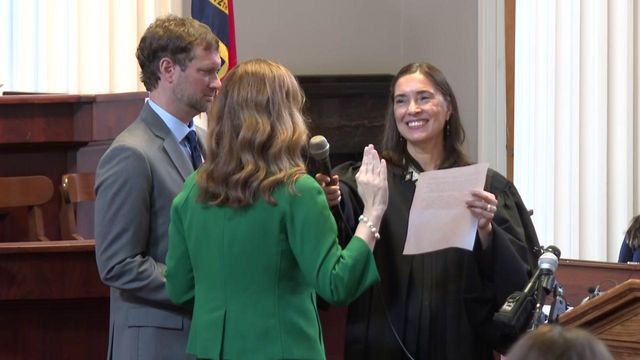
Allison Riggs was sworn in Tuesday for an eight-year term on the North Carolina Supreme Court — a ceremonial end to the six-month legal battle that was extinguished last week when her 2024 opponent lost his efforts to overturn the results of the election.
Riggs originally joined the court last year, appointed by Democratic Gov. Roy Cooper to replace former Justice Mike Morgan, who unsuccessfully ran for governor to replace Cooper. She then went on to win the 2024 election by just 734 votes out of more than 5 million ballots cast, in a race that attracted national attention for the efforts by her Republican opponent Jefferson Griffin to have thousands of voters’ ballots thrown out.
Other WRAL Top Stories
"Thank you for your trust and unwavering support," Riggs said to supporters gathered at the state Capitol building Tuesday, telling them: "You chose a path forward where power stays in the hands of the people, not politicians. You demanded accountability and used your voices to speak out for our constitutional rights."
She’ll now rejoin a court where most of the other justices, just a month ago, were open to kicking her off the bench by issuing a ruling that has since been overturned as violating the U.S. Constitution and the rights of those thousands of challenged voters.
“This is a victory for North Carolina voters and the rule of law,” Riggs wrote on social media last week after a federal judge ordered her 2024 victory to be made official. “But we must keep fighting to elect judges who will put the Constitution over party and personal ambition.”
There won’t be long to wait for the next fight over the direction of the state's judiciary. Another seat on the state Supreme Court is up for election next year: The seat held by the only other Democrat on the court, Justice Anita Earls, who swore in Riggs on Tuesday.
Earls mentored Riggs before either of them was a judge; Riggs worked at and later led the civil rights group Earls founded in Durham, the Southern Coalition for Social Justice. On Tuesday Earls spoke of her pride in watching her protege develop not just the brains for a high-powered legal career, but also "the courage and heart that it took to do that hard work."
On Tuesday Riggs heavily criticized Griffin for not just wasting time and taxpayer funds to fight the results, but also for doing "immeasurable damage" to democracy itself with his efforts. She said Griffin isn't the first losing candidate to try to wrongfully overturn election results, and likely won't be the last, but that she will use her position on the state's highest court to do what she can to protect voters' rights.
"Disappointed politicians should not use the courts to try to get a different election outcome," Riggs said. "We have before, and may continue, to see efforts to undermine our rights and our democracy."
Griffin didn't immediately respond to a request for comment Tuesday. Previously the North Carolina Republican Party, which backed his lawsuit, has praised Griffin's legal challenge for exposing what it says were flaws in how previous elections were run.
Griffin will remain on the state Court of Appeals despite his loss in the Supreme Court race. Appellate judges in North Carolina serve eight-year terms, and he doesn’t face reelection until 2028. When he conceded defeat to Riggs last week, he wrote that "I look forward to continuing to serve the people of North Carolina."
Riggs had recused herself from taking part in the case about her election when it came before the state Supreme Court and her Republican opponent, Court of Appeals Judge Jefferson Griffin, won a 4-2 ruling from Riggs’ colleagues.
Griffin had challenged only some voters who he claimed broke the rules, all of them from Democratic counties, and had predicted that a ruling in his favor would make him the winner of the election. Earls and one of the Supreme Court’s five Republicans dissented, siding with Riggs and state elections officials who also opposed Griffin’s efforts. The court’s other four Republicans sided with Griffin. Earls called their ruling an attempt at “a bloodless coup.”
In the end that argument prevailed when federal Judge Richard Myers, an appointee of Republican President Donald Trump, ordered Riggs to be certified as the winner. The state elections board is expected to issue the certification on Tuesday.
Griffin didn’t allege voter fraud but instead said the voters in question shouldn’t have been allowed to vote, based on new interpretations of state law. The state Supreme Court’s ruling in Griffin’s favor, Myers wrote last week when he blocked it from being enforced against Riggs, would’ve violated those voters’ constitutional rights by punishing them for not following election rules that didn’t exist when they went to vote.




Copyright 2026 by Capitol Broadcasting Company. All rights reserved. This material may not be published, broadcast, rewritten or redistributed.