FEMA 'our biggest obstacle' as Helene recovery drags on, NC disaster leaders tell lawmakers
North Carolina has requested federal funds that would cover almost half of the estimated damage caused in the state by Hurricane Helene. But less than 10% of that money has been awarded or received — despite months of public pressure on federal officials to release the money, local and state officials said during a legislative hearing Wednesday.
The hearing was held exactly one year after Helene first made landfall in the U.S. on its way toward becoming the most deadly and destructive storm in North Carolina history. And a year later, frustrations are rising with the federal government's response, which began under Democratic President Joe Biden and has continued under Republican President Donald Trump.
Other WRAL Top Stories
"The feds have been, obviously, slower than anyone anticipated," said Sen. Ralph Hise, R-Mitchell, who represents nine counties hit hard by Helene. "... We are on every member of Congress — we have all hands on deck on a regular basis — talking to these agencies, to try to get them to move some money."
The roughly 9% of Helene damage costs covered by the federal government so far for North Carolina pales in comparison to other large storms including Hurricanes Katrina, Maria and Sandy, when the federal government paid for more than 70% of those costs.
The briefing before the Joint Legislative Commission on Governmental Operations also included a breakdown of a new, $13.5 billion congressional funding request made this month by Democratic Gov. Josh Stein, as he seeks to ramp up the state's federal aid.

Ahead of lawmakers diving into those financial details, lawmakers heard from local leaders from Western North Carolina in government and charitable work. Like the state officials, the local officials said their biggest problem right now is the federal government and specifically the lack of funds from the Federal Emergency Management Agency.
WRAL previously reported the Trump administration has instituted new layers of bureaucracy in an apparent effort to cut government spending, blocking any FEMA funds from being sent out unless the money is signed off on by Trump's DOGE team and also receives personal approval from Homeland Security director Kristi Noem.
Jonathan Krebs, Stein's top western North Carolina recovery advisor, told lawmakers Wednesday that many other states are dealing with similar frustrations with the recent slowdowns at FEMA. But trying to apply pressure to get those problems addressed is a politically tricky question, he said, due to concerns about retribution.
"My fear is that the result may be that they just say, 'We're just going to stop funding stuff then,' so that's really what we have to be aware of, trying to work through this as tactfully as we can," Krebs said. "Because their support is critical to what we need as a state. But it comes with a lot of complexity."
Hise said he has to imagine that Noem's policy, of needing to personally approve anything that costs more than $100,000 in her massive agency, wasn't fully thought out. "I don't even think they recognize the scope of it when they go in," Hise said. "Requirements to sign everything over $100,000, when it's multibillion dollars? You can do some math on that one for a second. You're probably looking at seven years to sign them."

It wasn't only state political leaders airing their frustrations Wednesday in Raleigh.
"Our biggest obstacle is a lack of clarity and consistent guidance from FEMA," Avery County Commissioner Dennis Aldridge told lawmakers Wednesday. "Every time we get close to the finish line, they change the outcomes. We have been round and round. We have tried to get clarity on how to proceed. We're willing to connect the dots. Just don't keep moving the dots. And every time that we get close, something changes.”
Yancey County Manager Lynn Austin said they've spent nearly the sum of their annual budget simply on removing debris left behind by Helene. Normally, FEMA would reimburse the county for 90% to 100% of those costs. But Austin said that this time, the money simply hasn't arrived. And they're starting to worry about what that means for the financial health of the county. "Just remember that, when we get our audits turned in, it's not going to look good," she told lawmakers.
Hise told her he understands the concerns and expressed hope that the money would be coming soon, "whenever FEMA gets off their derrieres."
On Thursday, after this article was initially published, FEMA Assistant Secretary Tricia McLaughlin said payments by the agency are in line with a Trump executive order that requires payments tied to contracts, grants and loans to be recorded in a centralized system with written justification before funds are released. Since Feb. 1, she said, North Carolina requests under that process have been paid in an average of 12.7 days.
“As of today, there are no items pending in FEMA’s payment queue and more than $944 million is currently available for North Carolina to draw down immediately” through a government payment system, McLaughlin said. “This process reflects the broader goal of the executive order: to ensure efficient, accountable, and transparent use of federal funds nationwide.”
Greater future reliance on charities?
While the frustrations with FEMA were widespread at Wednesday's hearing, one bright spot for many lawmakers was the work of Samaritan's Purse, an international charity based in western North Carolina and led by Christian evangelist Franklin Graham.
Luther Harrison, who leads the North American disaster response efforts for Samaritan's Purse, told lawmakers that in addition to the group's work in the aftermath of the storm helping people out, they're now doing kinds of work the government can't — such as helping people who lost their homes keep their mortgages paid, so they don't lose their property while waiting for the government to rebuild their house.
"We've never done this before," Harrison said. "We've satisfied 50 families' mortgages because they're trying to keep the mortgage afloat while they're trying to pay for rent on places they have to live in."
After state officials ticked off a lengthy list of federal rules and regulations they have to follow when trying to rebuild homes with federal dollars, and explained how federally required environmental review can take months prior to any constructin begins, one state lawmaker asked if it might make more sense to just hand out taxpayer money to Samaritan's Purse or other charities to rebuild homes themselves, since they don't have to follow as many rules and can work faster.
Rep. Brenden Jones, R-Columbus, said he still has constituents who still haven't had their homes repaired from damage in Hurricane Florence in 2016 and wonders if they could've been back in their homes already if charities had been in charge instead of the government.
"I've still got folks, 10 years later, in hotels — still not repaired," Jones said. "Maybe that's the route we should take, and this body should take it and say, 'Okay Samaritan's, here's yours. Baptists, here's yours. Amish, here's yours. Because it sounds like to me, they've got a kind of a working system that can move a whole lot faster."
Some of Stein's top Helene recovery aides told Jones Wednesday that the state is already funding charities to help with recovery work, including Samaritan's Purse, Habitat for Humanity and Baptists On Mission, with tens of millions of dollars. But if the legislature wants to give more, they said, that could be a good idea.
"It’s really the only way some of that work is going to get done, so I believe it is wise to look at," Krebs told Jones.
Federal funding requests
Helene, which hit North Carolina a year ago this week, caused about $59.62 billion in damage, according to the state. A combination of state and federal funds — plus billions in expected insurance payouts — are expected to cover about one-quarter of the total. But about $44.71 billion of the estimated damage from the deadly storm remains unfunded, according to a report by the Governor’s Recovery Office for Western North Carolina released in advance of the hearing.
The Federal Emergency Management Agency has approved about $1.3 billion in funds for North Carolina, but much of the public assistance funding has been delayed because of a new federal funding process, according to state leaders. Stein has pressed FEMA leaders in recent weeks to release the funds.
Noem, who oversees FEMA in her role as Homeland Security secretary, is scheduled to be in western North Carolina later this week.
Stein traveled to Washington this month to request $13.5 billion in additional funding from Congress. The state has also requested another $6 billion from federal agencies.
According to the state report, the congressional budget request includes:
- $8.37 billion in additional Community Development Block Grant disaster recovery funding to speed housing, infrastructure and economic revitalization efforts.
- $1.99 billion for Community Disaster Loans for local governments and the reinstatement of the Building Resilient Infrastructure and Communities program to help protect the state from future disasters.
- $1.77 billion from the U.S. Department of Transportation for infrastructure restoration.
- $500 million in additional State and Tribal Assistance Grant funding for water and sewer projects.
- $400 million from the Small Business Administration for small business grants and forgivable loans.

Transportation progress
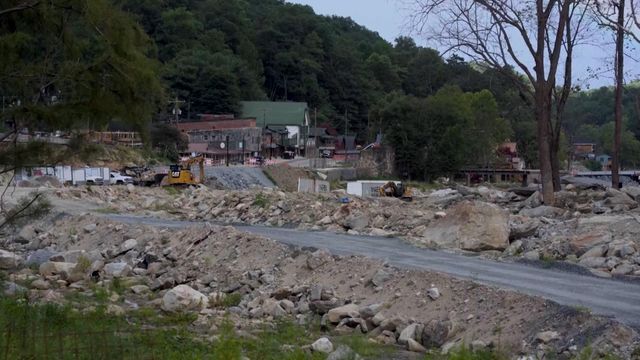
On Tuesday, Stein highlighted infrastructure milestones made in western North Carolina, including improvements to highways, water management systems and state parks.
“North Carolina’s whole-of-government approach has made encouraging progress to repair roads and other critical infrastructure,” Stein said in a statement.
The state says that since the storm hit in late September 2024:
- 96% of water systems are back online
- 97% of state-maintained roads have reopened, and all of the state parks that were affected by the storm are partially or fully reopened
- About 98% of state roads in western North Carolina have at least partially reopened with 95% fully reopened.
There are still more than 6,500 bridges that need to be repaired, according to the state.
On Tuesday, state lawmakers passed a mini-budget that provides additional funds for disaster relief, economic development and infrastructure projects. The U.S. Department of Transportation also announced it will give western North Carolina $1.15 billion in federal funding. The DOT said it's the largest single allocation of money under a federal relief program in DOT history. The federal DOT has now given the state nearly $2 billion.




Copyright 2026 by Capitol Broadcasting Company. All rights reserved. This material may not be published, broadcast, rewritten or redistributed.