NC Senate unveils new budget priorities: Teacher raises, tax cuts and more
North Carolina lawmakers took the first public step toward a new $32.6 billion state budget Monday, when state Senate leaders announced some of their top spending priorities — as well as areas they'd like to cut.
The state’s economy and population have been growing, as have government revenues. Some of that new money would go toward modest raises for teachers and other state workers, Republican senators are proposing. Large sums would also be spent on new aid for victims of Hurricane Helene, as well as on rebuilding the state’s savings reserves — which took a hit due to the Helene response.
Other WRAL Top Stories
The budget would spend $700 million on Helene response and would put another $1.1 billion into the state's "rainy day fund," which could be spent in the future on additional Helene aid, or on other needs. That is in addition to the $1.5 billion lawmakers have already spent on Helene since the storm hit six months ago.
The Senate also seeks to add hundreds of millions into the ongoing effort to build a new children’s hospital, which the state lacks, and spend smaller sums on issues ranging from child care subsidies to the state's mental hospitals.
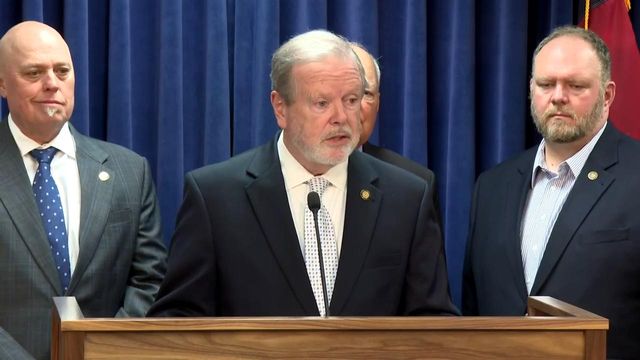
Senate leader Phil Berger said the new budget plan attempts to balance Helene aid, state employee raises, a lower income tax rate and more. The Senate is recommending some cuts to state government in order to pay for it all.
Senate Republicans "have taken a fine tooth comb to area budgets to try to find as much cost savings as possible — from eliminating obsolete programs to slashing some of the bloated portions of the bureaucracy — all in an effort that has served people state of North Carolina," said Berger, R-Rockingham.
Not everyone agreed. Sen. Sydney Batch, D-Wake, the top-ranking Senate Democrat, said in a statement Monday that the GOP budget plan "fails to fund public safety, offers pathetic pay raises for public servants, and hoards billions of dollars while families struggle.”
“It’s a blueprint for neglect, not success," she added.
Budget highlights
Most state employees would receive a 1.25% raise next year, as well as $3,000 in bonuses spread over the next two years. Some people in certain jobs — particularly prison staff and state law enforcement — would receive larger raises.
Over the next two years, the budget plan would fund the following average raises:
- 3.3% for teachers.
- 8.9% for correctional officers.
- 9.2% for the Highway Patrol.
- 14.4% for Alcohol Law Enforcement and State Bureau of Investigation officers.
The budget would break with tradition by paying thousands of people who don't work for the state at all. Local police and sheriffs deputies would receive $3,000 bonuses as well.

Other provisions within the Senate's budget proposal include:
- $638 million more toward construction of a children's hospital to be led by UNC and Duke universities.
- $25 million to bring back coverage of GLP-1 weight-loss drugs under the State Health Plan for some state workers, one-fourth the amount the State Health Plan requested.
- An overhaul of NCInnovation, which would be asked to give back the $500 million it got from the state in 2023 in exchange for a new funding model.
- Millions more for teacher signing bonuses, teacher mentors and a program aimed at boosting reading scores.
- Requiring UNC and N.C. State to play against more in-state schools, in college basketball games.
Budget cuts help pay for tax cuts
The budget plan also would speed up planned tax cuts, despite a recent forecast from the legislature's own economists predicting that the state will enter a deficit as soon as 2026 if lawmakers continue with plans to cut taxes beyond the current rate. Berger told reporters Monday he didn't believe that budget forecast, defending his decision to suggest making the tax cuts even more aggressive than already planned.
Democrats have called on Republicans not to go forward with planned tax cuts, and to instead keep the current rate in place. They say it does substantial harm to the state without doing much good for the average person's pocketbook.
If next year's planned 0.25% income tax cut goes through, an individual making $50,000 a year and taking the standard deduction would pay about $90 less in taxes. It will cost state government approximately $1 billion in revenue, according to the state budget office.

Some parts of state government would see their funding cut, including a roughly $50 million cut from the state's community college system, the elimination of the Innocence Inquiry Commission — a $1.6 million operation that has exonerated more than 20 wrongfully convicted people in recent years — and the elimination of a mentoring program within the state's Teaching Fellows program.
The budget would also order the UNC System to find more than $33 million in cuts to make at various campus institutes while at the same time trying to get tenured professors to quit in exchange for severance packages, with an aim of "faculty realignment."
The Senate also proposes cutting millions of dollars that have been going to K-12 public schools — ranging from $800,000 in computer coding grants to more than $15 million spent paying the fees for high school students to take advanced-placement and international-baccalaureate tests, in addition to millions more in canceled contracts with various educational websites and other programs.
DOGE-style government review
In addition to providing smaller raises for many state employees than previous budgets have paid for, the new budget plan made public Monday would also address shrinking income tax revenues in other ways.
It would double the tax rate to be paid by sports betting operators. It would eliminate many vacant jobs across state government, preventing them from being filled in the future. And it would cut existing state programs and jobs, in an effort Berger likened to the Department of Government Efficiency efforts led by billionaire Elon Musk in the federal government under Republican President Donald Trump.
Pressed for details on those cuts, Berger said more information would become public later — and that much of the work will be helmed by new Republican Auditor Dave Boliek, who won election in November and has since seen the legislature move to give his office immense new powers it never had in the past, when the auditor was a Democrat.
As one example, Berger said he expects to find tens of millions of dollars in savings from the state's community colleges. The Senate’s budget would task the system with consolidating its administrative workforce across all 58 campuses, eliminating a mentorship program for minority students and implementing other cost-savings measures.
The chamber also proposes to freeze the budgets of most of the state's 16 public universities in the second year of the two-year state spending plan.
But at the same time, hundreds of millions of dollars would be set aside for construction work at Elizabeth City State University, the Brody School of Medicine at East Carolina University and on Poe Hall at N.C. State University. N.C. State leaders closed Poe Hall in November 2023 after tests detected polychlorinated biphenyls, or PCBs, inside. Many studies have linked PCB’s to cancer, and, since the building closed, more than 200 people have told WRAL they or their loved ones were diagnosed with cancer after spending significant amounts of time in Poe Hall.
Not the final budget
The state budget process works in two-year plans, and lawmakers have previously said they plan to spend roughly $32 billion in the next two fiscal years, which will stretch from July 1 until June 30, 2027.
Democratic Gov. Josh Stein had proposed a larger spending total, largely due to his plan for substantially higher raises for teachers. But Stein would’ve paid for that by undoing two main priorities of GOP lawmakers in the past decade — by nixing future tax cuts and reallocating hundreds of millions of dollars currently planned to be spent on private school tuition vouchers. Stein’s budget plan never had much of a chance to sway Republicans who control both chambers of the legislature with large majorities.
But Stein does have more leverage this year than his predecessor and fellow Democrat, former Gov. Roy Cooper, did during the last several years of his time in office. Democrats broke the GOP’s supermajority in the state House in the 2024 elections, meaning Republicans can only avoid Stein’s veto if they get Democrats to buy in.
The Senate also has to find agreement with the House, which is expected to release its own budget proposal. Once that happens, the two chambers will begin negotiating.
In the end, the actual raises that teachers and other state workers get is likely to end up somewhere in between Stein’s proposal and the plan rolled out by the Senate Monday.
House GOP leadership isn’t expected to agree to everything in the Senate budget, and in the past the House has consistently pushed for higher raises than the Senate. Over the weekend a top House budget writer, Wake County Republican Rep. Erin Pare, told WRAL that her chamber was taking seriously a recent report from state budget forecasters that found continuing on with future tax cuts — as the Senate budget would do — could put the state into a deficit as soon as 2026.
If the House wants to slow or pause those planned tax cuts, that would free up for money for raises — but could also lead to an intraparty fight between House and Senate Republicans that might end up delaying the budget.
While the budget is technically due July 1, the legislature almost always misses that deadline by weeks if not months. When that happens, raises are typically made retroactive to the start of the fiscal year.


Copyright 2026 by Capitol Broadcasting Company. All rights reserved. This material may not be published, broadcast, rewritten or redistributed.