Republican NC lawmakers spar over Medicaid, children's hospital funding as budget impasse drags on
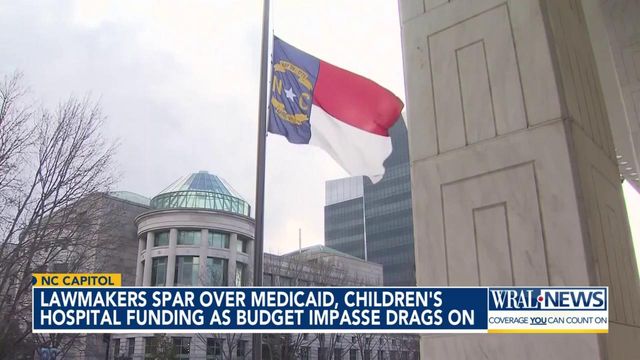
North Carolina lawmakers, who are still at an impasse over a full state budget, have turned their attention to a potential funding package for a variety of health care projects. But that package is now held up too, as leaders in the state House and Senate disagree over funding for a new children’s hospital and for the state’s Medicaid program, people familiar with the negotiations told WRAL.
Here’s a breakdown on where things stand.
Other WRAL Top Stories
Medicaid funding. A shortfall of state funds, combined with program changes under congressional Republicans’ spending-and-tax cut bill are causing officials to reassess how much money the state needs to pump into the state’s Medicaid program.
Medicaid leaders said earlier this year that the adjusted level of funding — known as the “rebase” — needed for the next fiscal year would be $819 million. However, a stopgap spending measure lawmakers passed this summer supplies only $600 million. That is forcing the North Carolina Department of Health and Human Services to consider ways to make cuts to close the funding gap by Oct. 1, state Health Secretary Dev Sangvai told legislative leaders last month.
Republicans in the Senate had originally proposed about $640 million for the rebase, plus an additional $50 million for administrative costs, according to Lauren Horsch, a spokeswoman for Senate leader Phil Berger. “The House would not agree to that at that time,” she said in an email.
The House's proposal remained at $500 million — and didn’t immediately seek more funding — because budget negotiators wanted to investigate why the health department's Medicaid rebase request was rapidly increasing, according to a statement from House Speaker Destin Hall’s office. Hall's office says leaders suggested boosting their $500 million figure to $600 million during the course of negotiations in July, and that the topic was not a major item of dispute. House leaders were open to boosting funding, Hall’s office said, so long as they received a sufficient explanation for why it was needed.

DHHS leaders have warned that the shortfall would force the state to reduce the amount of money it reimburses to health care providers who care for more than 3 million North Carolinians enrolled in Medicaid. House leaders have said they could revisit the funding levels for Medicaid periodically if funding levels needed to be adjusted.
Senate leaders are now weighing a House proposal that could increase the rebase. They’re considering a plan that would pump about $690 million into Medicaid for each of the next two years, according to people familiar with the preliminary proposal, in addition to almost $50 million in administrative costs.
The preliminary proposal also recommends increased cuts to DHHS services for mental health, developmental disabilities and substance abuse, people familiar with the plan said.
The proposal includes new measures to ensure the Medicaid funds are properly spent, Hall’s office said, and would fully fund Medicaid’s immediate needs. House leaders haven’t received any formal rejection of the proposal — only pushback that it doesn’t include funding for other items, such as the funding for the state's first children’s hospital, Hall’s office said. Still, the office said, House leaders are flexible on the details of the proposal and willing to negotiate a Medicaid deal.
Children’s hospital. North Carolina Children’s Health — a partnership between UNC Health and Duke Health — plans to build the state’s first standalone children's hospital on 230 acres in Apex. The project, which would bring thousands of jobs to western Wake County, is relying on state funding to open sometime after 2032.
In a video posted to X, state Rep. Grant Campbell, said state senators are holding up the Medicaid spending talks over funding for the hospital. Berger, the Senate leader, has been a major proponent of the project, which is scheduled to break ground in 2027.
Campbell, R-Cabarrus, said House negotiators met with Senate negotiators to explain a proposal that would “basically eliminate all cuts to Medicaid.”
Senate negotiators, Campbell said, put conditions on the deal. “They said, ‘We’ll only support it if you attach $300 million for the children’s office in Apex that we want.’”

Berger’s office disputed Campbell’s account. As part of negotiations, the Senate is offering to return to funding levels for the children’s hospital established by both chambers in the 2023 state budget, Horsch told WRAL on Tuesday.
The 2023 budget authorized about $320 million over three fiscal years. About $216 million has already been spent. Berger’s office is seeking the final allocation of funds from that budget — about $103.5 million, she said.
The Senate’s proposed 2025 budget called for investing an additional $535.5 million in the 500-bed pediatric hospital. That would have brought total state funding to about $855.2 million — nearly 30% the projected cost. It was one of the biggest earmarks in the Senate’s spending plan, which would cover the two years ending June 30, 2027. But the Senate has since backed off that proposal and is seeking just the previously approved money.
“We are not talking about new funding for the hospital, rather just what was previously authorized in the 2023 budget,” Horsch said.
In an email to WRAL, Campbell called on legislative leaders to address Medicaid funding "without tying it to other negotiations."
“The impending cuts to Medicaid that are slated to begin within weeks would be devastating to healthcare providers and patients. We have a clean solution to this problem that can be implemented before that occurs," Campbell said. "Debates and discussions about other issues are certainly warranted, but my hope is that we can address this crisis directly and swiftly."
Demi Dowdy, a spokeswoman for House Speaker Destin Hall, echoed some of Campbell’s comments in a statement to WRAL Tuesday night.
“House appropriators and health leaders have proposed a plan to fully fund Medicaid and prevent the NCDHHS’ politically-motivated cuts,” Dowdy said, adding: “We are hopeful that unrelated budget items will not hold up an agreement on this plan.”
The chambers are also squabbling over about $105 million in previously-approved funding for a program known as N.C. CARES that supports rural health care. Senate leaders are in support of paying out the money, which is intended to help rural hospitals.
"There are investments that were made based upon what we committed to as a General Assembly back in '23," Sen. Michael Lee, R-New Hanover, said in an interview Wednesday.
"We as the General Assembly need to follow through on what we promised we would do," Lee said.
Taxes remain an obstacle
The current fiscal year started July 1 without a budget. State law allows the state government to continue operations under previously approved funding levels. But some projects and programs require approvals for additional funding.
As lawmakers remain at odds over a full state budget, they’ve been returning to Raleigh periodically to approve one-off funding plans to keep key projects and operations humming.
It is unclear whether disagreements over the hospital or Medicaid would upend or delay plans for stopgap funding for other priorities. Lawmakers are due back in Raleigh next week and could resume negotiations then. Lawmakers are also expected to file a series of law-enforcement reforms in the wake of a fatal stabbing on a Charlotte commuter train.

Lawmakers last month approved stopgap funding for some state agencies and certain higher-education needs, but they’ve yet to adopt a plan that would fully fund government operations or provide raises to state employees.
Tax rates were the initial issue holding up negotiations for the overall state spending plan. The personal income tax rates are scheduled to be 4.25% this year and 3.99% in 2026. The chambers have disagreed on how to plan for tax cuts in 2027 and beyond.
State economists have warned budget writers that declining revenues could leave North Carolina without enough money to pay for the state’s growing needs. The Senate’s initial proposal called for reducing the personal income tax rate 3.49% in 2027, while the House proposed a less aggressive plan.
Democrats have criticized Republican leaders for a lack of urgency, pointing out that Republicans found time this summer to enact a number of “culture war” bills — but no sweeping legislation that could help North Carolinians with inflation or rising food costs. In response, Republicans have said they have a long track record of cutting taxes and asked for patience as they try to strike a deal to give state employees as big of a raise as possible.
"We still continue to talk about the broader budget, but right now we really need to focus on the health care piece of it," Lee said, adding: "Hopefully we will get (a deal) early next week, and then we can move on to a lot of those other priorities that that I know both chambers think are really important."





Copyright 2026 by Capitol Broadcasting Company. All rights reserved. This material may not be published, broadcast, rewritten or redistributed.