Health care rivals UNC, Duke partnering to build NC's first standalone children's hospital
Two of the region’s biggest health care rivals are partnering to build North Carolina’s first dedicated children’s hospital.
UNC Health and Duke Health on Tuesday announced a formal agreement to fund and operate a flagship, 500-bed pediatric hospital in the Triangle. The hospital would be the centerpiece of a new children’s health system in North Carolina, an unprecedented effort that is expected to create thousands of jobs in the region.
Other WRAL Top Stories
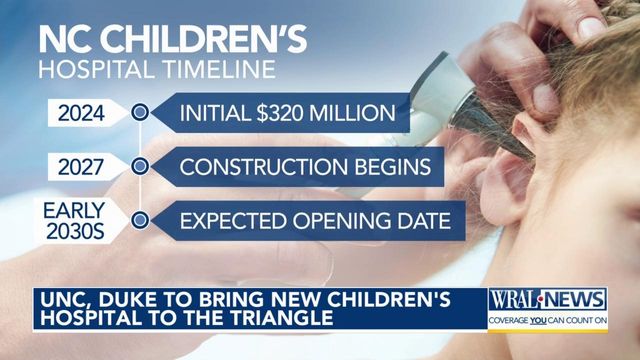
The hospital — to be called North Carolina Children's — is expected to include an ambulatory surgical center and behavioral health hospital on a site bigger than UNC Health’s hospital in Raleigh, Rex Hospital. It is expected to be complete in the early 2030s. The location hasn't been finalized, the universities said.
The partners filed articles of incorporation Tuesday for a nonprofit organization through which UNC Health and Duke University Health System would transfer all pediatric-related clinical services, programs and operations to North Carolina Children’s — the biggest such deal between the health care rivals, which have long competed for patients in this fast-growing region.
“By combining the resources, expertise and innovative approaches of our two organizations, we'll be able to tackle the most pressing health challenges and develop new treatments and therapies that will benefit children not only in North Carolina but in the world,” Mary Klotman, dean of Duke University School of Medicine, said during a news conference in Raleigh on Tuesday.
Health care providers in the region — including UNC, Duke and WakeMed — currently treat children in existing general hospitals, which dedicate units to pediatric care. UNC Children's Hospital, for instance, is attached to UNC Health's main campus in Chapel Hill. And Duke Children's Hospital & Health Center is attached to Duke Health's main campus in Durham.
But the fast-growing region is running out of pediatric hospital beds and doesn’t have enough specialty services to keep up with demand, pediatricians say. Organizers expect the new hospital will help bring more — and more advanced — medical care to more children.
North Carolina's current children's hospitals currently don’t have the ability to build broad-based, highly specialized pediatric care, Dr. Wesley Burks, the chief executive of UNC Health and dean of the UNC School of Medicine, said Tuesday. As a result, he said, thousands of sick kids each year have to transfer between hospitals or outside of North Carolina for treatment. “Together, we're building North Carolina Children's to ensure that we can provide the best care right here in North Carolina,” said Burks, who specializes in pediatric medicine.
The new children’s hospital would allow the universities to create a hub dedicated strictly to children and pediatric research and education — one that the universities expect to draw pediatric subspecialists, researchers, residents and fellows. Pediatric research and education functions will continue to be managed at the UNC School of Medicine and Duke School of Medicine, but they could move to the new hospital once it's operational, particularly clinical teaching and research, the partners said. The partners are developing a practice model that allows providers to retain existing academic appointments.
“You may be surprised to see Duke and UNC sharing and coming together, but it shouldn't be a surprise,” said Dr. Craig Albanese, CEO of Duke University Health System and a pediatric surgeon.
While Duke and UNC have long battled for market share in the region, they have partnered in pediatric care by providing subspecialties to one another, sharing patients who go between the hospital groups to see different patients. The organizations have also partnered to share fellowship training and research programs. “North Carolina Children's is just simply the next step in this progression,” Albanese said.
The new hospital — which is likely to cost at least $2 billion — would be aided in part by up to $319.7 million appropriated to UNC Health as part of the 2023 state budget. To fund the balance of the construction costs, beyond the state funds, it is likely UNC and Duke would have to invest some of their own money while also relying on donations from individuals or philanthropic groups.
The hospital will also enable the universities to grow health services at existing facilities. By enabling the relocation of existing pediatric care units, the arrangement would enable Duke and UNC to easily expand general care at their flagship hospitals.
Leaders of the university health systems Gov. Josh Stein on Tuesday thanked legislative leaders, particularly Republican Senate leader Phil Berger, R-Rockingham, for their efforts to fund the project and encourage its development, noting that pediatric care was an easy thing to unify around.
“If you can bring Duke and Carolina together, you can bring Democrats and Republicans together,” said Stein, a Democrat, adding that the hospital “will end up saving the lives of countless children for generations to come. It will also help to shape the economic future of our state.”
The project is expected to employ thousands as it is built and after it’s finished. Berger described it as one of the biggest economic development projects in the history of the state.
“This project is going to be life-changing for children and families across the state and really outside of the state of North Carolina,” Berger said at the news conference Tuesday. “... This is a win for the economy and for our children's health and for our state's infrastructure.”
UNC is still seeking a site for the new hospital, which would likely be built on a site that is central to the region with access to a robust road network. The project would need at least 100 acres, based on the expected scope of the project. By comparison, UNC’s nearly-500-bed flagship in Raleigh — UNC Health Rex — sits on about 60 acres. The planned children’s hospital could end up being more expansive than Rex, though.
The partners plan to break ground on the new campus by 2027, with construction of the campus expected to take about six years. Some services, such as the children’s behavioral health hospital, ambulatory surgical center or medical office building could open before the full project is complete, according to the universities.
The partners also said that the hospital is expected to include play areas and rehabilitation facilities, translational research capabilities with a dedicated innovation and collaboration area, and infrastructure for hotels, retail, dining and other services. The project is expected to spur residual development — beyond the project's borders — to serve patients and employees.
“Over the long term, once it is in operation, we will see biotech, medical device, and medical research companies grow and service industries like hotels and restaurants emerge to serve the families,” Stein said.






Copyright 2026 by Capitol Broadcasting Company. All rights reserved. This material may not be published, broadcast, rewritten or redistributed.