With protested override, NC lawmakers sap power from governor, attorney general, other incoming Democrats
North Carolina Republicans will have new powers over elections, public schools, utilities and more under a wide-ranging new law that strips control from the governor, attorney general and other incoming Democrats.
Senate Bill 382, which became law Wednesday after an override by the GOP-led state House of Representatives, is expected to have major ramifications for the future of state government — if it survives an expected legal battle over executive power.
Other WRAL Top Stories
The House voted along party lines to override Democratic Gov. Roy Cooper’s veto of the 131-page measure. The 72-to-46 vote — which came amid protests from Democrats and progressive groups — followed an override by the GOP-led state Senate last week.
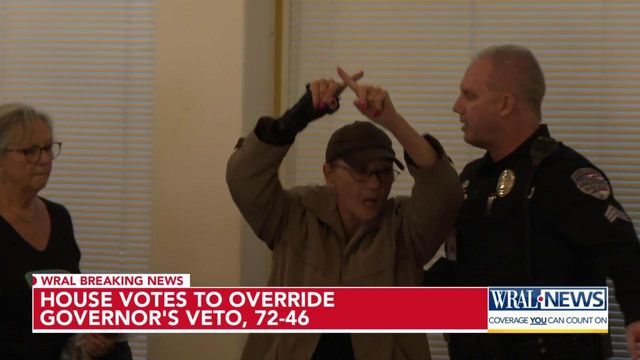
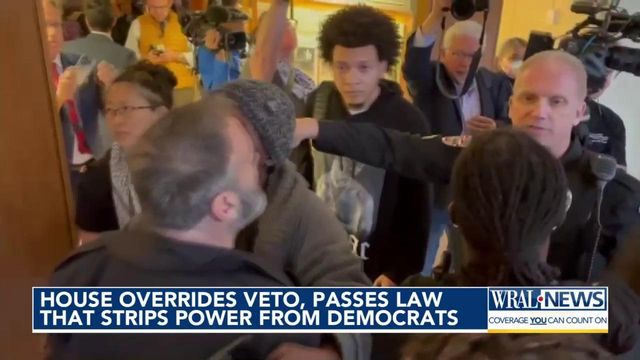
The passage followed an emotional debate on the chamber floor and as demonstrators packed the gallery and the halls of the legislative building, wielding signs and singing protest songs. At least one protester was arrested.
Republicans have said some of the changes were needed to improve public confidence in government. Democrats, however, say it's an unconstitutional, partisan power-grab that will significantly weaken the executive branch. Incoming Democratic Gov.-elect Josh Stein and his replacement as attorney general, Democrat Jeff Jackson, are the main targets of the legislation.
The measure was officially billed as a relief aid package for victims of Hurricane Helene, which ravaged the western part of the state in September. But critics said it doesn’t do enough for relief efforts. The law transfers $277 million from a general state savings fund to a Helene-specific savings fund, but it orders that much of that money remain unspent for now.
“The people of western North Carolina are desperate for help from their state government,” Stein said Wednesday. “Yet, this bill is a power grab, not hurricane relief. It is despicable for the Republicans in the General Assembly to use folks’ incredible need for aid to cloak their political pettiness.”
Republican state Rep. Destin Hall said if legislators didn’t pass the override, Helene victims might have to wait at least 40 days for lawmakers to vote on relief again. “I bet if you ask those folks who are there on the ground now, ‘Does that matter to them?’ They tell you it does,” Hall, R-Caldwell, said during a floor debate over the bill Wednesday.
The thrust of the law, however, isn’t Helene funding. Rather, it has drawn scrutiny for a variety of power-shifting measures.
For instance, it takes away the governor's control over the State Board of Elections and gives it to the state auditor, an office soon to be held by a Republican — just one of a host of provisions that saps power from incoming Democrats. Seizing control of the elections board has long been a goal of Republican lawmakers, but multiple past efforts have either been ruled unconstitutional or shot down by voters at the ballot box.

Republicans say the elections board has become too partisan in recent years — a claim the state party chairman repeated Wednesday after the elections board shot down the GOP’s attempt to overturn the party’s apparent loss in a state Supreme Court election by throwing out the ballots of more than 60,000 people who voted this year.
The legislation also takes away power that the governor and attorney general have over the state Utilities Commission — which regulates and votes on rate increases for Duke Energy and other utility companies — and either gives those powers to Republicans or eliminates them entirely.
The governor's power to appoint judges to fill judicial vacancies is also restricted by the law — in the short term, banning Stein from picking a Democrat to fill any vacancy for a judicial seat that was previously held by a Republican.
The measure eliminates state boards on energy policy and school safety that are led by the lieutenant governor and superintendent of schools. Both offices are currently held by Republicans but will be held by Democrats Rachel Hunt and Mo Green, respectively, starting next month.
And the attorney general's office will be banned from arguing in court that anything the legislature does is unconstitutional. The law also bans the AG from taking stances in court that state legislative leaders disagree with.

A legal battle over the new law is widely expected; lawsuits over controversial pieces of legislation are an increasingly common theme of North Carolina politics.
Cooper, who has called the law unconstitutional, has sued state lawmakers repeatedly over a variety of laws stripping power from the governor’s office that lawmakers began passing after he unseated the sitting Republican governor, Pat McCrory, in 2016. Cooper won some of those lawsuits but lost others. Several more are still pending and will soon be inherited by Stein.
McCrory has criticized the elections board provision in the new law as misguided and unconstitutional.
The vote was one of the last major actions by the General Assembly this year. Republican lawmakers pushed the measure through ahead of the next session, when the party is expected to have less power in the House.

Republicans appear to have lost their veto-proof supermajority during this year's elections after Democrats won upset victories in state House races covering Granville, Wilson and Buncombe counties. The race for one of those House seats remains undecided and could flip back to GOP control depending on whether Republicans succeed in throwing out the ballots in the plan the elections board rejected Wednesday. With the supermajority hanging in the balance, the GOP House leaders pushed through the veto override.
“The North Carolina Republican Party is desperately trying to cling to power after North Carolinians soundly rejected state Republicans at the ballot box this November,” Democratic National Committee Chairman Jaime Harrison said Wednesday. “Rather than respect the will of voters, state Republicans have put up bogus legislation that cloaks their attempt to overturn democracy and undermines essential hurricane relief.”

Helene update
Heading into Wednesday, the veto override vote in the House wasn’t a certainty. Several House Republicans originally joined all Democrats in voting against the bill, and rumors swirled in the corridors of the legislative building up until the moment of the vote Wednesday as to how they’d vote when it counted most. All three GOP defectors in that original vote — Reps. Mark Pless, Karl Gillespie and Mike Clampitt — are from western North Carolina.
On Wednesday morning, House Speaker Tim Moore went on a podcast hosted by conservative strategist Steve Bannon, and asked Bannon’s listeners to call the legislature and demand the GOP holdouts come back into the fold and vote to override Cooper’s veto.
In the end all did vote to override the veto.
Ahead of the House voting session, a legislative committee heard presentations from state budget officials and nonprofit groups on what has been done to help Helene victims — and what still needs to be done. Clampitt made a point of remarking in that meeting how his GOP colleagues have so far declined to authorize any money for grants to affected small businesses, a proposal that has been heavily lobbied for by Democrats and some western North Carolina Republicans.
While much of the commentary on the Helene parts of the new law focused on the relatively small amount of funding approved for immediate spending, one Republican said any amount helps. Rep. Dudley Greene, R-McDowell, recalled watching a creek near his house that’s normally a few feet wide grow to 50 feet across as water poured down the mountains. His family fled and came back to find their house flooded, garage gone, and roads severely damaged. But they’re fortunate compared to those who lost even more, he added.
“Right now, we have a shell of a house,” he said. “We hope to go back there one of these days. But we were blessed that I had that sister, and she allowed us to come in there and pile in on her, and we stayed there for a month.”
The storm brought 30 inches of rainfall, caused more than 1,400 landslides, killed 103 people and left hundreds homeless across the region, officials said. Nearly 5,000 people are using the Federal Emergency Management Agency’s housing assistance program and 500 people are on a waiting list for a mobile unit.
Cooper recently used an executive order to expand unemployment benefits following the storm, but one of the other changes in the new rules passed Wednesday is a new law that will end those extended benefits in early 2025 and ban Stein from doing anything similar once he becomes governor.
Helene damaged about 74,000 homes in western North Carolina and 95% of the victims don’t have flood insurance, Kristin Walker, the state budget director, told lawmakers Wednesday.
Before Wednesday, state lawmakers had approved about $877 million to help Helene victims so far, or roughly 2% of what the region will need to fully recover.
The state will need more than $53 billion to fully recover, Walker said. Even if North Carolina receives all the money it’s currently requesting, she added, it could come up nearly $20 billion short of what the western part of the state needs.
In addition to the state funds, Walker said the state expects private investment in Helene relief to surpass $6 billion. State lawmakers are also seeking about $26 billion from the federal government. Some of the state’s top lawmakers — including Stein, Hall and Republican House Speaker Tim Moore — traveled to Washington, D.C., in recent weeks to lobby members of Congress for the funding.
Congress is expected to vote before Christmas on a new funding bill that could include funding for disaster relief in multiple states hit by storms this year. Democratic President Joe Biden has proposed a $100 billion relief aid package to be divvied up between a dozen or more states.
In response to critics Wednesday, Republicans said they’re worried about spending too much too quickly for fear of limiting their ability to provide matching funds for federal relief. Oftentimes federal aid dollars come with stipulations requiring a state to match 10%. If the state depletes its savings before the federal dollars roll in, Republicans said, North Carolina might have to accept less federal funding because the state won’t have enough for the federal match. They also said that much of the $1.15 billion that has now been approved by the state hasn’t yet been spent.
“We don't have enough money to pay for this as a state,” Moore told reporters. “If we did that, it would be foolish, because we would forfeit those federal dollars, which is going to be the bulk of the money.”
Hall, who along with Moore visited Washington Tuesday to discuss federal funding, also said he anticipates the state receiving about $25 billion in federal funding. “We've got every indication that help is on the way, and on the way very soon,” Hall said.
Protests and arrests
Throughout the day, several dozen rain-soaked demonstrators filed into the legislative building on Jones Street and ascended the stairs toward the gallery above the House floor.
Security guards looked on as they waited to sit in one of the gallery’s long wooden pews. Most of them opposed the legislation. Some carried posters about Helene’s victims, others carried signs featuring an X over the bill number, SB 382.
As lawmakers cast the deciding vote, the gallery erupted with chants of “shame!” and “people’s house!” Protesters held up signs decrying what they described as election interference. Some waved flashlights at gallery attendants and officers.
Capitol police cleared the gallery, arresting one protester in the process. A 54-year-old Carrboro woman was charged with noise disturbance, second-degree trespassing and resisting arrest, according to court documents.
Outside the gallery, protesters continued to chant, packing shoulder to shoulder against the windows. Police threatened more arrests unless the crowd lowered their voices and left, at one point pulling out riot gear. Protesters eventually backed down, walking single file down the stairs and out of the legislative building.
“What they’re doing is they’re actually not trying to commit to Hurricane relief, they’re using it to steal political power, and I think that is very disheartening,” said Samuel Scarborough, a 19-year-old UNC student and protester.
Amendment passes
The chamber also voted Wednesday to put on 2026 ballots a state constitutional amendment on voter identification rules.
However, the House abandoned efforts to pass a second constitutional amendment proposal that would’ve further lowered the state’s maximum income tax rate. Senate Republicans voted last week to approve that amendment, saying it would advance conservative fiscal policy. But critics feared it could hamstring the state in a future recession, causing the need for deep budget cuts or pushing costs onto local governments instead. The House didn’t put it up for a vote Wednesday.
The amendment that will now be on the ballot in 2026, Senate Bill 921, seeks to cement the state's voter photo identification requirements, a move GOP leaders say is needed to strengthen confidence in election results and make the voting process more consistent. The decision becomes official because the Senate also voted to add it to ballots; a governor can't veto proposed amendments.
Voters already must provide proof of ID whether they vote in person or by mail. But only the in-person voting rules are part of the state constitution. The ID requirement for mail-in ballots is in state law, but not the constitution. Adding it to the constitution, as this amendment would do, would make it harder for courts or future legislatures to undo those rules.
The measure passed with a party-line vote of 73-to-45. Opponents said the measure wasn’t needed because state law already covers voter identification rules, adding that it will disenfranchise some voters.
WRAL Capitol Bureau Chief Laura Leslie and WRAL Reporter Eric Miller contributed to this report.



Copyright 2026 by Capitol Broadcasting Company. All rights reserved. This material may not be published, broadcast, rewritten or redistributed.