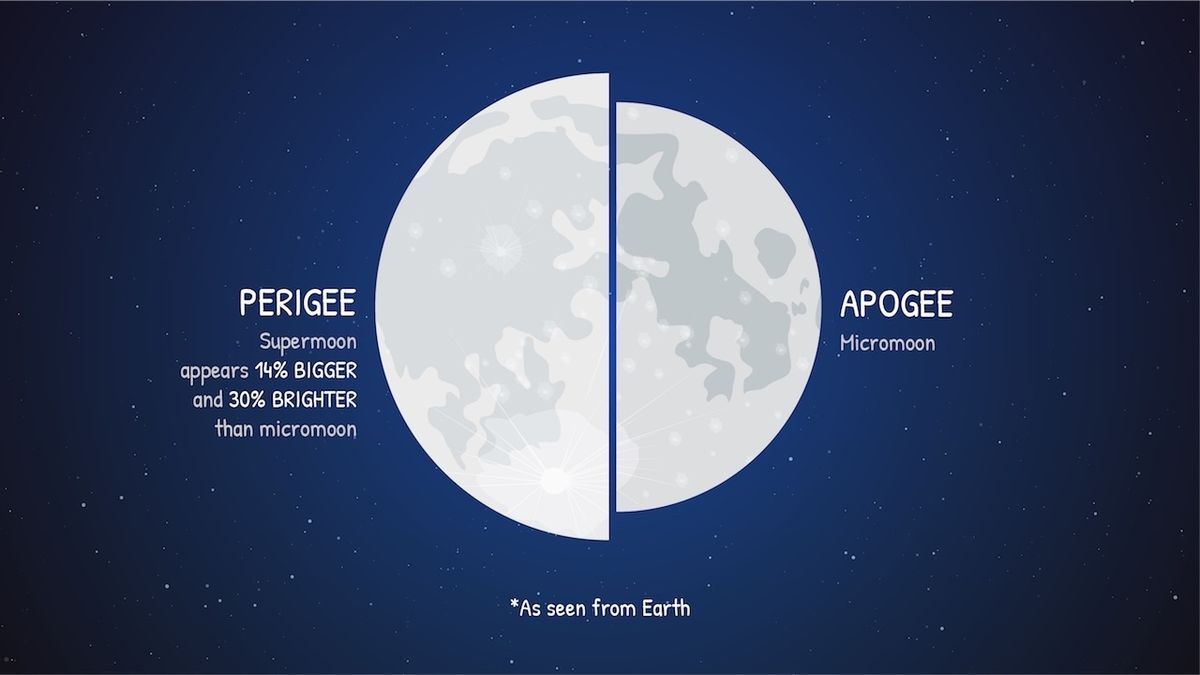
The Moon reaches full phase just before midnight Monday. It reaches the closest point to the Earth on Wednesday morning, close enough to make October's full moon a supermoon.
Supermoons appear a little bigger and significantly brighter than other full moons because they occur closer to the Earth. Monday's full moon will be 224,598.4 miles from Earth, about 15,000 miles closer than average.
Other WRAL Top Stories
It will appear a little bigger, about 14% bigger than average, but significantly brighter, about 30%. Why the difference?
The brightness of a star, or an object like a planet or the Moon which is reflecting starlight, is most affected by its distance. Astronomers express using the inverse square law,
Because distance is on the bottom of the equation, the closer the Moon is, the brighter it is. Because the distance measurement is squared, the change in brightness is greater than the change in apparent size.
What's with the 4 times pi part? Light from the moon is radiating outward in all directions, so we borrow this part of the formula from measuring a sphere.
Viewing tips
The best time to view the supermoon is around moonrise, shortly after sunset, when the Moon will appear even larger. Trees and buildings along the horizon give your eye a reference that enhances the “moon illusion,” making the Moon seem even bigger than it appears later in the night when it’s higher in the open sky.
First of four
The full moons in November, December, and January will also be "super"
- Mon 10/06/2025 11:47 PM EDT
- Wed 11/05/2025 08:19 AM EST
- Thu 12/04/2025 06:14 PM EST
Supermoons always come in groups, usually four, sometimes three, and occasionally five in a row. We next see that beginning January 2029.