NC schools are struggling to hire special education teachers. Parents are filing complaints
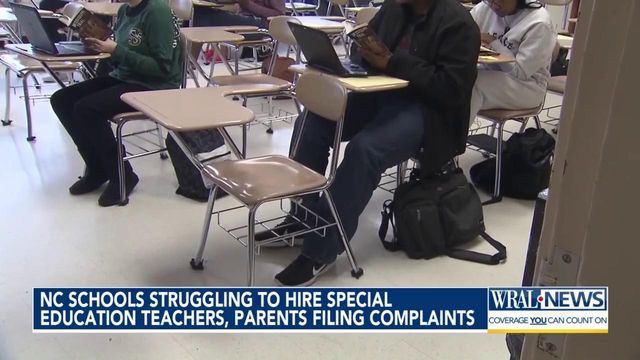
North Carolina schools are increasingly struggling to hire and retain qualified special education teachers, leaving some students without properly trained faculty who know how to provide specialized services.
A worsening shortage of such teachers is also leaving schools vulnerable to state scrutiny over whether they’re following special education law, state records indicate.
Other WRAL Top Stories
There’s no official record of how often people file complaints of unqualified staff providing special education services. But a review of state records shows it happens frequently across the state and that schools are increasingly at risk of violating state and federal guidelines.
Just last month, the North Carolina Department of Public Instruction found that a Wake County elementary school violated state and federal law when it failed to provide special education services via a certified special education teacher.
The school system was found in violation of special education laws on personnel qualifications the year before, too. And in recent years, so have other North Carolina school systems and charter schools, according to DPI records that outline corrective actions for the schools.
A Wake County teacher and a parent told WRAL News they’re worried kids with disabilities are being short-changed. Special education teachers serve students with disabilities, providing them with adapting teaching methods and overseeing the implementation of the students’ individual education programs. Those programs outline accommodations the students need to meet the goals their parents and teachers have agreed to. Without them, students with disabilities would be left to learn from people not trained to understand their disabilities or modify instruction for them, risking whether those goals are met and making it more difficult for them to advance in the public school system.
Terri Schmitz, a fourth-grade teacher at Swift Creek Elementary School in Garner, said she was asked to provide special education services to three students last school year, despite not being certified in special education. She was asked after her school went more than a year without a full-time special education teacher for grades above kindergarten, according to state education officials. During that time, a long-term substitute was the head of the classroom, records show. In February, the school hired a permanent teacher who was emergency-licensed on a “permit to teach” and also not certified to provide special-education services.
To compensate for the lack of qualified staff, the school system had a certified teacher oversee services, records show. The teacher was charged with meeting with the substitute and the emergency teacher once per month and assisting with lesson plans.
Schmitz said that wasn’t enough, so she filed a complaint with the Department of Public Instruction, which oversees the state’s public schools.
The state found the school system didn’t comply with federal special education law because it lacked a certified teacher.
“I was worried about students getting accommodations afforded to them in their [individualized education programs],” Schmitz said. Those programs are legally binding documents that require certain services and accommodations to help students with disabilities learn.
Schools are noncompliant with state and federal special education laws any time they have an unqualified teacher providing special education services, according to DPI. With growing job vacancies and hiring challenges, it’s difficult for schools to remain compliant.
Department officials told WRAL News they try to provide tailored advice to schools. But when pressed, officials didn’t provide examples of how to remain compliant.
DPI spokeswoman Mary Lee Belz said the department provides technical assistance to schools with vacancies that’s based on their unique circumstances, to mitigate the consequences.

She noted that new State Superintendent of Public Instruction Mo Green considers addressing the teacher pipeline to be a top priority. She pointed to his “entry plan” for taking over the department. That plan includes promoting the teaching profession through “reverence” for public-school educators, celebrating public education and making schools safe and secure learning environments.
“NC DPI takes staff vacancies very seriously,” she said in an email to WRAL News.
State law allows schools to hire someone who isn’t certified in special education instruction but wishes to become certified. Those candidates can get a three-year residency license but must receive intensive training and supervision throughout those three years toward full special education certification. They would be considered qualified.
The number of residency-licensed teachers across all subject areas has boomed to more than 5,000 such teachers this year, up from less than 2,000 just three years ago, according to the North Carolina School Superintendents Association.
A persistent shortage escalates
The state has experienced persistent special education teacher shortages for decades. About 1,200 special education teacher positions were vacant or filled by unqualified staff in the fall of 2023, according to the latest available state data. That’s more than three times the number of vacancies five years before that. In 2018, 356 special education teacher positions were vacant or filled by unqualified staff, meaning they don’t have a permanent or residency license to teach special education.
Special education teaching has become a less attractive job over the years, due to increasing administrative responsibilities, stress and low pay, said Lynne Loeser, a retired DPI special education consultant. Many people quit within the first few years, she said, and fewer people are going to college to become teachers.
To properly serve kids, schools can try to share special education teachers or otherwise get creative. But some solutions — such as having a certified mentor oversee services given by new teachers — won’t necessarily help schools stay compliant under the law, she said.
“I don’t think there’s a good answer to that,” Loeser said.
Providing more special education training to current teachers would just be a temporary stopgap measure that would add more to the plate of those teachers, she said.
“The solution is to make special education an attractive profession,” she said. “Not a job — a profession that’s respected and honored and teachers are given the pay, the compensation, the respect, the time to do their job well.”
Many schools are filling the vacancies with emergency replacements and substitute teachers who aren’t sufficiently licensed. But those unqualified teachers aren’t legally allowed to be the primary providers of the specialized instruction that special education students require.
In Wake County, special education teacher vacancy rates have declined slightly in recent years, according to data from the district. But it’s unclear just how many of those new hires have permanent or residency licenses in special education.
The Wake County Public School System reported about 117 special education teaching positions as either vacant or filled by an unqualified person in the fall of 2023 — up from just 24 in 2018, state data shows.

In an effort to hire more special education teachers, the district launched an advertising campaign for them beginning in the 2021-22 school year and hired a recruiter for special education teachers. Since then, slightly more of the positions are filled, county and state data show, but not necessarily by people who are certified in special education.
The district launched a webpage for special education teacher recruitment in 2023 and both a page and an advertising campaign for special education teaching assistants this school year.
“We are deeply committed to helping every student reach their full potential, including the approximately 22,000 students in our district with an individualized education [program],” district spokesman Matt Dees said in a statement. “Our goal is to ensure every student with an IEP receives the resources and support they need to thrive. We remain committed to serving our students with disabilities and their families with care, dedication, and excellence.”
‘It’s just not fair to the child’
To make that happen, Dees said, the district uses special education-certified central office staff to oversee services provided in the schools, such as providing lesson plans.
In its ruling on Schmitz’s complaint in December, the state Department of Public Instruction cited the district’s central office support as a reason the students in Schmitz’s class didn’t need “compensatory services” to make up for the time when they didn’t have a certified special education teacher. That frustrated Schmitz, who was worried about the quality of services she had been able to provide.
Emma Miller’s son received compensatory services after she filed a complaint about River Bend Middle School, which lacked a certified special education teacher for her son’s class during the 2022-23 school year.
For about a month and a half, Miller’s son, Devon, was given specialized instruction by a teaching assistant at the Raleigh school. That’s because his classroom didn’t have a teacher who was licensed in special education.
Miller hadn’t realized it until Devon was scheduled for a regular meeting on his individualized education program. The person she thought was his teacher wasn’t there, and school administrators said it was because she was only a teaching assistant and couldn’t provide services.

“I was, like, ‘What?’” Miller said. “It's like they have my son written down on paper that he's under somebody else, but he really wasn't. So I'm, like, ‘Whoa.’ That's where I just say you can't do stuff like that. It's just not fair to the child.”
Miller said she spoke with some advocates, including Legal Aid, which told her that his special-education classroom teacher should be certified.
“They told me that that’s against the law,” Miller said. So she filed a state complaint, and the state found the school district noncompliant.
Schmitz had filed a complaint once on behalf of her own son at his charter school, when she saw he wasn’t getting the services he needed by a qualified person. Schmitz was upset when she began to worry the same thing may be happening to students at the school where she taught.
“There was no plan for these kids, which was really disheartening, because I had just gone through this with my own child for two years,” she said.
Special education teachers are an “essential piece” of the team trying to serve a child with a disability, Loeser said. They can affect whether needs are met, having a significant impact on future preparation and future earnings.
She gave the example of a person who struggles with a reading disability.
“If you’re illiterate, the impact of that in your adult life [is] on your health, your mental well-being, your job opportunities, your social life, everything, so it can have significant impacts,” she said.
Wake County Public School System leaders have begun considering a reorganization of the special education department, in part to reduce instances of noncompliance.
Schmitz said improved training for employees and ensuring principals are held accountable for whether students get services would help.



Copyright 2026 by Capitol Broadcasting Company. All rights reserved. This material may not be published, broadcast, rewritten or redistributed.