Teachers take the hit as school supply prices surge and parents cut back
The price of school supplies is going up, and that means the price tag for being a teacher in North Carolina is, too.
Over the past three years, the cost of classroom essentials such as books, pencils, notebooks, crayons and paper has surged almost 24%, according to a recent Deloitte analysis of Consumer Price Index data.
Other WRAL Top Stories
Increases for those goods, along with inflated prices for other day-to-day items, is expected to cause parents to spend less on back-to-school items for K-12 students this year, the global consulting firm reports.
The household budget crunch comes during an era when the state budget allotment for school supplies has dwindled — from $59.82 per student in 2010 to $30.17 per student today.
So who fills the gap? Teachers, whose pay in North Carolina hasn’t kept up with inflation over that time.
Teachers have long reached into their own pockets to supplement the supplies given to them by the school district. But many interviewed by WRAL say the burden is increasing.
Teachers in North Carolina and beyond say they are spending hundreds of dollars of their own money every year to buy classroom supplies because their schools don’t provide enough.
“You can’t just not have colored pencils,” said Daisha Jacobs, a second-grade teacher at Fuquay-Varina Elementary School who estimates that she spends about $800 of her own money each year on supplies for her elementary classes.
The North Carolina General Assembly — the primary funder of schools in the state — cut funding for classroom materials from a peak of $88.2 million in 2010 to less than $50 million in 2012. Funding has remained below $50 million since 2014 and totaled $47.4 million this past school year.
The state funds $30.17 per child in a check written directly to a school system. But that doesn’t necessarily work out to hundreds of dollars per classroom or hundreds of dollars per teacher.

School systems often just cut checks to individual schools to create supply closets maintained by an administrator. Money doesn’t always go directly to teachers. After all, each teacher has different needs; some have 20 students, others have 100.
What teachers can’t get from supply closets, they get from other places, often using their own money.
If teachers don’t buy the supplies, parents have to. Some will. Some won’t.
Nationally, parents are expected to spend an average of $597 per student in grades K-12, according to Deloitte. That’s down 10% from last year, when families were more willing, or able, to swallow inflated prices.
Even when parents provide supplies, students can run out or lose them. Pencils can break, and the student might not always have a backup. That’s another reason why teachers always buy extras.
“Our teachers have to buy so much out of their own pockets, which is ridiculous, but they do,” said Keith Poston, president of Wake Education Partnership.
‘Thousands of dollars’
As the cost burden has increased on teachers, community groups, parent-teacher organizations and other nonprofit organizations have increasingly stepped in.
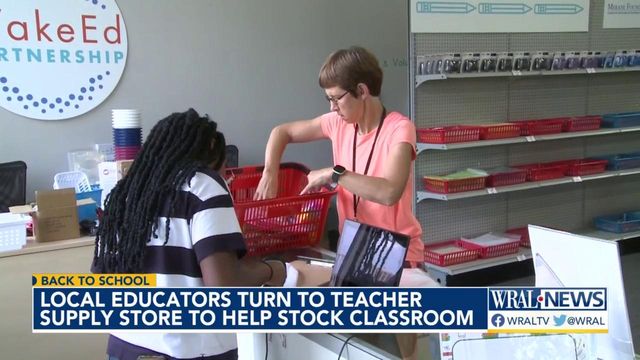
Every week, hundreds of Wake County school teachers flood into an old school bus repair shop for the promise of the most ubiquitous classroom supplies — notebooks, crayons, posters.
Wake Education Partnership runs the store, called Tools4Schools, which provides many of those essentials for free. Teachers are limited in how much they can procure from the shop each quarter by a point system. Each item is worth a certain number of points, and they only get 100 of them per quarter.
On a sweltering day last week, 11 days before the start of the traditional calendar school year, the neatly- kept shop off of a secluded Cary road was bustling with educators scoping the shelves. About 4,500 teachers shopped there for free supplies last school year. An additional 2,500 teachers signed up to shop just this month. The average shopper at Tools4Schools spends about $900 of their own money each year on school supplies, according to a Wake Education Partnership survey of 500 of its shoppers. Tools4Schools aims to defray some of those costs.
The startup cost for a classroom is high, said Kristin Nance, a third-through-fifth grade intervention teacher at Davis Drive Elementary School in Cary.
“Thousands of dollars for that first year,” she said. “My parents helped me a lot. I mean, thousands of dollars for everything.”
Cheri Yoder, a sixth-grade teacher at Mills Park Middle School in Cary estimated that she spends about $80 to $200 per year.
“Things are a bit different now,” Yoder said.
She spends less now than she used to because she’s trying to save money as inflation hits her budget. Middle school students don’t need as many activity supplies. They need pencils and other things they are always losing, she said.
Nance said she knows what works to help children, and she wants to stick with that. That includes fidget toys and chair bands for restless children.
“If we didn’t have those things, we’d have to find other ways for them to cool down, which can be challenging,” she said.
Josie Reed applied for – and received – grants to buy new books for her third-graders at Salem Elementary School. She didn’t think students were interested in the older books in her school’s supply closet. Books get pricey fast, too, because she buys them in sets for her students to read together.
Having books that are interesting helps children be more engaged when they’re reading and to like it more, Reed said.
“Animal books are like all the rage,” she said. “They all want to read from the perspective of an animal or something.”
Biographies, too. “If they see someone that they've seen on TV, or they've seen in a movie or something and they know who it is … they're so excited to read,” Reed said.
Rep. Julie von Haefen, D-Wake, filed a bill this spring that, if passed, would restore funding to what it used to be, but it’s never been heard in committee.
“It's really just a matter of priorities,” von Haefen said. “School supplies, unfortunately, is just one of the victims of the underfunding of our public schools.”
Republican legislative leaders Sen. Phil Berger, R-Rockingham, and Rep. Tim Moore, R-Cleveland, didn't immediately comment when asked about funding for school supplies.
Costs adding up
Every school year brings new names, new faces. And new pencils and pencil sharpeners and tissue boxes and nametags, everything dry-erase, paper towels, construction paper, folders, staplers and copy paper. Higher-priced pocket charts and giant paper pads. Dice, counters and other items for elementary grades. Feminine hygiene products are needed for middle and high schools. The copy paper goes fast at the free Wake County teacher supply store, Poston said. The store is always out of it.
That’s because schools are often out of it, too, and teachers are desperate to get their hands on it.
One ream of 500 pages of standard white paper can run $9 to $16 or more, depending on the type of printing that needs to be done.
Teachers often must ask an administrator to print off classroom materials for them. Color printing is often not an option. Schools can run out of paper mid-year and might not replace it right away.
Teachers sometimes band together to purchase a printer and paper that they all share and maintain.
To safeguard paper, sometimes teachers buy plastic covers for worksheets that students can write on in dry-erase markers, wiping away their answers afterward and keeping the paper clean.
Dry-erase markers go quickly, too, at Tools4Schools, and teachers are very opinionated about which ones actually stand a chance of lasting longer than a week, Poston said. The more expensive markers are the ones that do.
When teachers go after paper and dry-erase materials, however, they can run out of points quickly. A ream of paper takes up 10 points. A set of 24 dry-erase boards takes up another 48 points. Four sets of dry-erase markers cost another 20 points. Add in five dry-erasers (two points each), a bottle of board cleaning spray (seven points) and a set of crayons (five points) and you’re out of points. No notebooks, pencils, paper, staples or paper clips.
Yoder, the Mills Park Middle School teacher, was at the Tools4Schools store for the pencils, though.
She’s also getting replacement lead for mechanical pencils, an electric pencil sharpener and a dozen manual pencil sharpeners. The manual ones are important, she knows, because she can hand them to children when she wants them to stay on task and doesn’t want them getting out of their seats.
“They always are losing pencils,” Yoder said. “I’m literally getting as many as I’m allowed to get.”



Copyright 2026 by Capitol Broadcasting Company. All rights reserved. This material may not be published, broadcast, rewritten or redistributed.