NC teachers, students say school cellphone policies often don't work. Here's what they recommend
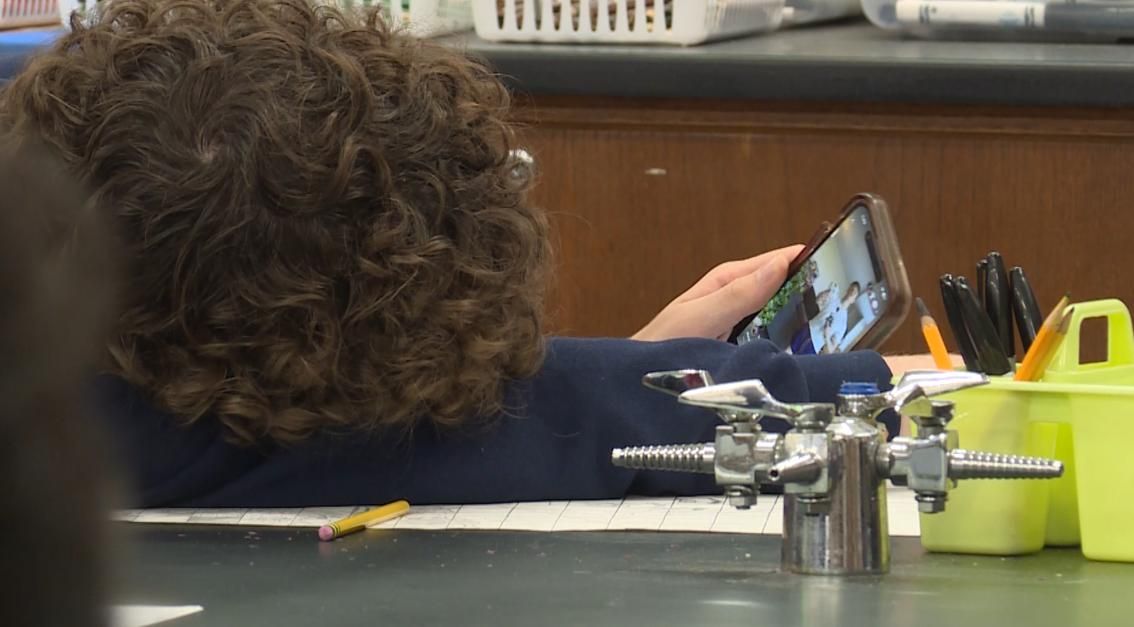
Seth Landesman was tired of the cellphones — students texting or scrolling while he was trying to teach, and not listening when he told them to put their phones away.
"I didn't get into teaching to police cellphones," said Landesman, a social studies teacher at Enloe Magnet High School in Raleigh.
Other WRAL Top Stories
So he and a group of colleagues sought to tackle the problem last year, asking: What if every classroom had a rule — the same rule — on when cellphones can and can't be used? What if students no longer had any excuse to not know what the rule was for that particular classroom? What if the expectation could be set from Day One?
They settled on a color-coded set of scenarios to be displayed on the wall, each status determined by the teacher in charge of the classroom. Red means phones must be put away. Yellow means phones are allowed for academic use. Green means phones are allowed so long as they don't interfere with learning, such as listening to music while doing an assignment. Scrolling social media is not allowed.
Landesman says the system helps students know the rules. But teachers have different opinions on using the colors and enforcing them.
"There are some teachers that are really strict about them, and there are some teachers that are very lax and just kind of let them do their thing, and it's on the kid," Landesman said. "And that's where the real struggle comes from, because in my years of experience, I don't feel that teenagers have the capability to monitor and manage their own time on social media and cellphones."
Some of the school’s 2,600 students say enforcement is inconsistent.
The chart in one art classroom was set at yellow. Students were allowed to draw from photos on their phones. If they finished early, they were allowed to use their phones for anything but social media. While nearly everyone was following the rule, one student in the back of the room was scrolling social media and not drawing.
Enloe's experience mirrors the fluctuating and evolving cellphone restrictions in schools across the country.
North Carolina lawmakers and school boards are joining throngs of policymakers nationwide who are trying to crack down on cellphone use in classrooms.
Most schools already have policies restricting cellphone use and have for years, yet most educators still believe cellphones are a distraction in school, surveys show. In other words, the policies in place aren't working well enough to keep cellphone disruptions at bay.
That's what prompted Landesman and his co-workers to shift their approach, and it's what's making him wonder if changes are needed again this year.
"It would be better to have one general thing that all the teachers follow," Landesman said. "But it's still very difficult, especially at a school this size, when you have almost 200 staff members, to get everyone on board."
WRAL News visited three area high schools and a middle school and interviewed students, teachers and principals inside and outside of those schools. Many said cellphone restrictions don't automatically work and that they need to be consistent across classrooms, as well as reasonable. The buy-in of teachers and the backing of administrators is critical for them to work.

Right now, students and teachers say not every student respects the rules and some teachers struggle more to enforce them. The right approach is easier said than done and needs to consider the feedback of the people subject to the rules or tasked with enforcing them, they say.
"Whatever policy they create, teachers and principals have to be behind it," said Ian House, a Green Hope High School junior who is a student adviser to the State Board of Education. "If teachers and principals are not behind it, students will not be behind it."
Spotty Enforcement
Proposed solutions abound: Phone lockers. Phone cubbies. Phone cabinets. Locking phone pouches. Hanging phone organizer bags. No phones on campus at all. Many ask: Can't schools just tell students to put their phones away?
One company promises to keep 30 students' phones securely locked away for the price of $713.87. Another will do 20 phones for $167.77. Another says it'll do 36 phones for $1,026.95.
A phone pouch can cost more than $20 per phone, or at least $20 million to lock up 1 million of the state's 1.5 million public school children's phones, not including replacement costs. Harnett County Schools was quoted $35 to replace each pouch that was damaged or went missing.
How can schools afford to solve a problem created by a product that the students' parents buy?
House said his Cary school uses phone caddies — storage bags and bins at the front of each classroom. The school's policy is clear that phones must be stored there unless the student has permission from the teacher. House says the policy works well in some classrooms and not as well in others.
"The solution is not the most sustainable approach we could go about doing because ultimately, over time, teachers get worn out having to nag at students to put their phones up," he said. Some students learn which teachers will be more lenient or who has less control over their classrooms and take advantage, keeping their phones with them, he said. Or they find ways to get around restrictions.
With state officials' help, House surveyed students across 10 school districts and a charter school for their thoughts on cellphones in schools. Most of the responding students — 56% — said their school's cellphone policy didn't work. Students said that's because of a lack of consequences, the ease of getting around the policy, and lenient teachers, among other reasons.
Still, most students believed schools should have at least some restrictions on cellphone use in schools, acknowledging they can be distracting, used to cheat, or interfere with socializing.
House is interested in Granville County Schools' approach, where consequences are clear and a school administrator ultimately supports the teacher and enforces the policy.
Teachers told WRAL News that they don't want to be responsible for confiscating phones, out of fear of accidentally damaging or losing the device.
While school board members express concern over the costs of phone storage, Granville's approach is free.
The district doesn't have phone pouches or other devices to keep phones away. They rely on the threat of confiscation by an administrator to keep students from breaking the rules.
‘A sore point’
Granville County Schools has taken a hard line on cellphones this school year. Students can't have them out at all in elementary or middle school, unless for instructional purposes or "for personal purposes when there is a reasonable need." The same applies to high school, with the exception that students can have their phones out during passing periods and lunch time. If a student breaks the rule, an administrator will be called to confiscate the phone and until the end of the school day, for the student's parent to pick up. After the first offense, the student will be suspended.
J.F. Webb High School math teacher Kelly Anderson said phones used to be a problem — "a sore point" that frustrated her and limited her effectiveness — but that they rarely are now. She reminds students to put their phones away as a part of her math-problem warm up to start each class period. For the most part, they comply, and they don't fight back. After that, Anderson has to tell a student to put their phone away up to twice each day or maybe not at all. She typically doesn't call an administrator when she spots a phone. She has only written up one student for noncompliance.
"If we're doing something and I have to ask for your phone, then they'll just give it to me. I'll put it on my desk," Anderson said. "They don't want that, so they just keep it away."

That seems to be a theme across the school, Principal Larry Ferebee said.
"It's hard for me to even think of the last time I got the call for a cellphone issue," he said.
Tension over cellphone restrictions hasn't gone away in Granville. Nextdoor to Anderson’s classroom is Rebecca Wilkinson's math class, where students didn't have their phones out during a recent May class but were ready to take them out as soon as the bell rang.
"They need to be banned from schools completely," Wilkinson tells her students, with a small smile.
"For real?" her students say in chorus.
"In Miss Wilkinson's opinion, for real," she responds. "I think that they're a major distraction and that we're addicted to them, all of us."
"What? What? What?" one student screams.
"What about in the case of emergency?" another asks. Their parents will want to reach them.
"They call the school front office," Wilkinson answers. "Back in old school, that's how it works. If your parents didn't get you, they called the front office."
"What if there was a lockdown at school and something happened?" another asks.
"They're going to know real quick," Wilkinson says, adding that media outlets will likely report it. "We want you locked down and quiet, not panicking, and let us take care of it."
"If we do go in a lockdown, people will want to talk to their parents," one student says.
"I know, but then your parents show up here, which causes more chaos because you can't get to your parents and they can't get to you," Wilkinson says.
Students told WRAL News that concessions for practical or emergency communication are important to them. Exceptions don't necessarily weaken policy, they said, inconsistently making them does.
Teachers say the same thing.
"You can get a positive outcome if you enforce something consistently," said Martha Lawrence, a Garner Magnet High School science teacher. Her school has a cellphone rule similar to Granville's, bringing administrators in to confiscate improperly used cellphones. "I think those students thrive on that consistency. So I think the [teachers] that that are enforcing it consistently are seeing the same positive result that I am."
Will students follow policies?
The Wake County Board of Education approved a new cellphone policy last week that restricts cellphone use at elementary and middle schools from morning bell to afternoon bell. High school students can use them for instructional purposes and during lunch or passing periods. They also have built-in exceptions for emergencies, students' disability plans, students' health plans and for translation or assistive communication. A health plan exception would include allowing students with diabetes to continue to check their blood sugar via an app, for instance. Students would get a warning first for violating the policy and then teachers would have the option to confiscate the phone.
Many schools will be able to keep their existing approaches under the new policy or only have to make small changes. That includes Garner Magnet High School, where the policy this year mirrored Granville's in that a school administrator would confiscate the phone if a student violated the policy, after one warning.
Garner High shifted to the low-tolerance approach last August after struggling to manage cellphones for years before that.
Lawrence, who has 25 years of teaching experience, made sure her students knew the rule on the first day of school and said that's the rule they'd follow every day.
At the beginning of the school year, she had to call administrators a few times, but she doesn't have to anymore.
"Once students realize, ‘Hey, this teacher is serious. She's going to follow the policy,’ then I think they're a little more hesitant," Lawrence said. “And then again, the gentle reminders, most students are really respectful, and as long as you're respectful, I can work with that."
Students don't necessarily like the rule. They long for the days when they used to be able to get their phones out after finishing their assignments.
"When I get my work done, I want to get on my phone, but they won't let me," Garner Magnet sophomore Malachi Hedgepeth said.
The school’s principal, Matt Price, said the rule helps students become accustomed to not be on their phones all of the time, helping them focus and socialize.
"In my mind, that's preparing them to be an adult," he said.

In the end, students, teachers and principals have noticed positive differences in places where cellphones have mostly disappeared from classrooms.
"I'm more talkative and I know how to talk to people more, so I'm growing socially," said Heidi Epitacio, who was an eighth grader at G.C. Hawley Middle School in Creedmoor this spring. She’s able to concentrate better. Still, Heidi wishes she could have her phone at least at lunch and "patio" time — an outdoor recess break at her middle school. It calms her.
Would having a phone at lunch change her newfound social habits?
"Yeah, I guess,” she said, “because I wouldn't talk to anyone if I still had my phone."





Copyright 2026 by Capitol Broadcasting Company. All rights reserved. This material may not be published, broadcast, rewritten or redistributed.