NC House overrides veto of $463.5M increase for private-school vouchers
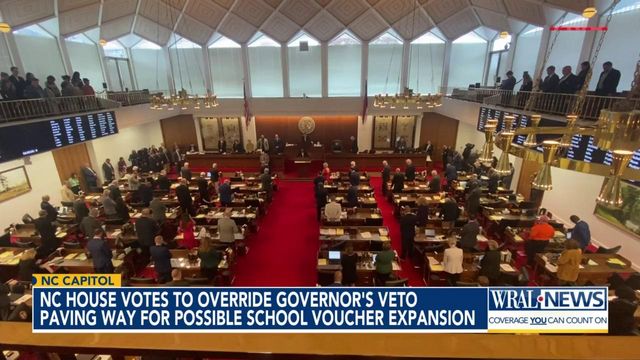
The North Carolina House of Representatives voted Tuesday to override the veto of a bill that would increase funding for the private-school voucher program by $463.5 million.
The Republican-controlled House voted 72-44 to override Democratic Gov. Roy Cooper’s veto. The state Senate must also vote to override the veto for the bill to become law. That chamber was expected to approve the measure Wednesday.
Other WRAL Top Stories
House Bill 10 — which also contains an unrelated immigration enforcement measure — would clear a 54,000-student wait list to use a voucher to attend a private school. Some students are already attending a private school, but without the tuition voucher.
It passed through both the North Carolina House and Senate in September, largely along party lines.
Republicans hold supermajorities in both chambers of the North Carolina General Assembly, meaning they can easily override vetoes by Democratic Gov. Roy Cooper if they vote as a bloc. Republican lawmakers have consistently overridden Cooper’s vetoes since obtaining the supermajority last year.
Cooper has called the voucher program “the biggest threat to public schools in decades.”
Public schools lose funding for every student who opts out of the public school and into a private school instead, because public schools are funded by headcount. Cooper and other critics argue that schools — especially rural ones — have many operating costs that won’t change just because a few students leave, but they’ll end up with less money to cover them.
“Something is wrong with our priorities,” Yevonne Brannon, a board member of Public Schools First NC, told a rally of public school advocates outside the legislative building on Tuesday morning, referring to Republican lawmakers.
In the afternoon, Democratic lawmakers urged House lawmakers to sustain Cooper’s veto, framing the Opportunity Scholarship program as less in need of funding than other things. They said billions more dollars are needed toward Hurricane Helene recovery, that public schools are short on resources, and that thousands of families of children with disabilities are on a years-long wait list for services that can help them live more independently.
“With what HB10 does we could provide services for that wait list over and over and over again and still provide funding for families to come,” said Rep. Sarah Crawford, D-Wake.
Supporters of HB10 say it’s possible for the state to have a well-funded public school system and robust school choice options and hurricane recovery funding.
“This program is about children,” said Rep. Tricia Cotham, R-Mecklenburg. “It’s about families being able to pick what is best for their child.”
Cotham said it was “shameful” to pit Opportunity Scholarship funding against hurricane relief, if they can both be funded.
“Stop the rhetoric, stop the posturing, vote for children and their families,” Cotham said.
The Republican-led House advanced a bill Tuesday to earmark an additional $227 million in relief aid for victims of Hurricane Helene — a measure criticized by Democrats for a smattering of unrelated provisions. The Senate is scheduled to take up the measure on Wednesday.
Republican leaders have criticized Cooper for rejecting what they describe as a common sense measure, noting that the veto halted other appropriations in the bill, including funding for enrollment increases at public schools and community colleges this fall.
That’s what convinced Rep. Carla Cunningham, D-Mecklenburg, to vote in line with Republicans on Tuesday. She said she supported the immigration enforcement measure requiring certain cooperation from county sheriffs, alongside other funding measures, even though she’s opposed to the Opportunity Scholarship program.
“It’s a matter of not throwing the baby out with the bathwater,” Cunningham said.
In addition to the $463.5 million for vouchers and $24.7 million for vouchers for students with disabilities, the bill includes $64 million for community college enrollment growth, $95 million for K-12 enrollment increases, $377 million for Medicaid, $55.1 million for infrastructure improvements in Chatham County and $150 million for transportation improvements at a Randolph County megasite.
The vouchers come through the state's Opportunity Scholarship program. The program serves 37,143 students this school year, up from 32,549 students last year. While the North Carolina State Educational Assistance Authority, which administers the program, offered vouchers this year for about 15,000 new students, most aren’t using the voucher this year. It’s unclear why.
The bill seeks to clear the 54,000-student wait list for the Opportunity Scholarship program. The wait list boomed this year after state lawmakers removed family income limits on eligibility and made it so all current private-school students would now be eligible. Many parents have pushed lawmakers to clear the wait list.
That includes Rachel Brady, a mom of four who sends her two school-aged children to private school. One has an Opportunity Scholarship after qualifying last year and the younger one is on the wait list.
Brady and some other families organized a demonstration this summer to get the wait list funded, after lawmakers initially failed to reach a deal to do so, despite leaders of both chambers saying they supported it.
“We're just so thankful that the House and Senate leaders took notice of us and listened to us,” Brady said.
The program provides checks of up to about $7,500 to a private school when they enroll a family that has applied and receive a voucher to attend it. Higher-income families receive smaller amounts, down to just more than $3,000 for the wealthiest families.
The expansion of the voucher program has prompted supporters and opponents to acknowledge that public schools sometimes don’t provide everything a family wants or needs from a school. But those people are split over whether to provide an immediate out for some families who feel that way or to invest in improving the conditions of the public schools so that people don’t feel that way.
Brady didn’t say why public school won’t work for her children, but she said waiting to fix a problem in public schools would take too long for many families. “My kids are growing up right now, and we need choice today,” she said.
Many families on the wait list earn enough money to not need a voucher if they want to make a change today, Brannon said.
Every Child NC advocates for change in connection with the 30-year-old lawsuit over education adequacy, Hoke County Board of Education v. State of North Carolina. State lawmakers have rebuffed a plan agreed to by other parties in that case that would require billions more dollars toward public school spending.
Brannon suggested more hurricane relief and — if lawmakers believed they had already provided enough hurricane relief — more funding to ensure every school has a nurse or to help get some children off of the wait list for a key state pre-kindergarten program. Others suggested making more heating and air-conditioning repairs and improving bus driver retention.
“Why don’t we do some of those things?” Brannon said.


Copyright 2026 by Capitol Broadcasting Company. All rights reserved. This material may not be published, broadcast, rewritten or redistributed.