NC education leaders want to change how schools are graded. What analysts say is needed
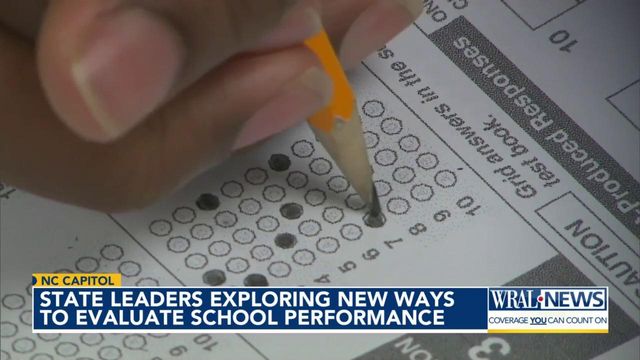
North Carolina education leaders are again mulling a revision to the state's most visible school accountability measure: school performance grades.
They're the letter grades — A, B, C, D or F — earned by every North Carolina public school each fall, when the state's standardized test scores are released. The intent is to illustrate to the community — especially students' parents — a measure of school quality. But critics argue the methodology used to form them is flawed and better reflects the socioeconomic status of the families in the school than anything else.
Other WRAL Top Stories
Superintendent of Public Instruction Mo Green, who oversees the state Department of Public Instruction, plans to form a task force in October to study revising the grades. It's part of the strategic plan drafted by Green and his staff and approved and recommended by the State Board of Education last month. It would make recommendations to lawmakers, who would ultimately have to approve of any changes.
The State Board of Education Task Force will seek to recommend a new "school-level accountability system." It will start with two missions. The first is studying the differences in North Carolina high schools' college and career course offerings. The second is assessing multiple ways of measuring third- through 12th-grade student performance that includes progress toward career or college readiness.
It's the latest movement to change a school performance grade system that's been fraught with frustration from North Carolina educators and in other states where school ratings systems have been criticized for being both over- and under-emphasized.
And it's a repeat of a stalled effort by Green’s predecessor, although the new task force could make entirely new recommendations.
Former state Superintendent Catherine Truitt wanted to reform how North Carolina assigns the letter grades, contending the current measure — weighing 80% test scores and 20% “growth,” a measure of how they performed against expectations, in most cases — too closely mirrors the socioeconomic status of each school, rather than how good its principal or its teachers are.
Better letter grades are associated with lower poverty levels, and lower letter grades are associated with higher poverty levels, according to education policy analysts.
Truitt, a Republican, wanted to assign multiple letter grades to each school that would better reflect year-over-year growth, school environments and other offerings. She pitched the idea to a group of state lawmakers — most of them Republicans — who agreed and issued a report listing such a change as a top education priority for the General Assembly. But that idea hasn’t advanced in the legislature.
"The interest is in looking at other indicators that could give parents information on the schools that are available to them," said Tammy Howard, senior director of the state Department of Public Instruction's Office of Accountability and Testing. Leaders have mentioned in the past chronic absenteeism or college and career readiness as other possible metrics for school performance, Howard said. "It's looking at all the other, many multitudes of things that happen in public schools that may not be captured by the current indicators that are in the school performance grades."
Education policy analysts caution that the issue is a sensitive one for schools but that it is necessarily seen that way by others, including those in power.
“This is controversial, and it's because we are trying to be honest about the performance of schools. And for schools that are not doing well, that is not popular,” said Michael Petrilli, president of the Thomas B. Fordham Institute, a thinktank that pushes for school accountability and nontraditional public school options.
Petrilli thinks something needs to change in North Carolina.
"It's a problem that North Carolina is so heavily weighted towards achievement instead of growth," he said. "It means that high-poverty schools, in particular, in North Carolina have a really hard time getting high grades that make them feel demoralized. They might feel like no matter how great they do they are going to get a low grade. So why even try? And I think that's a big problem."
What school performance grades are
School performance grades are one form of federally mandated school accountability. Some states assign letter grades, some use star rating systems, like for restaurants and product reviews.
North Carolina uses letters and bases them almost entirely on test scores. For elementary and middle schools, 80% of the grade is test scores — specifically, the percentage of students who scored on grade level on the standardized exam — and 20% of the grade is a growth metric based on those scores.
Growth is the difference between what students were expected to do, based on an algorithm that accounts for prior performance and other factors, compared to how they actually did on tests. Then, that difference is averaged and each school is placed on a curve of how well it did against that average. Schools that scored well below that average are labeled as having not met growth. Schools that did within a certain range of the average are labeled as having met growth. Schools well above that are labeled as having exceeded growth. It's common for schools to fall into different growth categories year-to-year, as it can also be common for schools to get different letter grades year-to-year.
For high schools, the state also credits schools for the percentage of students who meet certain college or career readiness standards and the percentage of students who graduate within four years.
Schools use all kinds of data to decide what needs or doesn't need to improve and how to teach children.
Schools aren't the ones using school performance grades to make those decisions. Rather, the grades are for parents and the community. Families often make real estate decisions based on the quality of nearby schools.
"The whole idea was to give parents an idea of what is going on in their school," said Robert Luebke, director of the Center for Effective Education at the John Locke Foundation, a think tank that promotes non-traditional public school options and tying funding to student test performance.
Luebke said the state does a good job of posting its School Report Cards, which are more robust than just the grades, online. Those have the letter grades on every school but considerably more information on each test, attendance, discipline rates, device-to-student ratios and more.
"Reducing a school to a letter grade, yeah, you miss a lot of nuance," he said. "But if you go to the school report card, they do fill in a lot of that."
Others argue that what goes into the grade matters, because it determines what schools focus on. The grades are public, and schools want to have good ones, they note.
"This sort of simple grading of schools is actually helpful to families, because it's simple, right?" said Thomas Toch, director of FutureEd, a thinktank at Georgetown University that's critical of current accountability systems and of school choice models. "I mean, people understand A through F. It's not a complicated metric.” He says the use of those grades isn’t the problem. “It's what goes into them," he said.
FutureEd thinks several factors make a school successful, including teacher quality and school climate, and those are not exactly reflected in performance grades.
To avoid the correlation with socioeconomic status, Toch said, schools need to put greater emphasis on growth. Growth can show families how far students can go, he said.
Petrilli echoed that. He said growth gives schools credit for helping students advance. Many students may enter a school far behind grade level, and they can make significant growth but still test below grade level by the end of the year.
"That accountability, that transparency is important," Petrilli said. "But you've got to get the ratings correct. And if there are schools out there that have a lot of kids who come in way behind, and that school is making a ton of progress with those kids, and it's still getting an F or a D or a C, that's wrong. And the North Carolina education policymakers should fix that."
Toch says school climate — which can be measured in part through student, parent and teacher surveys — would also be a useful metric.
"A fuller sense of the school's performance, and you're going to encourage the school to address or pay attention to things beyond just test scores that, in fact, are important to student success, both while they're in school and beyond," Toch said.
Toch thinks a too-heavy emphasis on proficiency rates can lead to more attention for students who are just below proficient — but also less attention for students who are too far away from that line.
A better school performance grade
Luebke says the grades aren't perfect. But if he were in charge, he's not sure he'd change them.
"The problem right now is people view this as zero-sum," Luebke said. If you shift the weight given to test scores over to growth, you lose the emphasis on test scores. That's why, in spite of the years of pushes from school leaders to change the system, lawmakers haven't agreed to do so. That's been where all of the pushback has been for the last 15 years."
Dividing the grading system into multiple grades could be a solution that makes more people happy, analysts said.
Petrilli said parents can appreciate and digest multiple letter grades.
Parents “are used to seeing report cards that have six or seven different grades on them, however many classes our kids are taking," Petrilli said. "That doesn't feel like too much information."
Texas assigns multiple letter grades to its schools, one for growth and one for test scores, then makes the highest letter the official grade for the whole school, he said.
Truitt had proposed four grades -- one for each of four topics -- and advised against a final letter that took all of those four areas into account. One would have been for what percentage of students were testing on grade level. Another would have been for student growth, a third would have been for career and college readiness and a fourth would have reflected the school's environment and opportunities.
Opportunities are one of the metrics the current state education officials are still looking at.
Howard, the DPI testing director, noted the opportunities high school students increasingly get to explore careers, which can change the trajectory of students' futures. That's weighted very little in the current system.
"Any time we're just looking at test scores and putting all of our eggs in that basket, I think we're missing the opportunity to see the breadth and the intention of public education and how we can fully help students," Howard said.
The state House Select Committee on Education Reform recommended Truitt's proposal — and a single letter grade summarizing the four topics — in a report in 2024, but it hasn't been taken up by either legislative chamber.



Copyright 2026 by Capitol Broadcasting Company. All rights reserved. This material may not be published, broadcast, rewritten or redistributed.