NC House approves spending plan, setting up showdown with Senate
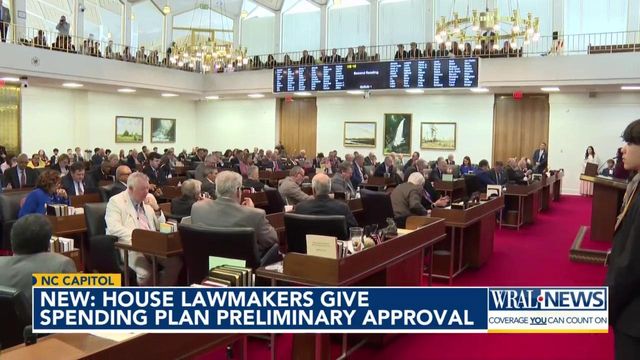
A new $32 billion budget plan to fund state employee raises, eliminate thousands of jobs throughout state government, enact new tax cuts and raise college tuition passed the North Carolina House of Representatives on Thursday.
Prior to Thursday's final vote, the GOP-controlled House passed the plan 93-20 in an initial vote Wednesday night — following hours of debate that ended with the budget plan earning some support from Democrats, including Minority Leader Robert Reives. The Democratic leader described the GOP-authored proposal as a “negotiating document” that’s better than a plan proposed by the Senate.
Other WRAL Top Stories
“I voted for the House budget today understanding that there are a lot of policies I disagree with and hope to see removed during the conference period,” Reives said in a statement after the vote. “The House is serious about governing this state and it is up to the Senate to come to the table in good faith.”
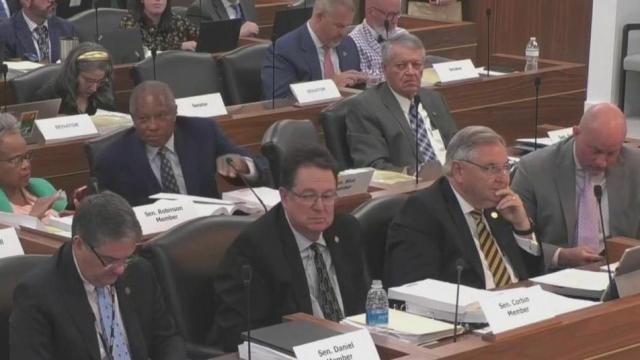
The Senate passed its own budget plan last month. So Thursday's vote by the House on its own plan will now set up closed-door negotiations over a final budget plan, which could become public later this summer. The next fiscal year starts July 1.
Even though both chambers have Republican majorities, they disagree strongly on major questions of what should or shouldn’t be in the budget. Tax policy could be a key sticking point. The state's professional budget analysts believe North Carolina is headed toward deficit spending as soon as next year due to continued tax cuts. The House plan acknowledges that, suggesting stricter rules limiting future tax cuts. The Senate goes in the other direction, amping up even more aggressive tax cuts than are currently planned.
Broadly speaking, the House favors larger state employee raises than the Senate, more state job cuts and smaller income tax cuts. Its budget plan proposes new types of tax reforms — like a back-to-school sales tax holiday and a no-tax-on-tips plan — that would be more beneficial to lower-income North Carolinians.
“This is an excellent plan, well-thought out, and with a major investment in state employees, particularly with teachers, where North Carolina has slipped in our national and regional rankings,” said state Rep. Donny Lambeth, R-Forsyth. “Our goal and commitment is to be smart in our spending plans and deliberate in our tax strategy, while responding to the critical needs across the state.”
State Rep. Terry Brown, D-Mecklenburg, said he appreciated Republican efforts to include some initiatives that Democrats have sought for years, noting the sales tax holiday. He praised House Republicans for taking measures to potentially avoid a revenue shortfall.
However, Brown said, “this bill also makes some poor choices.” For instance, he said, “It makes the choice of eliminating over 2,000 vacant positions in our state government, instead of doing more to fill those vacant positions. Our public universities funding is stagnant through this budget, while taxpayer funded vouchers are going to continue to rise. Those aren't good choices.”
The Senate favors smaller state employee raises than the House, fewer jobs eliminated in state government, and a tax package focused solely on aggressive income tax cuts that would mostly favor wealthier North Carolinians and corporations.
But the chambers do agree on some issues, such as a plan to free up more than $100 million to help pay for tax cuts by slashing spending on higher education and requiring universities to raise tuition. They both also seek to eliminate state programs aimed at helping Black, Hispanic and other minority communities, with Republican politicians saying they want to root out pro-diversity efforts within state government.
When Republicans in the House and Senate eventually reach a budget deal, it will likely receive far less support from Democrats, House Speaker Destin Hall said jokingly after Wednesday’s vote.
Budget highlights
Among the more high-profile segments within the House’s proposal:
Taxes. The House budget continues Republicans’ plans to lower taxes, although not as aggressively as the state Senate’s plan. The House would lower the personal income tax rate by another 0.25 of a percent, raise the standard deduction, bring back an annual back-to-school sales tax holiday in 2026, and exempt people from having to pay taxes on the first $5,000 they earn in tips.
The standard deduction would increase by $500 for single tax filers or $1,000 for married couples filing jointly. At the proposed new income tax rate of 3.99%, that would save single people just under $20 a year, or married couples just under $40 a year. It will cost the state $126.3 million annually, the budget estimates.
State budget analysts have said state revenues could start dropping in July 2026 if lawmakers continue to reduce the state’s sources of revenue, such as corporate and personal income taxes.

State job cuts, raises. The House seeks to eliminate 3,000 vacant jobs in state government, freeing up money for raises for existing employees. State government has struggled to recruit or retain workers, due in part to competition with higher-paying roles in the private sector. The state reported more than 14,000 vacant jobs last month. The Senate proposes hundreds of job cuts.
Under the House budget, most state workers would get at least a 2.5% raise over the next two years. Many would be in line for even higher raises, depending on how much money their department freed up by eliminating open positions. That 2.5% minimum raise is twice what the Senate is proposing for most state workers, although the Senate would give substantially higher raises to law enforcement officers.
Teacher pay. The House budget would alter the teacher pay scale to allow more experienced teachers to receive bigger pay raises. Starting teacher pay would jump from $41,000 to $48,000 next year and then to $50,000 the year after that, ultimately a 22% boost — which could help recruiting efforts at a time when schools are facing hiring challenges. That would propel the state above the national average in starting pay, which was $46,526 during 2023-24, according to the National Education Association.
The changes wouldn't do much to match the national average teacher pay of $72,030. North Carolina ranked 43rd in average teacher pay, at $58,292. Teacher pay would top out at $57,820 for teachers with at least 25 years of experience during the 2026-27 school year, a much smaller increase than for beginning teachers. The most experienced teachers currently earn $55,950 in base pay. The budget would also restore extra pay for teachers with master's degrees.

Education policy. The House’s budget would double financial assistance for prospective teachers in harder-to-staff fields and raise the cap on the number of students with disabilities that the state will fund.
The bill would largely cut the state superintendent and State Board of Education out of the oversight of the state's charter schools, giving final decision-making on rules and leadership to the Charter School Review Board.
Under the House plan, all elementary schools would have to provide performing arts and visual arts at least once per week, lasting at least 30 minutes.
The legislation would also eliminate class-size limits for high-growth school systems, increase funding for some literacy programs and establish a program to more easily hire school psychologists from other states, among other things.
The House budget also contains restrictions on cellphones during instructional time and added instruction on social media addiction, bullying, misinformation, avoiding sexual predators and more.
Children’s hospital. The House budget would reduce already-approved funding for a new state children’s hospital by more than $100 million, setting up a possible battle with the Senate. The North Carolina Senate proposed investing an additional $535.5 million in the planned 500-bed pediatric hospital, which is expected to be finished in the early 2030s. The project is a priority of Senate leader Phil Berger, R-Rockingham. If his chamber gets its way, the appropriation would bring total state funding to about $855.2 million — nearly 43% of the lowest projected cost.
NC Children’s — to be developed by UNC Health Care and Duke Health and finished in the early 2030s — stands to create thousands of jobs in the Triangle. Some House Republicans weren’t comfortable with earmarking lots of money for the project, but House budget writers predicted funding would be partially or fully restored in the final negotiated between the House and Senate.

DMV. The House budget aims to address delays at the Department of Motor Vehicles by opening new DMV offices in three fast-growing suburbs of Raleigh, Charlotte and Wilmington. Those new locations are planned for Fuquay-Varina, Cabarrus County and Brunswick County at a cost of more than $10 million spread over the next two years. North Carolinians have dealt with delays and technical glitches at the DMV for years, with complaints hitting a fever pitch in recent months as motorists lined up for hours to secure a REAL ID. The budget also proposes spending more than $3 million more per year to hire dozens of new driving examiners, and to ramp up production of license plates.
Higher education. The UNC System would lose the ability to hire dozens of employees, with requirements to cut at least $7 million worth of currently vacant jobs. They'd also lose another $3.5 million for graduate student tuition waivers. Those savings would revert to the general state budget to either be spent elsewhere or to help pay for tax cuts.
The UNC System would also be required to find an additional $60 million in annual savings — potentially through additional layoffs — plus $8 million more in savings from cutting one-time expenses like construction or equipment spending.
Universities would also be required to come up with an additional $30 million in revenue by raising tuition. Tuition has remained flat for in-state students for nearly a decade, although some universities have raised prices substantially for out-of-state students.
Elections board. The House budget adds seven new state elections board positions for political appointees. They'd be picked by new state elections director Sam Hayes, who was most recently the top lawyer for House Speaker Destin Hall. The approval comes weeks after oversight of state elections administration moved from Gov. Josh Stein to Republican Auditor Dave Boliek. Democratic House members have raised concerns about politicizing the work of carrying out elections.
The state elections agency has 65 positions, mostly career employees with expertise in elections and who are mostly protected by the State Human Resources Act, shielding them from politically motivated hiring or firing decisions. The new appointees would work alongside those career workers.
Late additions. About eight hours into Wednesday's debate, Republicans rolled out an amendment to the budget making widespread changes to more than a dozen areas of the budget. It quickly passed, with no explanation as to what the changes would do, in a 77-36 vote.
One of the changes would add to the budget a bill that the House already passed in a party-line vote earlier this month, to require state employees to investigate the citizenship status of people applying for state aid. Republicans say it'll ensure no immigrants living here illegally are getting benefits. Democrats said some immigrants have U.S. citizen children who are eligible for benefits.
Another late addition to the budget was something Republicans have been trying but failing to pass in North Carolina for years, to ensure less transparency surrounding donations to nonprofit groups. Supporters say they're hoping to protect people's privacy. Critics say it will allow for even more secrecy surrounding "dark money" political contributions.
But that late-arriving amendment also included less controversial items, including $500,000 to expand benefits for the families of firefighters who die from cancers related to their work, and $1.5 million to create a new unit that Stein has asked for, to fund work on sexual assault cold cases and the opioid epidemic.
What’s next
Now that the House’s budget is approved, the House and Senate must negotiate a final deal — a process that in years past has stretched months beyond the July 1 start of the new fiscal year.
Unlike the federal government, North Carolina isn't allowed to engage in deficit spending. The state budget must be balanced.
Stein, a Democrat, proposed his own budget, which would give substantially higher raises for teachers than the House or the Senate have proposed. Stein’s proposal — which also includes spending on other items, such as Helene relief aid — would pay for higher spending by freezing tax rates and slashing state-funded private school vouchers. GOP leaders have dismissed Stein's proposals, but Stein is still part of the process.
Stein released a statement Wednesday indicating he likes the House’s proposal more than the Senate’s.
“The House’s proposed budget isn’t perfect. But I am pleased that the House raises teacher pay to make North Carolina’s starting teacher salaries the second-highest in the Southeast and rewards our state employees with a raise,” Stein said. “In contrast, the Senate’s fiscally irresponsible revenue scheme will result in fewer teachers and law enforcement officers and diminished services that would harm our people.”
Once the chambers agree on a spending plan, Stein has the option to sign it, veto it, or let it pass without his signature.
Democrats flipped enough GOP-held seats in the 2024 elections to break that chamber's veto-proof majority, meaning that in order to override any potential vetoes from Stein, Republicans likely need some bipartisan support.
Speaker Hall told reporters Wednesday that he only needs one Democrat to help the House override a gubernatorial veto, adding: “I’m confident that we’ll have that.”
WRAL State Government Editor Jack Hagel contributed to this report.


Copyright 2026 by Capitol Broadcasting Company. All rights reserved. This material may not be published, broadcast, rewritten or redistributed.