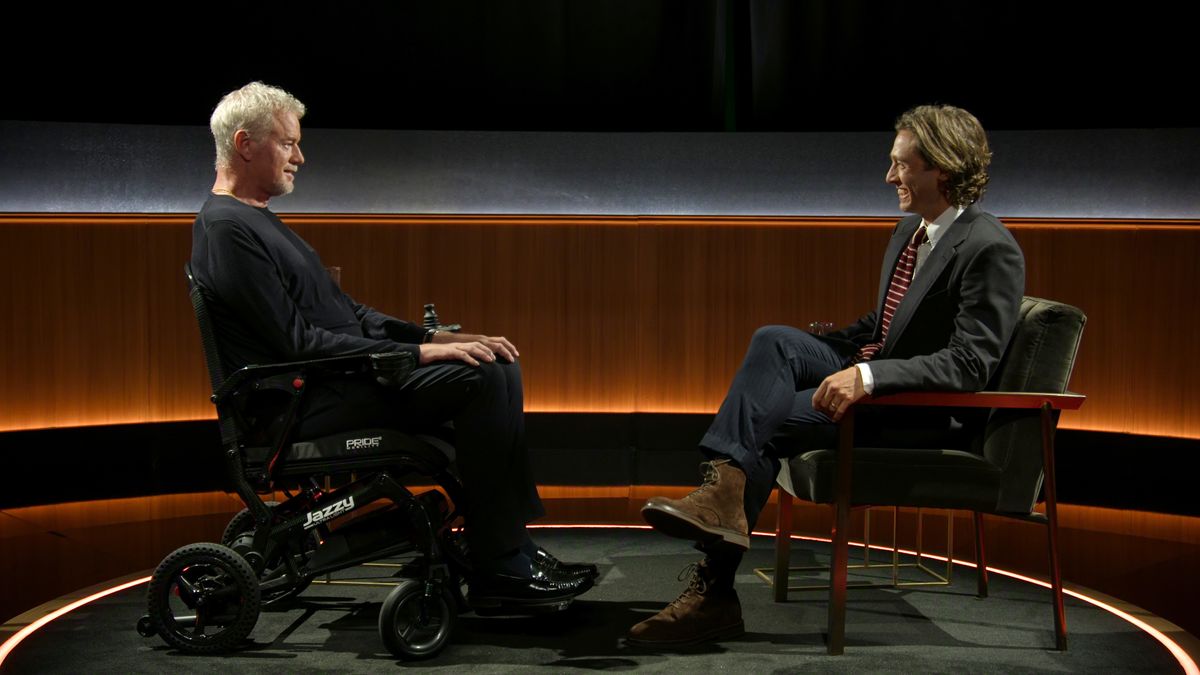
This weekend, I and millions of others watched Eric Dane look into a camera and said goodbye to his daughters. He knew they wouldn't hear him until he was gone.
The "Grey’s Anatomy actor," who died last Thursday at age 53 after a brutal year-long battle with ALS, had sat for Netflix's "Famous Last Words," a series where the interview airs only after the subject's death.
Other WRAL Top Stories
Through my work running one of America’s largest caregiving platforms CareYaya and helping thousands of older adults, I’ve seen my share of emotionally powerful end-of-life stories.
But to me, Dane’s story and the response to it, felt different because it is at a time of rapid technology innovation.
Alone on a soundstage, the Netflix cameras rolling, Dane addressed his girls directly: “I stumbled sometimes, but I tried. Overall, we had a blast, didn't we?” Then he told his daughters Billie and Georgia to be resilient, to fall in love, and to fight until their last breath. And then, he signed off forever: "You are my heart. You are my everything. Good night. I love you. Those are my last words."
It was devastating, emotionally powerful, and deliberate. And, I fear that it may be the last time a public figure's farewell belongs entirely to them.
Because while Dane was recording his goodbye the old-fashioned way – with his own voice, his own tears, and in his own imperfect words – a multi-billion dollar “death tech” industry has been gearing up to make such human rituals obsolete. Technology startups now promise that nobody ever needs to say goodbye at all. Upload a single photograph and a 10-second audio clip, and their algorithms will generate a walking, talking avatar of your dead loved one – one that doesn't just replay memories, but even manufactures new conversations from beyond the grave.
The grief tech market is projected to reach $80 billion within the decade. In China, startups sell "digital resurrection" services for under $2. In an Arizona courtroom last year, an AI clone of a murdered man addressed his killer in a victim impact statement scripted by surviving relatives. And researchers at Cambridge have coined a term for what's happening to the deceased in all of this: "spectral labor" – the dead being compelled to work for the emotional, political, and commercial desires of the living.
I spend my professional life at the intersection of aging and technology, running a tech platform that helps thousands of older adults get care near the ends of their lives. I've watched families agonize over what their father would have wanted after dementia stole his ability to tell them. I've seen daughters clutch voicemails from mothers they'll never speak to again. The hunger to hold onto someone is ancient and sacred. I understand, viscerally, why someone would pay any price to hear their person say one more thing.
But what troubles me about these new technology concept is that I think Eric Dane's message worked because of what it wasn't. It wasn't generated or optimized. It wasn't produced by an algorithm scraping his Instagram captions and Grey's Anatomy scripts to approximate what he might have said. It was a man with a failing body, choosing, with full intention, the words that would outlast him. The silences between his sentences carried weight. The moments he choked up meant something precisely because no software was smoothing them out.
Sure, I think an AI avatar can mimic someone’s cadence and replicate their tone. What it cannot do is decide – with the gravity of someone facing oblivion – what matters enough to say. Grief psychologist Elaine Kasket warns that these digital surrogates may prevent people from ever processing their loss, acting more like emotional painkillers than healing tools. Additionally, I think the consent problem is significant. Who gave permission for grandpa to become a chatbot? Who authorized a murder victim to testify through words he never spoke?
I do think there are humane applications here. Holocaust survivors recording interactive testimonies, terminally ill patients preparing messages while their voices still hold, or military service members preserving bedtime stories against the worst-case scenario. These are acts of love, not algorithmic ventriloquism.
What we need is a framework akin to “digital wills” that lets individuals dictate what happens to their voice, their likeness, and their data after death. California and Indiana already protect posthumous publicity rights for over a century. We need equivalent protections for the rest of us, before the grief tech gold rush turns every funeral into a product launch.
What was moving about Eric Dane’s message is that it didn't need an algorithm. He sat down, looked into a lens, and told his daughters the truth about his life. The rest of us should do the same, not because the technology doesn't exist to fake it, but because the people we love deserve better than a simulation of our love.
Take the time to write and speak your last words before it’s too late. And leave the dead in peace.
Neal K. Shah is an NIH-funded Principal Investigator on the YayaGuide AI for Caregiver Training project that he started at Johns Hopkins, and CEO of CareYaya, a social enterprise helping caregivers. Neal also serves on North Carolina's Steering Committee on Aging.